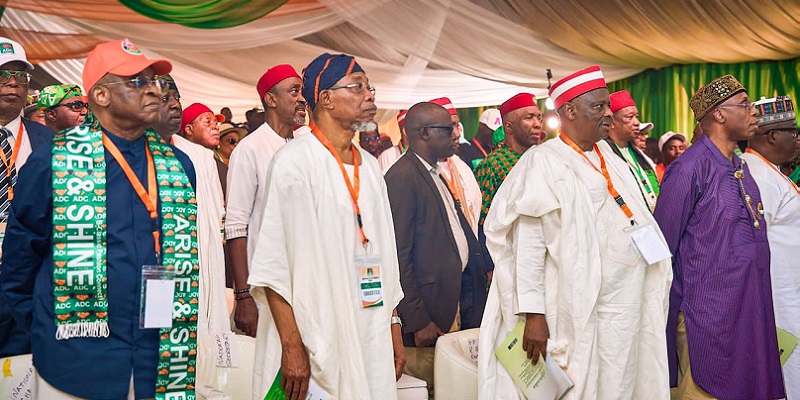
TDThe African Democratic Congress (ADC) has categorically rejected circulating reports suggesting that its coalition leadership is engaged in discussions with the Peoples Redemption Party (PRP) as a contingency ahead of an impending court judgment.

In a strongly worded statement, the ADC described the claims as “not true” and emphasized that no such conversations are taking place at the moment.
The party stressed its unwavering focus on challenging what it calls the “illegal action” taken against its leadership by the Independent National Electoral Commission (INEC) and other agents allegedly linked to the ruling All Progressives Congress (APC).
According to the ADC, overturning this action is essential to upholding the rule of law and preserving multiparty democracy in Nigeria.
Background on the Ongoing Crisis
The ADC has been embroiled in a protracted leadership dispute involving factions led by former Senate President Senator David Mark and challenger Nafiu Bala, following the resignation of previous national chairman Ralph Nwosu.
INEC recently withdrew recognition from all claiming leadership groups.
It cited a Court of Appeal ruling and pending substantive suits at the Federal High Court.
This move has created significant uncertainty for the party’s operations, including its ability to conduct primaries and meet electoral timelines ahead of the 2027 general elections.
The ADC, which has emerged as a key platform for a broad opposition coalition—including figures such as former Vice President Atiku Abubakar, Peter Obi, Rabiu Kwankwaso, and Rotimi Amaechi—recently held a national convention in mid-April 2026.
The gathering aimed to ratify a new constitution, manifesto, and direction for the party. However, the leadership impasse and INEC’s stance have fueled speculation about the coalition’s stability and potential fallback options.
Recent media reports had suggested that some actors within the David Mark-led faction were exploring the PRP as a “backup platform” due to looming INEC deadlines and legal uncertainties.
Closed-door meetings between ADC and PRP leaders, including PRP National Chairman Hakeem Baba-Ahmed, were also reported in recent weeks, though these were often framed as expressions of solidarity rather than merger or alliance talks.
ADC’s Position on PRP
The party’s statement made clear its position:
“The coalition leadership is not having any such conversation with any political party at the moment.
“We are fully committed to ensuring that the illegal action taken against our leadership by INEC and other agents of the ruling party is upturned…
“While we are open to expanding the coalition to bring all opposition elements in the country together to rescue our country, we remain clear about the responsibility that this moment has imposed on us.
“We will not abdicate that responsibility.”
The ADC further described suggestions of abandoning the party as “preemptive and speculative” and urged Nigerians to ignore them.
It expressed confidence that the judiciary would “resist the pressure to be complicit in undermining Nigeria’s democracy” at this critical juncture.
Context and Implications of PRP Talks
Nigeria’s political landscape ahead of 2027 remains fluid, with opposition forces seeking to consolidate against the ruling APC.
The ADC’s leadership crisis has raised questions about the viability of smaller parties as coalition vehicles, especially given INEC’s regulatory powers and strict electoral timelines.
Analysts note that while the party insists on fighting its legal battles, the uncertainty has prompted contingency discussions across the opposition spectrum.
The PRP, a smaller social-democratic party with historical roots, has been mentioned in some reports as one potential alternative platform, though both parties have downplayed formal negotiations.
The ADC’s denial appears aimed at projecting unity and resolve within its coalition as it navigates the court processes and prepares for what many describe as a high-stakes period for Nigerian democracy.
This story is developing, with the outcome of the ADC’s legal challenges against INEC likely to shape the broader opposition realignment efforts in the coming months.