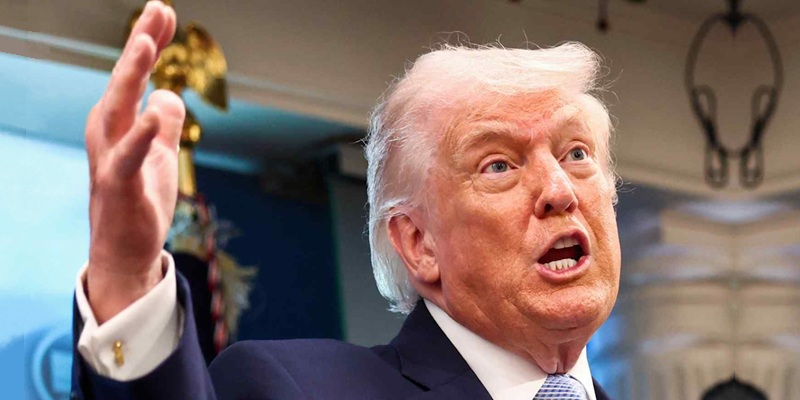
TDPresident Donald J. Trump escalated U.S. pressure on Iran Monday, warning that failure to accept a new deal would trigger the destruction of every power plant and bridge in the Islamic Republic.

The threat came hours after reports of fresh gunfire in the Strait of Hormuz, a critical chokepoint that carries roughly one-fifth of the world’s seaborne oil trade.
In a fiery Truth Social post that quickly circulated on X, Trump declared Iran had fired bullets “yesterday in the Strait of Hormuz — A Total Violation of our Ceasefire Agreement!”
He claimed projectiles targeted a French ship and a United Kingdom freighter.
“That wasn’t nice, was it?” he wrote.
He added that U.S. representatives would travel to Islamabad, Pakistan, for negotiations tomorrow evening.

‘Iran Unwittingly Aiding the Blockade’
Trump portrayed Iran’s actions as self-defeating.
He noted the U.S. naval blockade had already closed the strait, forcing Tehran to lose “$500 Million Dollars a day” while America “loses nothing.”
Ships were already rerouting toward U.S. ports in Texas, Louisiana, and Alaska, he said.
He praised the Islamic Revolutionary Guard Corps (IRGC) for unwittingly aiding the blockade but warned they were “always wanting to be ‘the tough guy!’”
The president offered Iran “a very fair and reasonable DEAL,” then issued an unmistakable ultimatum:
“If they don’t, the United States is going to knock out every single Power Plant, and every single Bridge, in Iran. NO MORE MR. NICE GUY! … IT’S TIME FOR THE IRAN KILLING MACHINE TO END!”
Strategic Stakes in the Strait of Hormuz
The narrow waterway between Iran and Oman remains the most vital oil artery on the planet.
Tankers passing through it supply Asia, Europe, and beyond with crude from Saudi Arabia, Iraq, Kuwait, and the United Arab Emirates.
Iran has repeatedly threatened to close the strait during crises, knowing any sustained disruption could send global oil prices soaring and trigger economic shockwaves.
The current standoff traces to late February 2026, when U.S. and Israeli strikes on Iranian targets prompted Tehran to blockade the strait in retaliation.
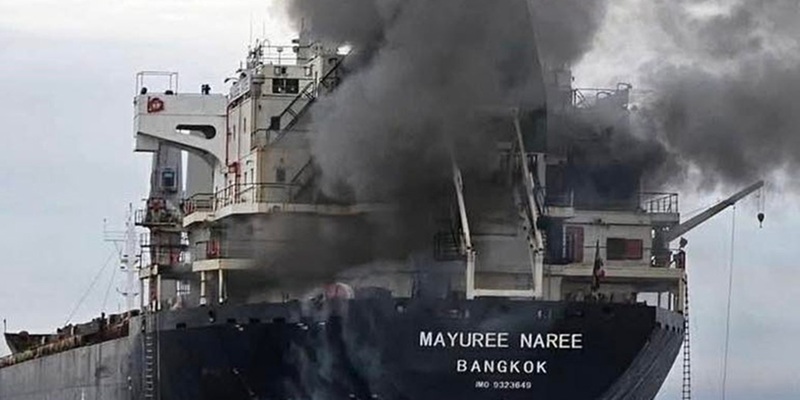
A fragile two-week ceasefire in early April briefly reopened shipping lanes,
Iran, however, reimposed “strict control” over the passage on April 18 after accusing Washington of violating the truce.
Iranian gunboats then opened fire on multiple commercial vessels, including tankers and container ships.
UK Maritime Trade Operations and other monitors confirmed incidents involving gunfire and projectiles.
London, though, later disputed Trump’s specific claim that a British-flagged freighter was hit.
International Reactions and Military Moves
France and the United Kingdom, whose vessels were allegedly targeted, have responded by announcing they will jointly lead a multinational defensive mission to protect commercial shipping and assist with mines clearance.
British Prime Minister Sir Keir Starmer and French President Emmanuel Macron described the operation as “strictly peaceful” and defensive.
The U.S. Navy, meanwhile, has enforced its own blockade.
On Sunday, the guided-missile destroyer USS Spruance fired on and seized an Iranian-flagged cargo ship in the Gulf of Oman after it attempted to evade the cordon.
Economic Fallout
Oil markets reacted nervously to the renewed violence.
Prices climbed again after Iran’s re-closure, compounding earlier spikes caused by the six-week conflict.
Analysts warn that a full shutdown could add several dollars per barrel within days.
This could ripple through gasoline prices worldwide and disrupt supply chains for fertilizer, steel, and semiconductors.
Diplomatic Off-ramp or Escalation?U.S. officials say the Islamabad talks represent the last best chance to salvage the ceasefire.
Iran has sent mixed signals: its foreign ministry insists the strait remains under its control until the U.S. lifts sanctions and ends the blockade.
Some Iranian officials have already questioned whether their delegation will even attend the Pakistan meeting.
The World Waits on Bated Breath
Experts caution that the region is one miscalculation away from catastrophe.
“Both sides are posturing for domestic audiences,” said a senior Gulf-based analyst who requested anonymity.
“But naval incidents in confined waters have a nasty habit of spiraling,” he added.
A senior U.S. lawmaker told reporters the administration is “serious about the deal—but equally serious about consequences if Iran walks away.”
As night fell in Washington, the White House declined to elaborate beyond Trump’s post.
Pentagon sources confirmed U.S. forces remain on high alert.
Whether tomorrow’s negotiations in Islamabad produce a breakthrough or merely another round of brinkmanship may determine what next.
Whether the world sees a diplomatic off-ramp—or the opening salvos of a far wider confrontation in the Persian Gulf waits to be seen.