


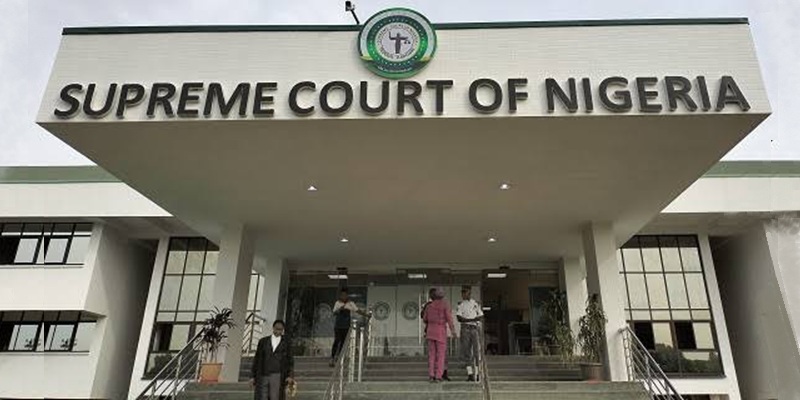

The Supreme Court has reserved judgment in the case involving alleged unlawful interference by INEC in the internal affairs of the African Democratic Congress (ADC).
The apex court’s decision follows heated arguments over whether courts have jurisdiction to intervene in political party leadership disputes.
Key Highlights
- Date: April 22, 2026
- Court: Supreme Court of Nigeria, five-member panel led by Justice Garba Mohammed
- Case: Appeal by ADC National Chairman, Senator David Mark, challenging INEC’s role in de-recognizing his leadership.
- Issue: Whether courts can adjudicate disputes over internal party leadership and whether INEC acted lawfully in intervening.
Background
- The dispute stems from a leadership tussle within the African Democratic Congress (ADC).
- David Mark, ADC National Chairman, argued that the Federal High Court lacked jurisdiction to entertain suits involving internal party matters.
- His counsel, Jibrin Okutepa (SAN), cited a 2025 Supreme Court ruling that declared courts have no jurisdiction over internal affairs of political parties.
- The appellate court had earlier dismissed Mark’s appeal as premature, ordering parties to maintain the status quo ante bellum.
- Following this, INEC de-recognized Mark’s leadership, pending judicial resolution of the authentic leadership.
Arguments Before the Supreme Court
- David Mark’s Position:
- Courts cannot interfere in internal party matters.
- INEC’s de-recognition of his leadership was unlawful.
- The appellate court erred in dismissing his appeal.
- Respondent’s Position (Hon. Nafiu Gombe, represented by Robert Emukpero SAN):
- The appeal was premature and properly dismissed.
- The lower court acted within its jurisdiction.
- INEC’s decision to suspend recognition was justified pending resolution.
Supreme Court’s Decision
- After hearing arguments, Justice Garba Mohammed announced that judgment has been reserved.
- A date for the ruling will be communicated to the parties.
- The outcome will determine whether INEC’s intervention in ADC’s leadership crisis was lawful and whether courts can adjudicate such disputes.
Implications
- For Political Parties: The ruling could set a precedent on whether internal leadership disputes are beyond judicial review.
- For INEC: The judgment will clarify the extent of INEC’s powers in recognizing or de-recognizing party leadership during disputes.
- For 2027 Elections: With party structures critical to candidate nominations, the decision may influence how internal crises affect electoral participation.
Public Reaction
- Legal analysts describe the case as a test of Nigeria’s democratic framework, balancing party autonomy with judicial oversight.
- Civil society groups warn that unchecked INEC interference could undermine party independence, while others argue that judicial intervention is necessary to prevent abuse.
The Supreme Court will announce its judgment date soon.
Both ADC factions and INEC await clarity on the leadership question.
Political observers expect ripple effects across other parties facing internal disputes.

The Supreme Court’s reserved judgment in the ADC leadership tussle marks a pivotal moment in Nigeria’s electoral jurisprudence.
The ruling will determine whether INEC acted lawfully in intervening and whether courts can adjudicate internal party disputes—issues that could shape the political landscape ahead of the 2027 elections.