TDA fresh war of words has erupted between the Movement for the Actualization of the Sovereign State of Biafra (MASSOB) and the Nigerian Army ahead of the 59th anniversary of the declaration of Biafra, with both sides taking opposing positions on planned memorial activities across the South-East.

MASSOB on Friday condemned the 82 Division of the Nigerian Army for describing its directive to churches in the South-East and parts of the South-South to hold memorial services for victims of the Nigerian Civil War as “illegal” and “provocative.”
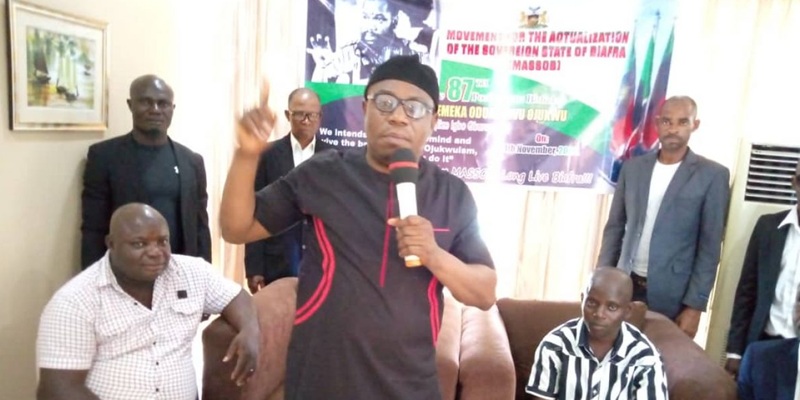
In a statement signed by its leader, Uchenna Madu, the pro-Biafra group defended its call for churches to observe prayers and memorial services on Sunday, May 31, in honour of those who lost their lives during the 1967-1970 civil war.
Madu questioned the Army’s opposition to the planned memorials, insisting that prayers and remembrance services should not be considered an offence.
“When has national memorial prayers become an offence or irresponsible?” the MASSOB leader asked
Madu accused the military of focusing its attention on a non-violent organisation while failing to adequately confront security challenges posed by bandits and terrorists in other parts of the country.
He maintained that MASSOB’s struggle for Biafra’s actualisation has always been rooted in non-violence and lawful self-determination principles.
“The foundation of MASSOB is rooted in the principles of non-violence. We have never carried arms against the Nigerian state, nor have we retaliated against security agencies despite the killings of our members,” he stated.
The group further alleged that the military’s criticism was motivated by discomfort with the continued agitation for Biafra, warning that attempts to provoke the organisation would not push it toward violence.
MASSOB also called on residents of the South-East, whom it referred to as Biafrans, to observe a sit-at-home exercise on May 30 to commemorate the anniversary of the declaration of the defunct Republic of Biafra by Chukwuemeka Odumegwu Ojukwu in 1967.
However, the military has strongly rejected the directive.
In a statement issued by Headquarters Operation UDO KA and signed by Lieutenant Colonel Olabisi Olalekan Ayeni, Acting Deputy Director of Army Public Relations for the 82 Division, the Army described MASSOB’s directive as illegal and capable of undermining peace in the region.
The military acknowledged the pain and sacrifices associated with the civil war but noted that the Federal Government already recognises official occasions for honouring fallen heroes, including Armed Forces Remembrance Day, Nigerian Army Day Celebration and Independence Day commemorations.
According to the Army, lawful national ceremonies provide appropriate avenues for remembrance and reflection, warning that parallel commemorations promoted by separatist groups could create tension and confusion.
“The directive by MASSOB is therefore illegal, provocative, and must be disregarded by all,” the statement said.
The Army further alleged that sympathisers of MASSOB and the Indigenous People of Biafra (IPOB) were attempting to use the memorial exercise to create panic and disrupt public peace in the South-East.
Religious leaders, youths and residents were advised not to participate in activities deemed unlawful by security authorities.
Operation UDO KA assured churches and members of the public that they were free to conduct their normal religious activities and businesses without fear.
Meanwhile, it warned that any individual or group found disrupting public order would face legal consequences.
The security outfit reiterated that the Armed Forces, working alongside other security agencies, remain committed to protecting lives and property and maintaining stability across the South-East region.
The disagreement comes amid heightened sensitivities surrounding annual Biafra remembrance activities, which often generate debate between separatist groups and government authorities over issues of legality, security and historical remembrance.