


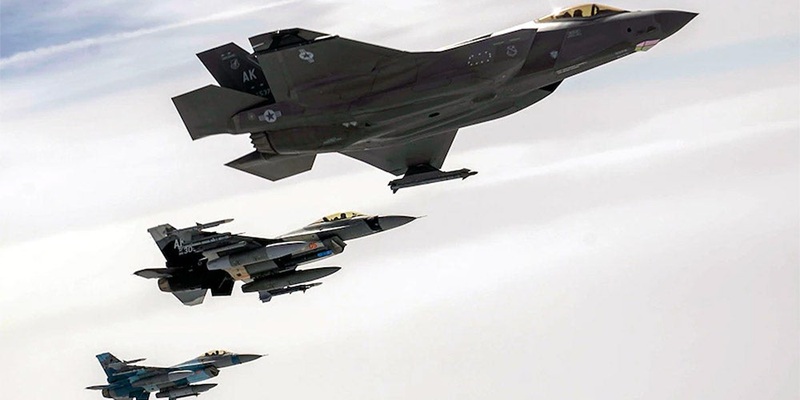

TD WASHINGTON/TEHRAN — The United States has launched a new round of strikes on Iranian military targets, intensifying a confrontation that now threatens to spiral into a full-scale regional conflict.
President Donald Trump, speaking at the NATO Summit in Turkey, vowed to hit Iran “hard”.
Trump warned that Washington would “knock the hell out of” Tehran if it continued to threaten international shipping lanes.
The strikes come just a day after eight Iranian military personnel were killed in southern Iran.
The attack prompted Tehran to suspend peace negotiations and accuse Washington of violating the countries’ Memorandum of Understanding.
Iran has responded with defiance, promising a “crushing response” and already launching strikes toward Bahrain.

It is, meanwhile, preparing what officials describe as a “massive” attack on US bases in the region.
Trump’s Hardline Rhetoric
President Trump’s remarks left little room for diplomacy.
He declared the memorandum of understanding “over,” dismissed Iranian leaders as “scum” and “liars,” and suggested that Iran’s leadership “may be gone soon.”
Such language underscores a dramatic shift away from negotiation toward confrontation.
The President’s comments reflect frustration with what Washington views as Iran’s destabilizing actions — from alleged attacks on shipping to the downing of a US MQ-9 Reaper drone.
Yet the rhetoric also risks closing off diplomatic channels at a moment when tensions are already at a breaking point.

Iran’s Defiance
Iranian officials have responded with equal ferocity.
The Supreme Leader’s advisor warned that US actions could push the Middle East into a “sea of fire.”
Chief Negotiator Mohammad Bagher Ghalibaf accused Washington of “seriously violating” the memorandum of understanding.
In the meantime, Iran’s embassy in Japan charged the US with undermining agreements on multiple fronts.
Iran’s military has already demonstrated its willingness to escalate, striking toward Bahrain and promising further retaliation.
The downing of the US drone was presented as proof of Iran’s resolve to defend its sovereignty.

“Go ahead, strike,” Iranian officials said. “You’ll get hit back, and you’ll get hit hard.”
Regional Fallout
The confrontation is reverberating across the Gulf.
Bahrain, already targeted by Iranian strikes, sits at the heart of US naval operations in the region.
Other Gulf states, including Saudi Arabia and the UAE, are watching nervously.
They are aware that any escalation could threaten oil infrastructure and shipping routes critical to the global economy.
The suspension of peace talks marks a significant setback for diplomacy.
For months, negotiators had sought to craft a framework to reduce tensions, but the latest strikes have effectively collapsed that effort.
Analysts warn that the absence of dialogue leaves military confrontation as the dominant path forward.
Global Implications
The stakes extend far beyond the Middle East.
Global energy markets are highly sensitive to instability in the Gulf, and any disruption to shipping through the Strait of Hormuz could send oil prices soaring.
NATO allies, already gathered in Turkey, face the challenge of balancing support for Washington with concerns about being drawn into a wider war.
China and Russia, both with ties to Tehran, may seek to exploit the crisis to expand their influence in the region.
Meanwhile, European powers are likely to push for restraint, fearing that escalation could trigger refugee flows, terrorism, and economic shocks.
A Dangerous Spiral and Conclusions
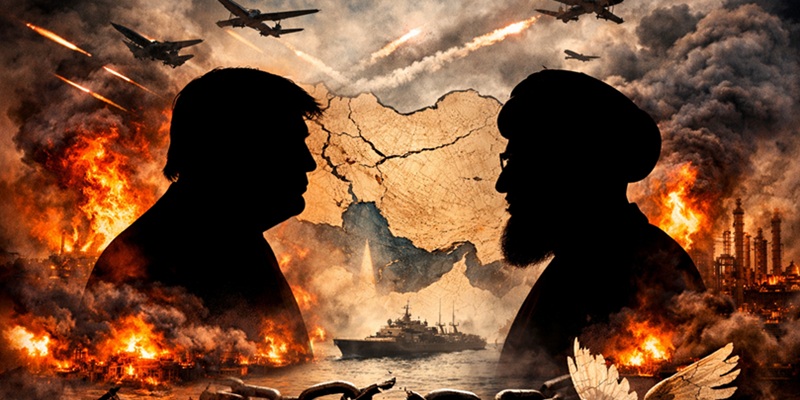
The current trajectory suggests a dangerous spiral: US strikes provoke Iranian retaliation, which in turn prompts further US action.
Each step reduces the space for diplomacy and increases the risk of miscalculation.
The rhetoric on both sides — Trump’s vow to “knock the hell out of” Iran and Tehran’s promise of a “crushing response” — leaves little room for compromise.
Observers note that the situation bears echoes of past confrontations, but with higher stakes given Iran’s expanded military capabilities and the volatile regional environment.
The possibility of a direct clash between US and Iranian forces is no longer theoretical; it is unfolding in real time.
The US–Iran confrontation has entered a perilous phase.
With peace talks suspended, harsh rhetoric escalating, and military strikes already underway, the risk of a broader regional war is acute.
The coming days will be critical: whether cooler heads prevail or whether the Middle East plunges into the “sea of fire” warned by Iranian officials.
For now, the only certainty is uncertainty.
The world watches as two adversaries trade blows, and the future of regional stability hangs in the balance.