


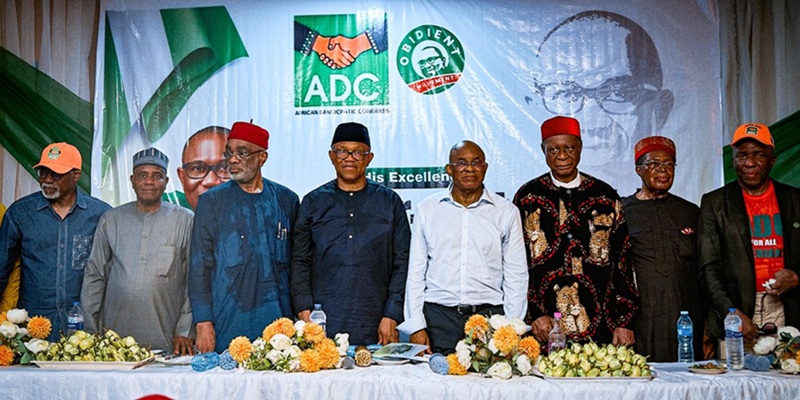

Nigeria’s political landscape is facing renewed uncertainty as the African Democratic Congress (ADC) descends deeper into a protracted leadership crisis, raising serious questions about the viability of a united opposition ahead of the 2027 general elections.
At the centre of the dispute are three rival factions, each claiming legitimate control of the party.
One bloc is led by former Senate President David Mark, widely viewed as representing an establishment-backed effort to transform the ADC into a broad-based coalition platform.
Opposing him is a faction aligned with Nafiu Bala, which insists on preserving the party’s internal structures and resisting what it describes as an external takeover.
A third group, spearheaded by former presidential candidate Dumebi Kachikwu, has positioned itself as a reformist alternative, critical of both camps.


The crisis has moved beyond internal party disagreements into the legal arena, with multiple court cases now underway.
Nigeria’s judiciary is expected to play a decisive role in determining which faction, if any, holds legitimate authority. Until then, a cloud of uncertainty hangs over the party’s operations.
Compounding the situation is the intervention of the Independent National Electoral Commission (INEC), which has reportedly withheld recognition from certain leadership structures within the ADC.
This move carries significant implications: without formal recognition, any faction risks being unable to organise primaries or field candidates in upcoming elections.
The internal strife has already disrupted party activities nationwide.
Scheduled congresses in several states have been stalled, while a recent national convention was marred by disputes and competing claims of legitimacy.

What should have been a period of consolidation has instead exposed deep fractures within the party. The stakes extend far beyond the ADC itself.
The party has recently emerged as a potential rallying point for opposition figures seeking to challenge President Bola Tinubu in 2027.
Notably, prominent politicians such as Atiku Abubakar and Peter Obi have been linked to discussions around a possible coalition under the ADC banner, though neither has made a formal commitment.
Analysts suggest that the outcome of the leadership dispute could determine whether the ADC evolves into a formidable opposition platform or fades into political irrelevance.
Should the Mark-led faction prevail, the party could serve as the foundation for a unified opposition coalition, potentially reshaping Nigeria’s electoral dynamics.
Conversely, if the crisis persists or alternative factions retain control, the ADC may remain fragmented, forcing opposition figures to seek other platforms.

There is also the risk of prolonged litigation. If court proceedings drag on, the party could miss critical electoral deadlines, effectively excluding it from meaningful participation in the 2027 race.
At its core, the ADC crisis reflects a deeper ideological struggle: whether the party should become a vehicle for a broad political coalition or remain an independent institution guided by its existing structures.
As legal battles continue and political manoeuvring intensifies, the resolution of this conflict will likely have far-reaching consequences for Nigeria’s democratic trajectory.
For now, the ADC stands at a crossroads—its future, and potentially that of Nigeria’s opposition politics, hanging in the balance.