


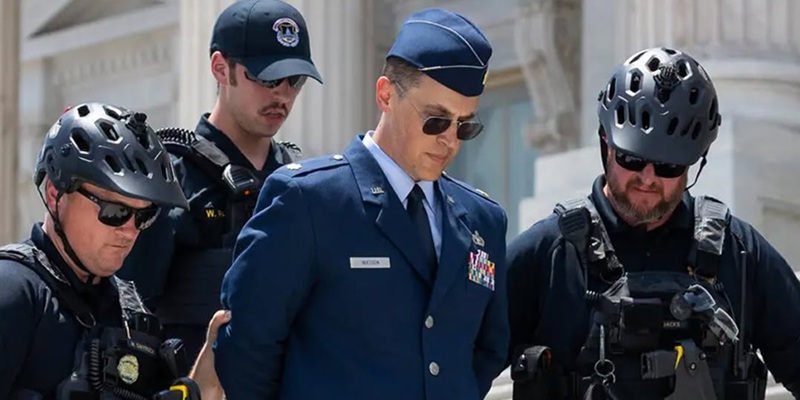

TD WASHINGTON, D.C. — A U.S. Air Force Major Jason Watson, who publicly called for the impeachment and removal of President Donald Trump has been formally charged under the Uniform Code of Military Justice (UCMJ), in an unusually high-profile case involving allegations of contemptuous speech, disobedience and conduct unbecoming an officer.
Major Watson, who was arrested twice after publicly criticizing Trump, faces 10 charges under the UCMJ, according to a charging document shared with CNN by his attorney.
The charges include:
- three violations of Article 88 for allegedly making “contemptuous” remarks about the president,
- five Article 92 violations involving alleged disobedience of orders, and,
- two Article 133 violations alleging conduct unbecoming an officer.
Arrested After Capitol Protest
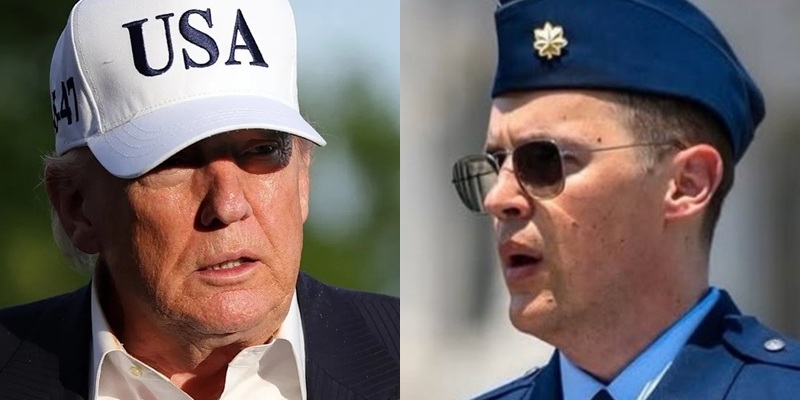
Watson first attracted national attention on July 1, 2026, when he appeared in uniform on the steps of the US Capitol and called for Trump’s impeachment and removal.
Military regulations generally prohibit service members from engaging in overtly partisan political activity while in uniform.
The regulations also restrict the use of contemptuous language against senior civilian officials.

Watson was subsequently arrested again in August, shortly after making further criticisms of Trump during a CNN interview.
During that interview, Watson accused Trump of violating the Constitution and engaging in corruption, saying he considered the situation unacceptable.
His attorney, Chris Mutimer, said Watson remains in pretrial confinement and described his client as being held in isolation for his safety.
Air Force Defends Military Rules
Air Force Secretary Troy Meink previously warned personnel that they were expected to comply with laws and regulations governing political participation, personal conduct and the wearing of military uniforms.
“Americans place their trust in us,” Meink said, emphasizing that the military could not compromise that trust.
The Article 92 allegations against Watson include claims that he violated Defense Department rules prohibiting troops from:

- participating in partisan political activity,
- improperly wore his uniform during a Capitol press conference,
- traveled to Washington while allegedly violating leave regulations, and,
- refused to wear his uniform to work following his CNN appearance.
Prosecutors also allege that his Capitol protest and television interview amounted to conduct unbecoming of an officer.
Rare Use of Article 88
The case is particularly notable because Article 88 charges involving contemptuous remarks against senior civilian officials are rarely prosecuted to conviction.
A review cited by CNN identified only two convictions since the modern UCMJ was enacted in 1951.
One involved Army Lt. Henry Howe, who was convicted in 1965 after participating in an anti-Vietnam War protest.
The other was former Marine Lt. Col. Stuart Scheller, who pleaded guilty in 2021.
Lt. Col. Scheller pleaded guilty after publicly criticizing the Biden administration’s handling of the Afghanistan withdrawal.

Scheller was ultimately fined and resigned from the Marine Corps without a pension.
He was later appointed by the Trump administration to a senior Pentagon advisory position.
Legal Fight Ahead
Legal experts say the definition of “contemptuous” language under Article 88 can be difficult to apply because the provision requires more than simply criticism of a president.
Retired Army judge advocate and law professor Frank Rosenblatt explained to CNN why Article 88 can be difficult to apply.
Rosenblatt said that remarks must generally amount to insulting, rude or disdainful expressions rather than merely political disagreement.
He suggested that an Article 32 preliminary hearing could become important.
He said it could determine whether Watson’s statements constituted prohibited contempt or were instead protected criticism.
Watson’s attorney maintains that his client acted out of conviction and in accordance with the oath he swore to uphold the US Constitution.
The Air Force has stressed that Watson is presumed innocent.
His case has yet to be referred to a court-martial, and it remains uncertain whether he will ultimately face a special or general court-martial.
The proceedings could therefore become an important test of the boundaries between military discipline, political neutrality and an individual service member’s right to criticize the commander-in-chief.