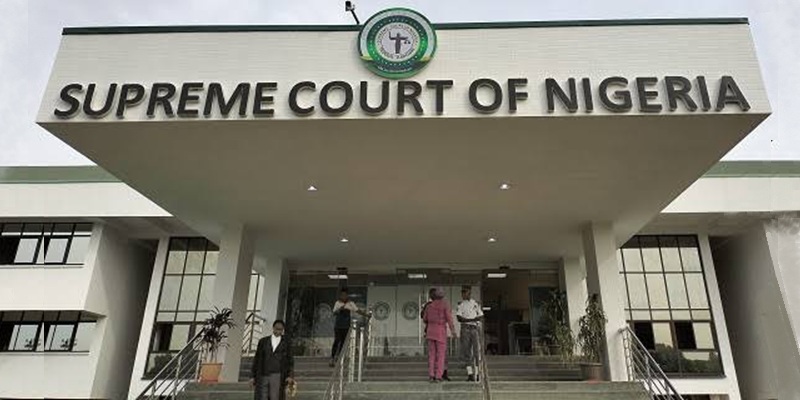
TDThe Supreme Court of Nigeria has fixed April 14, 2026, for the hearing of an appeal filed by David Mark, National Chairman of the African Democratic Congress (ADC), in a case that has stirred significant political attention.

The appeal, marked SC/CV/180/2026, challenges a ruling of the Court of Appeal delivered on March 12, 2026, which had cast doubt on Mark’s continued leadership of the party.
At the heart of the dispute is a suit filed by Nafiu Bala, a former Deputy National Chairman of ADC, who is contesting Mark’s legitimacy as party leader.
Bala argues that Mark’s ascension to the chairmanship was procedurally flawed and inconsistent with the party’s constitution.
Background of the Dispute
The ADC, one of Nigeria’s smaller but increasingly visible political parties, has faced internal wrangling in recent years.
The leadership tussle between Mark and Bala reflects broader struggles within the party over control, direction, and strategy ahead of the 2027 general elections.
- David Mark, a former Senate President and influential political figure, was appointed National Chairman of ADC in 2025.
The move that was hailed by supporters as a step toward strengthening the party’s national profile.
- Nafiu Bala, however, insists that the appointment violated internal procedures and marginalised other stakeholders.
His suit seeks to nullify Mark’s leadership and restore what he describes as “constitutional order” within the party.
The Court of Appeal’s ruling on March 12 appeared to side with Bala’s arguments, raising questions about the legality of Mark’s chairmanship.
In response, Mark approached the Supreme Court, seeking an order to stay execution of the appellate court’s decision until the matter is fully resolved.
What the Supreme Court Will Decide
On April 14, the apex court will consider whether to grant Mark’s request for a stay of execution.
This would effectively suspend the enforcement of the Court of Appeal’s ruling, allowing him to remain in office while the substantive issues are litigated.
Legal experts note that the Supreme Court’s decision could have far-reaching implications:
- For ADC: The ruling will determine whether the party continues under Mark’s leadership or faces a possible interim restructuring.
- For Nigerian Politics: With ADC positioning itself as a reformist alternative, leadership instability could weaken its ability to mobilise ahead of the next election cycle.
- For Party Democracy: The case underscores the importance of internal democracy and adherence to constitutional provisions within political parties.
Reactions
The development has sparked reactions across Nigeria’s political landscape:
- ADC Members: Some party loyalists have rallied behind Mark, citing his experience and national stature as vital for ADC’s growth.
Others, however, back Bala, arguing that rules must be respected to ensure fairness.
- Political Analysts: Commentators suggest that the case highlights the fragility of Nigeria’s smaller parties, which often struggle with internal cohesion.
- Civil Society: Advocacy groups have urged the judiciary to uphold transparency and fairness.
They stress that the credibility of Nigeria’s democracy depends on impartial adjudication of intra-party disputes.
Wider Context of Anticipated Supreme Court Ruling
Nigeria’s political parties have long grappled with internal conflicts, often revolving around leadership succession, candidate selection, and resource control.
The ADC’s current crisis mirrors similar disputes in other parties, including the PDP and APC.
Factional battles have sometimes led to parallel congresses and prolonged litigation in those parties.
Observers warn that unresolved leadership disputes can erode public confidence, weaken party structures, and limit their ability to compete effectively in elections.
For ADC, which has recently attracted high-profile figures such as Mr. Peter Obi and Dr. Rabiu Musa Kwankwaso, stability at the top is crucial to sustaining momentum.
Conclusion
As the Supreme Court prepares to hear the appeal on April 14, all eyes will be on the judiciary to provide clarity in a case that could reshape the future of the ADC.
Whether David Mark retains his position or Nafiu Bala succeeds in his challenge waits to be seen.
Meanwhile, the ruling will send a strong signal about the importance of internal democracy and the rule of law in Nigeria’s political system.
For now, the ADC remains in a state of uncertainty, with its leadership question hanging in the balance until the apex court delivers its verdict.