


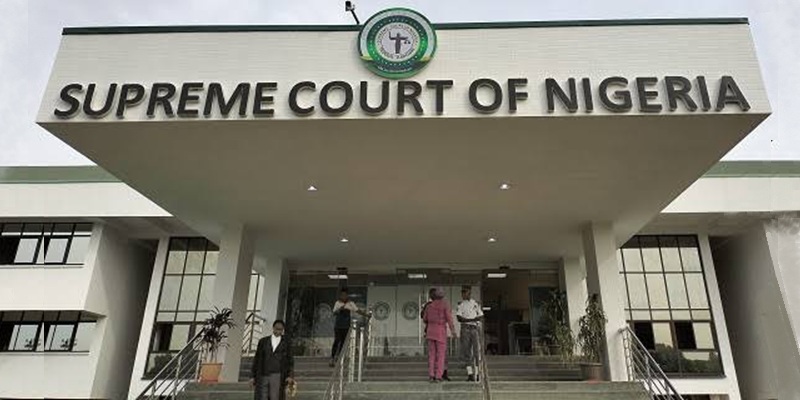

TDThe Supreme Court of Nigeria has dismissed an application filed by Senator David Mark seeking a stay of execution of a Court of Appeal ruling that prompted the Independent National Electoral Commission (INEC) to derecognize his leadership of the Action Democratic Congress (ADC).
The apex court’s decision, delivered on Tuesday, followed the withdrawal of the application by Mark’s counsel, Jibril Okutekpa, SAN.
Okutekpa informed the five-member panel, presided over by Justice Lawal Garba, that INEC’s interpretation of the March 12 Court of Appeal judgment had effectively rendered the ADC “leaderless.”
He argued that the injunctive order directing parties to maintain the status quo antebellum had created a vacuum in the party’s leadership.
The injunction left it unable to function effectively in the run-up to the 2027 general elections.
Counsel’s Plea and Court’s Response
Okutekpa stressed the urgency of the matter.

He noted that the leadership crisis within the ADC could have far-reaching consequences for the party’s participation in the forthcoming polls.
He urged the Supreme Court to intervene swiftly to provide clarity and restore order.
In response, the apex court acknowledged the time-sensitive nature of the dispute and issued procedural directions aimed at expediting the resolution of the substantive appeal.
The court ordered an abridgment of time for filing briefs and responses, thereby fast-tracking the process.
It subsequently fixed April 22, 2026, for the substantive hearing of the appeal.
Background of the Dispute
The leadership tussle within the ADC originated from a suit filed by Nafiu-Bala Gombe, the party’s former Deputy National Chairman.

Gombe challenged the legitimacy of Senator Mark’s position as National Chairman and Rauf Aregbesola’s role as National Secretary.
He sought orders restraining both men and other members of their faction from parading themselves as leaders of the ADC.
Gombe also asked the court to prevent INEC from recognizing Mark and Aregbesola’s leadership until the matter was conclusively resolved.
His suit alleged that the duo’s emergence was irregular and violated the party’s constitution.
INEC’s Position
Following the Court of Appeal’s ruling on March 12, INEC moved to derecognize Mark and Aregbesola.
On April 1, 2026, the commission removed their names from its official portal, citing the appellate court’s directive to maintain the status quo and related correspondence.

INEC explained that the order effectively barred it from recognizing either faction until the courts provided clarity.
As a result, the ADC has been left without officially recognized leadership, complicating its preparations for the 2027 elections.
Implications for the ADC and Next Steps
The Supreme Court’s dismissal of Mark’s application underscores the precarious position of the ADC.
With its leadership unresolved, the party faces significant challenges in mobilizing members, conducting primaries, and presenting candidates for the next general elections.
Political analysts warn that prolonged uncertainty could weaken the party’s electoral prospects and erode confidence among its supporters.

The ADC, which has positioned itself as a reformist alternative in Nigeria’s political landscape, risks marginalization if the leadership crisis persists.
The substantive appeal scheduled for April 22 will be pivotal in determining the future of the ADC’s leadership.
The Supreme Court’s ruling is expected to provide clarity on whether Mark and Aregbesola can continue to lead the party or whether Gombe’s challenge will succeed.
Until then, INEC has maintained its stance of withholding recognition from either faction, insisting that it must abide by judicial directives.
The commission has emphasized its commitment to neutrality and adherence to the rule of law in resolving intra-party disputes.
Broader Context
Leadership crises are not uncommon in Nigeria’s political parties, often arising from internal power struggles, factionalism, and disputes over party constitutions.
Such conflicts frequently spill into the courts, with INEC caught in the middle as the regulatory body responsible for recognizing party leadership.
The ADC’s case highlights the broader challenges facing Nigeria’s democratic institutions as they prepare for the 2027 elections.
With multiple parties grappling with internal disputes, the judiciary’s role in providing timely and decisive resolutions has become increasingly critical.
The Supreme Court’s dismissal of Senator David Mark’s application marks another chapter in the ADC’s ongoing leadership crisis.
While the court has taken steps to fast-track the resolution of the substantive appeal, the party remains in limbo until April 22.
For the ADC, the stakes could not be higher.
The outcome of the appeal will determine whether it can stabilize its leadership and mount a credible challenge in the 2027 elections—or whether internal divisions will undermine its ambitions on the national stage.