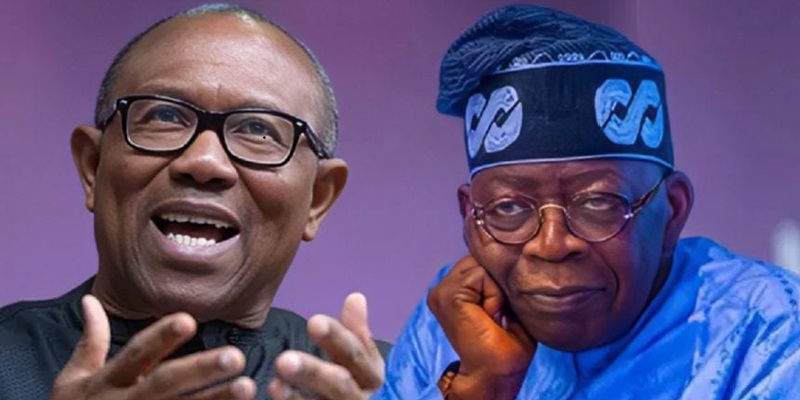
TDFormer presidential candidate Peter Obi has called for the resignation of President Bola Ahmed Tinubu, citing worsening economic hardship, insecurity, and unfulfilled campaign promises.
In a statement released Monday, Obi referenced the recent announcement by the British Prime Minister to step down amid public dissatisfaction, noting that advanced democracies often demonstrate accountability when leaders fail to deliver.
Obi recalled that prior to 2015, Tinubu himself had repeatedly demanded the resignation of then-President Goodluck Jonathan over insecurity and economic challenges, particularly during the Chibok schoolgirls’ abduction. He argued that the same standards should now apply to Tinubu, who campaigned in 2023 on promises of improved electricity supply, anti-corruption reforms, and better living conditions for Nigerians.
“Electricity remains unreliable, insecurity has intensified, kidnappings are rampant, and economic hardship has deepened.
“Across critical sectors—security, infrastructure, transportation, and anti-corruption—conditions have regressed.
“We are in the worst possible state,” Obi stated.

He emphasized that Tinubu had pledged not to seek re-election if he failed to deliver on his commitments, but that the current realities show a monumental failure in governance.
Obi urged the President to resign, saying such a move would strengthen Nigeria’s democratic culture by reinforcing accountability and responsibility in public office.
“Resignation would send a powerful message that leadership is a sacred trust, not an entitlement.
“It would help end the culture of impunity and build a society where failure carries consequences.
“Only then can we secure a better future for our children in the New Nigeria that is possible,” he concluded.
Presidency Responds
The Presidency rebuffed former presidential candidate Peter Obi’s call for President Tinubu’s resignation, describing the demand as “childish, hollow, and an unwarranted distraction.”

In a statement issued by Bayo Onanuga, Special Adviser to the President on Information and Strategy, the Presidency argued that Obi’s comparison between Nigeria’s presidential system and the UK’s parliamentary system was misplaced.
“Obi forgets our country does not run a parliamentary system of government like the UK. We run a presidential system, with the president elected to a fixed four-year term. The recent victories recorded by President Tinubu’s party in Ekiti, Nasarawa, Enugu, Ondo, and Rivers are proof of his popularity with Nigerians,” the statement read.
The Presidency highlighted Tinubu’s achievements in security, noting that thousands of terrorists have been neutralised, captives rescued, and advanced technologies deployed to strengthen operations nationwide. It also dismissed Obi’s criticism of insecurity, pointing to his own record as governor of Anambra State, which it described as “a colossal failure.”
On the economy, the statement cited consistent GDP growth, rising oil production, record foreign reserves, and surging stock market performance as evidence of Tinubu’s reform-driven leadership. It stressed that federation revenue had more than doubled compared to 2022, enabling states to pursue development projects.
The Presidency also defended Tinubu’s record on infrastructure and education, pointing to landmark road projects and the introduction of interest-free loans for nearly two million tertiary students. It clarified that Tinubu never promised 24-hour electricity for all Nigerians but pledged to end estimated billing and expand power generation, which his administration has begun implementing through the Electricity Act and prepaid meter rollout.
Acknowledging Nigeria’s challenges, particularly the high cost of living, the Presidency attributed them to global disruptions, including tensions in the Middle East.

“Peter Obi’s call for President Tinubu’s resignation is not a call to accountability but mere political grandstanding. Leadership is about determination to confront challenges, and President Tinubu has shown he is up to the task,” Onanuga stated.
The Presidency concluded by accusing Obi of living in “self-constructed echo chambers” and urged Nigerians to focus on the government’s ongoing reforms rather than what it termed “puerile distractions.”