



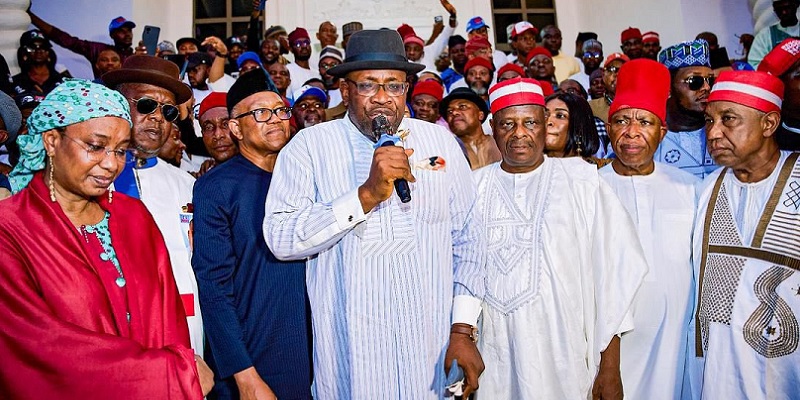

TDFresh signs of internal unease may be emerging within the Nigeria Democratic Congress (NDC) following the release of resolutions from the party’s second National Executive Committee (NEC) meeting.
A statement, issued by NDC National Publicity Secretary Osa Director, outlined a series of measures aimed at strengthening party structures and enforcing accountability.
It also established what the leadership described as an enduring political institution.
Political observers have interpreted parts of the statement as a subtle response to concerns about the influence of prominent personalities and support groups within the party, including former Bayelsa State governor and senator, Henry Seriake Dickson, former presidential candidate Peter Obi, and the Obidient Movement.
NDC insiders, who spoke with This Dawn News over the weekend, confirmed that cracks have emerged between party stalwarts.
They pointed out that the road to 2027 is getting bumpy and not as rosy as envisioned by Obi and the Obidient Movement, citing the recently held primary elections as case study.


During the elections, several Obidients who hoped to ride on the Movement’s popularity are seen scrambling for foothold in the new platform.
Meanwhile, the party has yet to release the whole list of candidates several days after it was held.
Furthermore, some party members and political analysts have made specific references to “party supremacy,” interpreting it as control of powerful individuals and affiliated groups.
Also, the remarks that the NDC is being built as an institution, not a personality cult, political movement, or Special Purpose Vehicle (SPV) have been alluded to Peter Obi (personality cult) and Obidients (political movement) by pundits.
The language has fueled speculation about possible disagreements between leading figures associated with the party’s emerging coalition, including Dickson, Peter Obi, influential activist Aisha Yesufu, and other members of the Obidient movement.
While the NDC statement did not mention any individual or group by name, observers note that its emphasis on subordinating personal interests to party structures appears directed at preventing any individual, movement, or support network from wielding influence outside the formal party hierarchy.

One of the resolutions stated that all governments elected on the platform of the NDC must consult party structures before making key policy decisions and appointments, reinforcing the principle that “the party remains supreme.”
Another resolution declared that all affiliated groups and non-governmental organizations connected to the party must operate under its guidance and control and should not function independently or in parallel with official party structures.
Political commentators say this provision may be particularly significant given the prominence of the Obidient movement, a grassroots political network that emerged in support of Peter Obi and has remained a powerful mobilizing force beyond traditional party frameworks.
The statement’s strongest wording came in its declaration that the NDC would not become “a personality cult, political movement, or Special Purpose Vehicle (SPV) to be used and discarded.”
That phrase has attracted widespread attention because it appears to address concerns that powerful political figures or external support groups could dominate the party’s identity and direction.
The party leadership also announced the establishment of a National Reconciliation Committee to address grievances among members, a move that some insiders interpret as recognition of disagreements that surfaced during recent party activities and internal consultations.

Additionally, the NEC approved the creation of a Code of Conduct for party officials and candidates and introduced stricter financial accountability measures.
Under the new framework, candidates seeking elective office will be required to disclose campaign funding sources, while campaign contributions must be routed through designated party accounts.
Supporters of the resolutions argue that the measures are necessary to prevent the mistakes that have weakened other political parties in Nigeria, where influential individuals often overshadow party institutions.
Critics, however, suggest that the timing and language of the statement could deepen existing tensions if supporters of major political figures perceive the directives as targeting them.

Although neither Peter Obi, Henry Seriake Dickson, nor Aisha Yesufu has publicly responded to the NEC resolutions, discussion has intensified across social media platforms, where some Obidient supporters have questioned whether the party is attempting to curtail the movement’s independence and influence.
Others have defended the resolutions, arguing that any serious political party must establish clear lines of authority and avoid becoming dependent on any single personality, no matter how popular.
For now, there is no official confirmation of a rift between Obi, Dickson, or the Obidient movement.
Nevertheless, the wording of the NDC statement has triggered debate about the balance of power within the party and the challenge of integrating powerful political personalities and grassroots movements into a single institutional framework.
As the NDC continues preparations for future electoral contests, political watchers will be closely monitoring whether the party’s drive for institutionalization strengthens internal cohesion or exposes deeper fault lines within its expanding coalition.