TD Former Anambra State Governor Peter Obi’s camp has refuted the challenge by the Professor Charles Chukwuma Soludo-led administration’s allegations over salary arrears owed workers of the defunct Anambra State Water Corporation.
Peter Obi’s camp cited the Corporation’s enabling law to argue that it had its own financial and administrative responsibilities.
The controversy followed recent claims by the Anambra State Government that Obi left unpaid salary, pension and gratuity liabilities when he left office in 2014.
Obi’s response was contained in a statement issued by Chief Barr. Jeo-Martins Uzodike, a former Commissioner for Information.
The former governor’s office challenged the allegation that more than 200 Water Corporation workers died during Obi’s tenure because of unpaid entitlements.
Uzodike demanded verifiable records showing:
- the Corporation’s workforce during Obi’s tenure,
- the number of workers who allegedly died, and,
- comparable figures under previous and subsequent administrations.
He said the allegations should be established through official records rather than gossips.

What the Water Corporation Law says
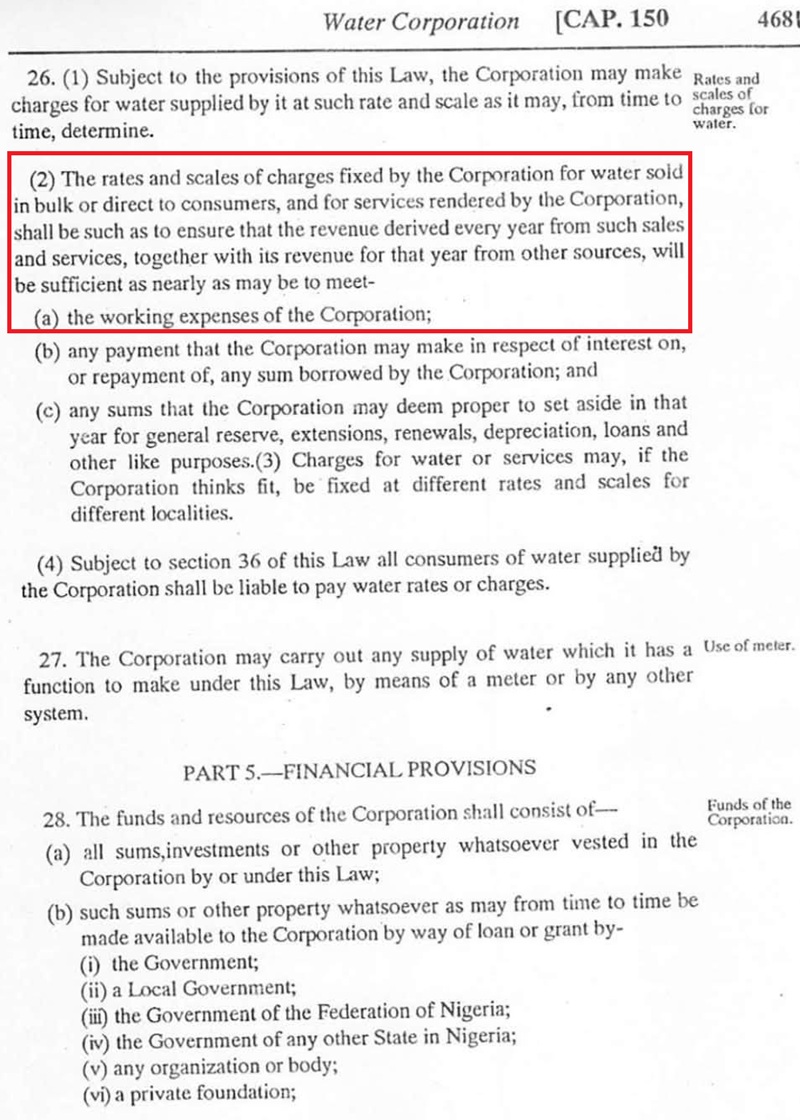
Obi’s media aide, Valentine Obienyem, separately drew attention to the Anambra State Water Corporation Law, Cap. 150.
He argued that the law does not expressly make the state government the automatic or exclusive payer of Water Corporation workers’ salaries.
According to his interpretation, Section 18(1)(a) empowers the Corporation’s Board to appoint officers and servants and determine their salaries, emoluments and conditions of service.
He also cited Section 28, which provides for the Corporation’s funds, including income from its property and investments, water charges, loans and government grants or contributions.
Most importantly, Obienyem pointed to Section 26, which requires the Corporation’s rates and charges to be sufficient to meet its “working expenses.”

The argument advanced by Obi’s camp is therefore that the Corporation was legally structured to generate revenue to meet its operational costs, including staff expenses.
Meanwhile, government assistance remained possible through grants and other support.
The former governor’s office cited Sections 4(1) and 26 in establishing it’s case (see the document attached below).
He argued that the Corporation had responsibility for developing, providing, and distributing water while generating sufficient revenue for its operations.
The salary arrears controversy
Historical records, however, establish that salary arrears involving Water Corporation workers existed during the period in question.

In July 2014, shortly after Obi left office, the National Industrial Court in Enugu ordered the release of about N1.5 billion for salary arrears involving Water Corporation and ANSEPA workers.
Vanguard reported that the underlying case had been instituted during Obi’s administration.
The same contemporary report quoted the workers’ union which claimed that 232 workers had died between 2006 and 2014.
That figure was an allegation by the union and should not be confused with an independent judicial finding which never established the claimed deaths.
In November 2014, the succeeding administration of Willie Obiano announced payment of approximately N1.503 billion to Water Corporation workers.
Contemporary reports said the arrears covered successive administrations, dating back to 2000 and extending to the immediate past administration.
New settlement under Soludo
The issue has resurfaced because of a later settlement involving former Water Corporation and ANSEPA workers.
A 2024 out-of-court settlement reportedly put verified outstanding salary claims at N1.325 billion for Water Corporation workers and N238.19 million for ANSEPA workers.
The Soludo administration has presented the settlement as evidence that liabilities remained unresolved after Obi left office.
Obi’s camp disputes that interpretation and says the historical record must distinguish liabilities inherited from earlier administrations from those incurred during his tenure.
Obi’s defence
Uzodike said Obi did not abandon the Water Corporation.
According to the statement, Obi held meetings with its management and requested a workable plan for improving water supply.
He also offered government assistance within the limits of the law.
The administration also reportedly partnered with the European Union to rehabilitate major waterworks in Awka, Onitsha and Nnewi, while providing boreholes to more than 300 schools.
Obi’s office therefore argues that the present controversy should be resolved through the Corporation’s law, payroll records, court documents, payment records and audited financial statements.
The central question is no longer simply whether Water Corporation workers were owed money.
It is which administration incurred each portion of the arrears and what was inherited.
It is also about what was paid during Obi’s tenure and what remained outstanding when he left office.
Those records will ultimately determine the competing claims now being made by Obi’s camp and the Soludo administration.
For Obi’s supporters, however, the Water Corporation Law provides a significant legal basis for challenging the claim.
It refutes claims that the state government was automatically responsible for all salaries of the Corporation’s employees.
See the Anambra State Water Corporation Law, Cap. 150, below: