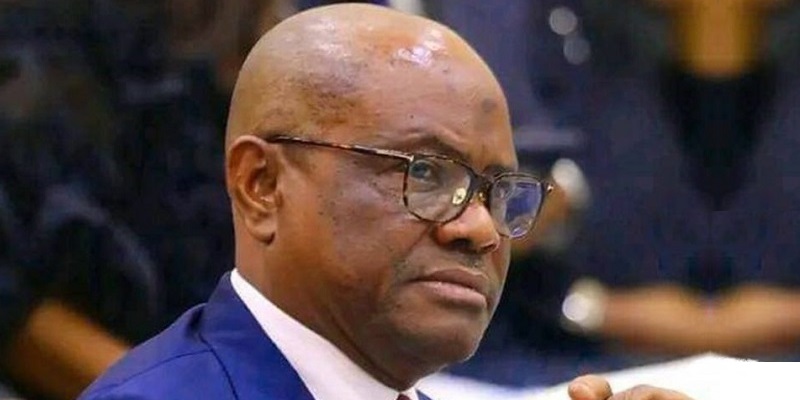
TD Minister of the Federal Capital Territory (FCT), Nyesom Wike, has rejected allegations that he manipulated the 2023 presidential election in the South-South to favour President Bola Tinubu over Labour Party candidate Peter Obi.
Wike, who spoke in Abuja on Wednesday, September 23, 2026, described the allegations as a “baseless narrative” driven largely by social media.
His comments followed controversy over remarks he made during a recent appearance on TVC’s Journalists’ Hangout.
Therein, he disclosed that the five-member Peoples Democratic Party (PDP) Governors’ Group, popularly known as the G5, deliberately adopted a strategy that allowed Obi to win in parts of the South-South during the 2023 presidential election.
Critics and opposition figures subsequently interpreted the disclosure as an admission that the election results had been manipulated.
Wike, however, said there was a distinction between political strategy and electoral rigging.
‘How could I have rigged the election?’
Responding to accusations that he personally altered election results in favour of Tinubu, Wike questioned how such manipulation could have been carried out across Nigeria’s thousands of polling units.

“People who don’t understand, how can they say I rigged the election? How would I have done it? So, I just took the result sheets, wrote it, and gave it to INEC?”
He argued that conclusions about election outcomes should not be based on a limited number of polling units or social-media projections.
“I’ve always said social media does not win elections,” Wike said, noting that the 2023 election involved about 176,000 polling units.
“You have probably seen 300 polling units, and then you rush to the conclusion that so-and-so has won. Election outcomes are not predicted this way,” he added.
The Independent National Electoral Commission’s official 2023 election report records results and polling-unit information for the presidential election across the country, including Rivers State.

Wike explains G5 strategy
Wike said the G5’s actions during the election were driven primarily by its opposition to Atiku Abubakar, the PDP presidential candidate.
The G5 consisted of Wike and four other PDP governors—Seyi Makinde of Oyo, Samuel Ortom of Benue, Okezie Ikpeazu of Abia and Ifeanyi Ugwuanyi of Enugu.
The group had opposed Atiku’s presidential candidacy and demanded the resignation of then-PDP National Chairman Iyorchia Ayu before the election.
According to Wike, the South-South presented a particular political problem because the PDP had traditionally enjoyed considerable strength in the region.
“We felt that Atiku was more of a factor in that election than Obi,” Wike said.

“Our strategy was to make sure that you vote for Obi to win in order to deny Atiku the votes.”
He explained that allowing Atiku to dominate the region would have strengthened the PDP candidate’s national position, whereas votes going to Obi would reduce Atiku’s advantage.
“South-South was purely a PDP state, and so if we had voted for PDP all through, then Atiku would have won. That was a threat,” he said.
Wike said the strategy was applied in parts of the South-South, including Edo and Cross River, although Rivers State was treated differently because of its particular political significance to him and the G5.
‘Obi was not our major threat’
Wike also rejected the suggestion that Obi’s growing popularity constituted the principal political threat to the G5’s interests in the region.
“Obi wasn’t a threat. Obi was merely a threat by social media,” he said.
He argued that even if Obi had won Rivers State, the additional votes would not have been sufficient to change the overall national outcome.
“Assuming Obi won Rivers, add it for him. Would he have won the election?” Wike asked.
His remarks came shortly after he also dismissed claims by Obi and his supporters that the Labour Party candidate had actually won the 2023 presidential election in Rivers State, saying such claims were not established by the results declared by INEC.
Wike points to election tribunal
Wike further challenged those alleging that the 2023 presidential election was rigged to demonstrate how the alleged manipulation was established during the legal challenges that followed the poll.
“You remember that when they went to the tribunal, did anybody tender any result from Rivers to say, ‘Look, this is the result; we won?’” he asked.
His argument was that allegations of electoral manipulation should be supported by polling-unit results and evidence presented through the judicial process rather than social-media calculations.
He also maintained that widespread manipulation would be difficult in areas where a candidate or political party lacked genuine grassroots support.
“When you talk about rigging, you cannot rig an election where you are not popular. You cannot. If you try that, then you see what will happen to you. People will resist it,” he said.
‘Our strategy worked’
Wike maintained that the G5’s intervention was a deliberate political calculation rather than an attempt to falsify election results.
“We had our strategy, and that strategy worked well for us,” he said.
He added that the group’s principal objective was to prevent Atiku from benefiting from the PDP’s traditional strength in the South-South.
The latest comments have therefore reframed Wike’s earlier disclosure.
While he acknowledges that the G5 deliberately influenced its supporters’ voting strategy in parts of the region, he denies that this amounted to changing ballot results, falsifying result sheets or otherwise rigging the election.