TD A new cross-border investigation has identified 284 properties in the United States, collectively valued at nearly $271 million, linked to 61 current and former high-level Nigerian officials, their families, associates and affiliated companies.
The investigation was conducted by the Platform to Protect Whistleblowers in Africa (PPLAAF) in partnership with the Anti-Corruption Data Collective (ACDC).
It examined how wealth associated with Nigerian political and economic elites moved into the US real-estate market.
Key figures from the investigation
Finding |
Reported figure |
|---|---|
| US properties identified | 284 |
| Combined value | Nearly $271 million |
| Properties acquired while officials were in office | 152 |
| Value of those properties | About $177 million |
| Properties without apparent financing | 230 |
| Value without apparent financing | About $232 million |
| Properties linked to PEPs | 232 |
| Value of PEP-linked properties | About $238 million |
| Individuals examined | 61 |
| Individuals with previous public corruption allegations, indictments or sentences | 39 |
| Properties linked to 27 publicly accused individuals | 79 |
| Value of those properties | About $73 million |
The report was titled “Nigeria: Dirty Deeds — How Top Nigerian Officials Bought a Piece of America.”
The investigators said the properties were acquired from 1991 onwards.
152 properties worth approximately $177 million were purchased while the officials were still in office.
The report, however, does not establish that all the identified properties were acquired with proceeds of corruption.

Rather, it identifies ownership and transaction patterns that the investigators say warrant further scrutiny by law-enforcement and asset-recovery authorities.
$232 million bought without apparent financing
One of the investigation’s major findings concerns the manner in which the properties were purchased.
According to the report, 230 of the 284 properties — about 81 per cent — valued at approximately $232 million, were acquired without apparent financing.
The investigators said that, in the available property records, they could not identify mortgages or other obvious financing arrangements for those transactions.
The report identified purchases made while public officials were in office as another significant risk factor.

It found that 94 properties worth approximately $135 million were acquired without an apparent source of financing while the officials were still serving in public office.
The investigators said the timing of some transactions was significant because the individuals were politically exposed persons (PEPs) when substantial real-estate purchases were made.
61 officials and associates examined
The investigation identified 61 current and former high-level Nigerian officials, together with family members, associates and companies connected to them.
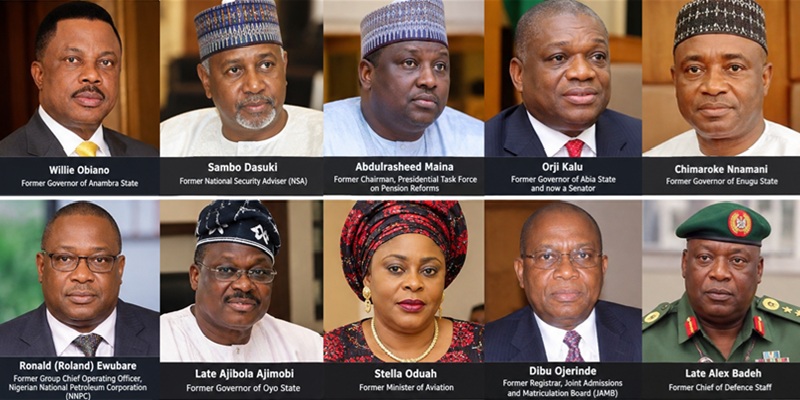
Among the prominent names identified in the report are:
- Sambo Dasuki, former National Security Adviser;
- Orji Kalu, former Abia State governor and serving senator;
- Abdulrasheed Maina, former chairman of the Presidential Task Force on Pension Reforms;
- Stella Oduah, former Minister of Aviation;
- Chimaroke Nnamani, former Enugu State governor;
- late Ajibola Ajimobi, former Oyo State governor;
- Dibu Ojerinde, former Registrar of JAMB;
- late Alex Badeh, former Chief of Defence Staff;
- Abdulrahman Dambazau, former Minister of Interior and former Chief of Army Staff;
- Chris Ngige, former Anambra State governor and former Minister of Labour and Employment;
- Willie Obiano, former Anambra State governor; and
- Ronald (Roland) Ewubare, former Group Chief Operating Officer of the Nigerian National Petroleum Corporation.
The report said 39 of the 61 individuals examined had previously faced public corruption accusations, indictments or convictions/sentences.

That finding is an association with previous allegations or legal proceedings.
It does not mean that every individual identified in the property investigation has been convicted of corruption.
PEPs linked to $238 million in property
According to the report, politically exposed persons among those investigated were linked to 232 properties valued at approximately $238 million.
Of those, 195 properties worth about $208 million were acquired without apparent financing during or after the officials’ periods in office.
The investigation further identified 79 properties valued at approximately $73 million.
Those properties remained connected to 27 individuals who had previously been publicly accused of corruption.
The investigators said the properties could become relevant to asset-recovery proceedings.
Authorities could use the findings once they establish that they were purchased with proceeds of corruption or otherwise fall under applicable forfeiture laws.
Properties bought through companies
The report also identified corporate structures as an important feature of some of the transactions.
It found that 147 properties worth approximately $111 million were acquired by officials or their spouses either directly in their names or through legal entities registered in their names.
Another 104 properties, valued at approximately $140 million, were purchased through companies.
In 12 cases, the investigators identified Nigerian officials who allegedly used US-incorporated entities that appeared to be affiliated with their Nigerian companies to acquire, hold or dispose of properties.
According to PPLAAF and ACDC, the use of companies and intermediaries can make it more difficult to determine the ultimate beneficial owner of a property.
Maina’s US properties among previous investigations
The investigation builds on earlier reporting by other investigative organisations into the overseas assets of some Nigerian officials.
One example is Abdulrasheed Maina, whose US and Dubai property holdings were previously investigated by PREMIUM TIMES, the Organised Crime and Corruption Reporting Project (OCCRP) and PPLAAF.
Earlier reporting found that Maina acquired four properties in the United States and Dubai worth more than $1.3 million.
They were bought between 2010 and 2013, the period he was serving in government and was later accused of diverting pension funds.
According to that investigation, property records showed that Maina paid cash for three Kentucky properties.
The properties include a house purchased for $215,000 in August 2010, while other properties were acquired through a company associated with him.
He was subsequently convicted in Nigeria in a pension-fund money-laundering case and sentenced to eight years’ imprisonment in 2021.
He was released in February 2025 after receiving statutory remission for good conduct.
The previous investigation also reported that Nigerian courts ordered the forfeiture of 23 properties linked to Maina in Nigeria.
Meanwhile, the ownership status of some of the overseas properties remained a separate matter.

Dasuki’s money trail
The new report also refers to previous PREMIUM TIMES investigations into the financial activities of Sambo Dasuki.
Dasuki served as National Security Adviser (NSA) under former President Goodluck Jonathan.
Investigation showed that billions of naira were made in payments authorised through the Office of the NSA during Dasuki’s tenure.
The investigation traced payments to individuals and companies linked to people in Dasuki’s circle.
It raised questions about the procedures used in approving and disbursing security funds.
The new US property investigation places such cases within a broader examination of how wealth associated with Nigerian political elites has been transferred into foreign assets.
Warning over the US real-estate market
PPLAAF Executive Director Jimmy Kande said the findings demonstrated how money associated with corruption risks could cross international borders and enter foreign property markets.
“The purchases, transfers, and sales documented here could amount to international money laundering and must be investigated as such.”
Kande called for Nigerian and US authorities to cooperate in investigating the transactions.
Where appropriate, assets established to have been acquired with illicit proceeds could be recovered.
The report also raised questions about the safeguards employed by some professionals involved in real-estate transactions.
According to the investigators, they identified cases where professionals allegedly failed to adequately verify identity documents or accepted transactions conducted in the names of deceased persons.
The report said these findings required further investigation rather than constituting definitive proof of wrongdoing by every person or professional involved.
Six categories of public officials
The investigators grouped the officials examined into six broad categories:
- Security officials
- Executive officials
- Legislators
- State government officials
- Other public officials
- State-owned enterprise officials
Security, executive and legislative officials accounted for properties worth approximately $222 million, representing about 82 per cent of the total value identified in the investigation.
The researchers said they initially examined roughly 100 cases involving public officials, immediate family members and close associates before applying their identification and verification methodology.
How the investigators linked the properties
PPLAAF and ACDC said their investigation relied on US property records and corporate ownership databases.
They also relied on Nigerian government records, corruption-case documentation and other open-source intelligence.
The investigators said they did not rely solely on matching surnames.
For a property to be included, they sought at least two independent corroborating links.
These could include dates of birth, residential addresses, signatures, company records and other identifying information.
For properties held through companies or other intermediaries, the investigators examined corporate records, family relationships and other publicly available information.
The report said the researchers also considered potentially exculpatory evidence and applied a false-positive assessment before attributing properties to individuals.
The property valuations were based on 2025 appraised values, rather than necessarily reflecting the prices originally paid for the properties.
Potential asset-recovery implications
The investigators said the significance of the findings lies not only in the total value of the properties.
They say it lies also in when and how some of the properties were acquired.
They argued that where Nigerian or US authorities can establish that particular properties were purchased with proceeds of corruption, existing asset-forfeiture and recovery laws could potentially be invoked.
PPLAAF called for closer cooperation between Nigerian and American authorities.
Such cooperation includes financial-intelligence agencies and law-enforcement bodies, to investigate the identified transactions.
The organisation also urged authorities to prevent the dissipation of assets where there is sufficient legal basis.
It urged authorities to pursue repatriation of assets proven to have been stolen from the Nigerian public.
Investigation does not amount to convictions
The report’s findings should, however, be distinguished from criminal convictions.
Being identified as having a property linked to one’s name, family, associate or company does not by itself establish that the property was illegally acquired.
Similarly, the report’s classification of individuals as having faced corruption accusations, indictments or convictions covers different legal circumstances and does not mean that all 61 individuals were convicted of corruption.
The investigators said their work identifies potential risk indicators and assets requiring further scrutiny.
Questions of criminal liability, unlawful enrichment, money laundering or forfeiture would ultimately depend on evidence and applicable legal proceedings, they said.
A wider international money trail
The findings add to a growing body of investigations examining how politically exposed persons in developing countries use international financial and property markets.
The investigators said the use of corporate structures, intermediaries and cash purchases can complicate efforts to identify beneficial ownership and establish the origin of funds.
The report therefore calls attention to the role of both Nigerian and foreign institutions in detecting and investigating suspicious transactions.
For Nigeria, the findings could provide leads for domestic agencies investigating unexplained wealth and potential proceeds of corruption.
For US authorities, the report raises questions about beneficial ownership transparency.
It also questions the due-diligence obligations surrounding high-value real-estate purchases involving politically exposed persons.
The investigation does not, by itself, establish that the entire $271 million portfolio represents stolen Nigerian public funds.
Instead, it identifies a substantial collection of US real-estate holdings connected to Nigerian political and economic elites.
It further highlights transactions and ownership structures that the investigators say warrant further examination.