



TD From John Gotti to Pablo Escobar, history carries a warning: secrecy protects criminal power; political ambition exposes it.
I met a real gangster when I was living and working in New York in the early 1980s.
I was young, fresh from completing my National Youth Service in Lagos, where I had served around the National Assembly and Presidency during the Shehu Shagari administration.
I then found myself working at Philip Morris World Headquarters on Park Avenue in Manhattan.
New York was alive. It was exciting, dangerous, glamorous and utterly unforgettable.
My dentist, Gus, was an elderly man with an extraordinary appetite for life. He also had some unusual patients: people associated with New York’s organised-crime world.

One weekend he took me into Little Italy and introduced me to people from a universe I had previously encountered only in newspapers and films.
That was how I encountered John Gotti.
To be historically precise, Gotti did not become boss of the Gambino crime family until 1985.
But he was already part of that world, and what subsequently happened to him has stayed with me ever since.
Gotti became the “Dapper Don” and then the “Teflon Don.” He loved the cameras, the expensive suits, the restaurants, the theatre of celebrity.
That was precisely the problem. The cleverest organised criminals understand something fundamental: power survives longest in darkness.

You cannot behave like a movie star while expecting the machinery of organised crime to remain invisible. Eventually Gotti’s luck ran out.
He was convicted in 1992 on racketeering and murder-related charges and spent the remainder of his life in federal prison.
Pablo Escobar made the same mistake in a different register.
He built extraordinary criminal power through the Medellín Cartel, but money and underground influence were apparently not enough.
He entered Colombian politics and briefly became an alternate member of Colombia’s House of Representatives.
That decision dragged his life out of the shadows and into the full glare of the Colombian establishment, the press, and law enforcement.

What followed was catastrophic: terrorism, assassinations, bombings, kidnappings, and a war between the Colombian state, rival criminal organisations, and Escobar’s network.
Thousands suffered. Escobar was killed in Medellín in 1993.
The lesson is not that every controversial politician is another Gotti or Escobar.
The lesson is narrower: once a man carrying serious unanswered questions about his past seeks the highest political office, those questions become matters of legitimate public interest.
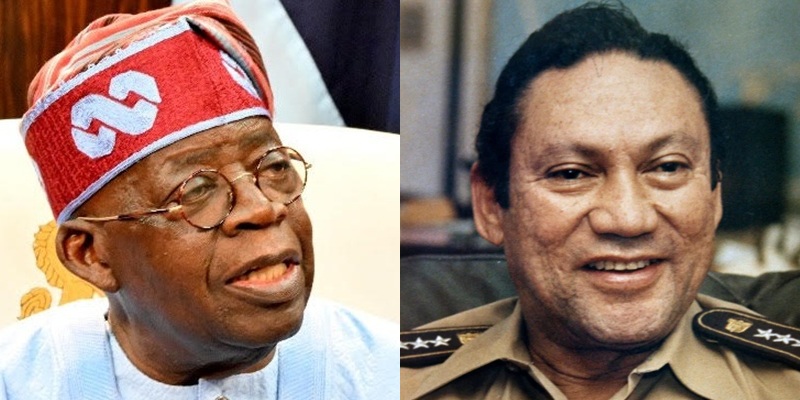
And that brings me to Bola Ahmed Tinubu.
I have reached extremely grave conclusions about Tinubu.
They are my opinions, and where allegations remain disputed or unproved, I describe them as such.
But I refuse to pretend the documented controversies surrounding his past do not exist. The 1993 American civil-forfeiture proceedings involving funds linked to Tinubu are real.
The continuing battle in the United States over government records concerning him is real.
The disputes surrounding aspects of his biography and educational history are real.
What those records ultimately prove — and what they do not prove — must be determined from evidence, not propaganda from either side.
But Nigerians are entitled to ask.
Tinubu’s mistake, in my view, was believing that the methods that built political dominance in Lagos could simply be transferred to the presidency of Africa’s most populous country.
Lagos is not Nigeria. And Nigeria is not a back room.
The moment you become President of the Federal Republic, every unexplained chapter of your life becomes internationally relevant.
Your identity matters. Your education matters. Your financial history matters.
Your relationships matter. Your dealings with foreign governments matter.
And if American intelligence or law-enforcement agencies hold records concerning you, Nigerians have every legitimate reason to demand the lawful disclosure of whatever can be released.
I go further. I personally remain unconvinced by important aspects of Tinubu’s publicly presented biography and nationality history.
I have questions about whether the story Nigerians have been given is his complete history.
Those are suspicions, not established facts, and I will not pretend otherwise.
I have also questioned whether Tinubu ever had a relationship with American intelligence.
I do not possess public evidence that he was a CIA asset, so I state it as a suspicion rather than a fact.
That distinction matters — because if we are demanding truth from government, we must demand it from ourselves too.
There is another question that continues to trouble me: where is the sustained American media interest?
Imagine the headline — the president of one of the world’s largest democracies, the subject of decades-old American narcotics-related financial records and a continuing fight over US government files.
Why has this not become a much larger American story?
I am not claiming CNN or the American government has deliberately suppressed it. I have no evidence of that.
But I am entitled to ask why a story that has generated enormous political interest among Nigerians has attracted such limited mainstream attention in the United States.
And then there are those famous three words: “Emi lo kan.” It is my turn.
Those words fascinated me because they sounded less like an argument for government than a declaration of entitlement to power.
But democracy does not belong to anybody in turns. Nigeria is not an inheritance.
The presidency is not compensation for political deals conducted behind closed doors. And 230 million Nigerians are not pieces on somebody’s chessboard.
I first watched Tinubu closely during the Chatham House appearance in the 2023 campaign, and came away astonished that a candidate for the Nigerian presidency would distribute questions to members of his delegation rather than personally answer everything put before him.
Then he won. I was shocked.
But I learned something from 2023: never underestimate a political machine simply because you despise what it represents.
Never confuse outrage with organisation. Never assume that exposing contradictions automatically defeats political power.
And never confront a sophisticated political organisation without understanding how it operates at street level, institutional level, and national level.
That lesson matters enormously for 2027.
This time the opposition cannot merely shout on social media. It must organise legally, constitutionally, and electorally.
It must document abuses. It must protect polling agents. It must challenge unlawful conduct through the courts.
It must build structures capable of matching the ruling party ward for ward and polling unit for polling unit.
And above everything else, it must insist on evidence.
John Gotti discovered that notoriety eventually attracts investigators.
Pablo Escobar discovered that entering politics places a criminal empire beneath a completely different microscope.
Their stories ended catastrophically — Gotti dying in federal custody, Escobar dying violently after years of war with the Colombian state.
That history is not a threat against anybody. It is a warning about exposure and accountability.
The higher a man climbs, the brighter the light becomes.
And when someone seeks to govern an entire nation, there should be nowhere for legitimate questions about his public record to hide.
No violence. No revenge. No mob justice. Documents. Courts. Elections. Accountability.
That is how a democracy deals with allegations against powerful men.
If Bola Tinubu’s history is exactly what his defenders say it is, open records should help establish that.
If it is not, Nigerians deserve to know that too. Either way, the age of treating questions about a president’s past as forbidden territory must end.
No man is bigger than the truth.