 Brazilian President Luiz Inácio Lula da Silva has won re-election, defeating right-wing Senator Flávio Bolsonaro in a closely contested presidential runoff.
The victory marks a significant political comeback for Lula, who overcame his first-round defeat to retain leadership of Latin America’s largest country.
Brazil’s Superior Electoral Court announced the result on Sunday, October 25, 2026. Lula received 51.79 per cent of valid votes, while Bolsonaro secured 48.21 per cent.
According to the final official count, Lula received 64,256,232 votes against Bolsonaro’s 59,826,041. The difference amounted to approximately 4.43 million votes.
The result gives Lula an unprecedented fourth, non-consecutive presidential term. It also represents a setback for Brazil’s right-wing political movement, which had entered the runoff with considerable momentum.
Viva: Lula Wins After First-Round Setback
The election produced a dramatic reversal after Flávio Bolsonaro finished ahead in the first round.

The senator secured 47.03 per cent of valid votes in the October 4 first round. Lula followed with approximately 45.16 per cent, forcing both candidates into a runoff.
Bolsonaro’s first-round performance raised expectations among conservative voters. His campaign also demonstrated the continued strength of the political movement associated with his father, former president Jair Bolsonaro.
However, Lula’s campaign gained momentum during the final weeks before the decisive vote.
The incumbent benefited from grassroots mobilisation, renewed social media engagement and efforts to consolidate support among working-class voters. Campaign activities, including public demonstrations and online outreach, helped energise his supporters.
Lula’s victory is particularly significant because he became the first candidate in Brazil’s post-dictatorship democratic era to finish second in the first round and subsequently win the presidential runoff.
The outcome demonstrates how political campaigns can change direction between voting rounds. It also highlights the importance of voter mobilisation in closely contested elections.

Election Day Extension Sparks Controversy
The presidential runoff was marked by controversy surrounding voting arrangements and the extension of polling hours.
Voting was initially scheduled to close at 5 p.m. Brasília time. However, authorities extended voting hours in some locations following concerns about transportation difficulties and severe weather.
Reports indicated that the problems affected access to polling stations in areas where supporters of both candidates were expected to vote.
The decision generated political tension, particularly because the election was already highly competitive.
Bolsonaro and his political allies challenged the extension and questioned the circumstances surrounding the decision. The controversy added another layer of uncertainty to an election closely watched across Brazil and internationally.
Nevertheless, the Superior Electoral Court proceeded with the official vote count and declared Lula the winner.

The final results showed that the incumbent had secured a clear majority of valid votes, although the relatively narrow percentage margin reflected Brazil’s deep political divisions.
The election authority also reported substantial voter participation. More than 128 million people cast ballots in the presidential runoff, while approximately 19.2 per cent of registered voters abstained.
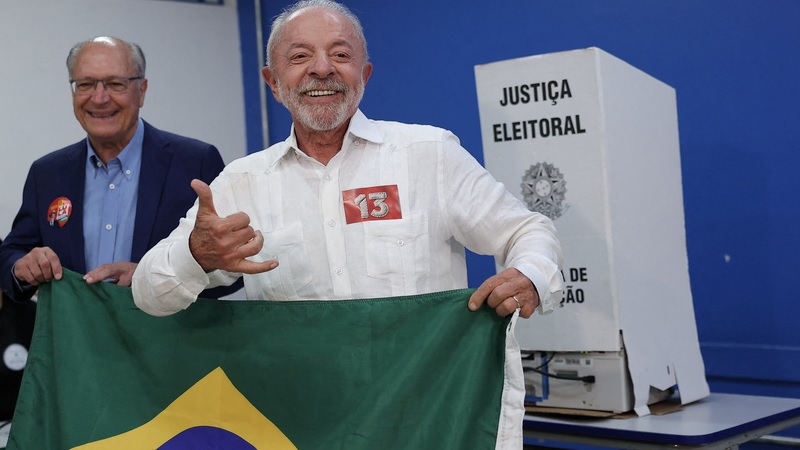
Lula’s Victory and Brazil’s Political Divide
Lula’s re-election highlights the continued strength of Brazil’s left-wing political movement despite a powerful challenge from the conservative right.
The Workers’ Party leader has built much of his political identity around poverty reduction, workers’ rights and social welfare programmes.
His earlier presidencies, from 2003 to 2010, coincided with economic growth and expanded social programmes that helped lift millions of Brazilians out of poverty.
However, his latest presidency has faced challenges involving living costs, public security, economic management and political polarisation.
These issues became important themes during the 2026 campaign.
Lula sought to defend social programmes and present his administration as a source of economic and social stability. Bolsonaro, meanwhile, campaigned on a conservative platform emphasising public security, lower taxes and changes to government policy.
The candidates represented sharply different visions for Brazil’s future.
The election therefore became more than a contest between two individuals. It reflected competing expectations about the economy, public spending, social protection, environmental policy and Brazil’s international relationships.
Although Lula has secured another term, the substantial support for Bolsonaro demonstrates that conservative politics remains a powerful force in the country.
Viva: Lula’s Win Challenges Latin America’s Right
Lula’s victory could influence political debates across Latin America, where left-wing and right-wing movements continue competing for electoral support.
His re-election prevents a major victory for Brazil’s conservative opposition. It also strengthens the position of a prominent left-wing leader in regional and international diplomacy.
However, the result does not mean that right-wing politics has been defeated across Latin America.
Political movements in individual countries operate within different economic, social and historical circumstances. Their electoral fortunes depend on domestic concerns, leadership, public opinion and the performance of governing parties.
Nevertheless, Lula’s comeback offers an important example of how an opposition challenge can be overcome through voter mobilisation and political organisation.
For progressive movements, the result provides encouragement. For conservative parties, it presents an opportunity to reassess their strategies and understand why a strong first-round performance did not translate into victory.
The election also demonstrates that Latin America’s political direction remains contested rather than settled.
BRICS and Brazil’s International Relations
Lula’s victory is likely to attract attention among countries seeking stronger cooperation through the BRICS grouping.
Brazil is an important member of BRICS, which promotes cooperation among major emerging economies. The grouping has become increasingly relevant to discussions about global governance, development financing and international trade.
Lula has generally supported stronger relationships with emerging economies and advocated a more multipolar international order.
His continued presidency provides political continuity for Brazil’s existing international partnerships.
The election outcome may therefore reassure governments that favour closer cooperation with Brazil through BRICS and other multilateral platforms.
However, the result does not automatically neutralise external pressure on the grouping or guarantee a particular outcome for its members.
Brazil’s international policy will continue to be shaped by economic interests, diplomatic negotiations and relations with major global powers.
Lula will also need to balance domestic priorities with international commitments, particularly as global trade disputes and geopolitical tensions affect emerging economies.
His administration’s approach to these challenges will help determine Brazil’s influence during his next term.
Workers and Social Welfare Remain Central Issues
For Brazilian workers, Lula’s victory raises expectations about employment, income protection and social welfare.
His political movement has historically maintained close ties with organised labour and low-income communities.
Supporters view his administration as an opportunity to protect social programmes and improve living conditions for vulnerable households.
However, electoral victory alone cannot resolve Brazil’s economic challenges.
The government will face pressure to address living costs, employment opportunities, public services and the sustainability of government spending.
It must also respond to concerns about crime and public security, which featured prominently in the campaign.
Lula’s ability to maintain support will depend partly on whether his administration delivers tangible improvements in people’s daily lives.
The president must also work within Brazil’s political institutions, where competing interests can complicate efforts to implement major reforms.
His next term will therefore require negotiation, economic management and continued engagement with voters across the political spectrum.
Lula Promises a New Chapter for Brazil
Lula’s victory gives him another opportunity to shape Brazil’s domestic and international direction.
The result represents a remarkable reversal after Bolsonaro’s first-round lead. It also confirms that the presidential contest remained competitive until the final stage.
The president’s supporters celebrated the outcome as a victory for their political movement and its social priorities.
However, Brazil remains divided between competing ideological camps. Millions of voters supported Bolsonaro’s conservative programme, highlighting the challenges Lula faces in governing the country.
The president will need to address the concerns of voters who did not support his re-election while fulfilling the expectations of his own supporters.
His administration’s performance will ultimately determine whether the electoral victory translates into broader public confidence.
For now, the result confirms Lula’s continued political influence and secures him another term leading Latin America’s largest economy.
The election also sends a message about the importance of democratic participation, campaign organisation and the ability of voters to change the direction of a closely contested race.
Lula has won the presidency again, but the greater challenge now lies in governing a deeply divided Brazil.