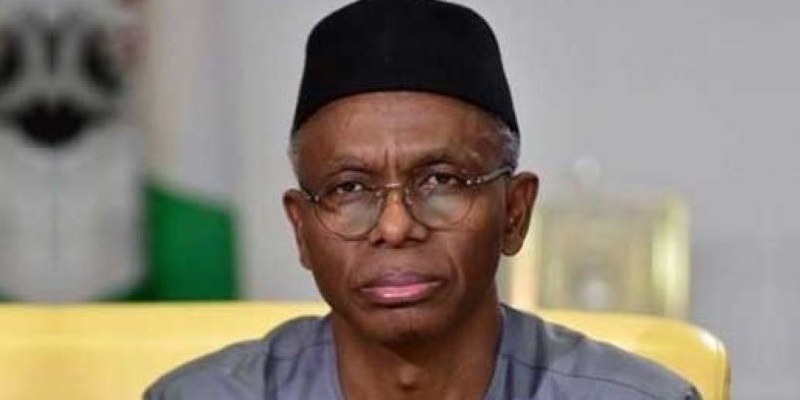
TDPublic reactions to recent developments involving Nasir El-Rufai have been swift and deeply divided. For some Nigerians, the moment appears to represent long-awaited accountability.

For others, it raises troubling questions about fairness, due process, and political intent.
We all know El-Rufai never gave his victims the same chances at fairness, one can go on and on starting with his pure unadulterated bigotry, both religious and tribal.
This is certainly not news to Nigerians in general and especially the people of Southern Kaduna in the eight years of hell they endured in the hands of El-Rufai as the governor of Kaduna State.
Try as he may to distance himself from that past, Nigerians, especially Christians in general and the people of Southern Kaduna in particular, should never let him get away with this cold hearted wickedness unless he gives us a public apology.
This should serve as a lesson to each and everyone who ever thinks of committing such acts in the future.
And, yes, it is alright never to forgive until a genuine apology is public from him.
In a country of equal divide amongst Christians and Muslims with a population of about two hundred million people, El-Rufai had the audacity to publicly boast on video about his despicable Muslim-Muslim exploits.
He did it as the governor of Kaduna State and replicated same on a federal level with the election of President Bola Ahmed Tinubu and Kashim Shettima as President and Vice President of Nigeria, both Muslims.
Whatever your feelings or reactions are about El-Rufai, we risk missing the more consequential issue at stake, the credibility of Nigeria’s institutions ( Legal Institutions).
El-Rufai’s record in public office, policies and public statements drew both support and criticism, often with more criticism.
It is, therefore, unsurprising that current events are being interpreted through the prism of those past positions, especially those he deeply hurt for many years, and for no reasons other than the fact that they are from different ethnic stocks or that they prayed differently from him.
However, a democratic society cannot afford to treat justice based on personal sentiment or political memory.
The rule of law requires a higher standard, one grounded in evidence, transparency, and consistency.
Nigeria’s democratic development has long been hindered by perceptions of selective accountability.
When legal scrutiny appears uneven, rigorous for some, lenient for others, it weakens public confidence in governance and we all suffer from that at the end of the day.
Even well-founded actions can be viewed with suspicion if they occur within a system perceived as inconsistent.
This is the challenge confronting the country today; not merely whether one individual is held to account, but whether accountability itself is applied impartially.
El-Rufai’s encounter with the justice system has to be fair and must be fair even though he was not fair to many of his fellow country men.
Moments like this test the strength of institutions more than the character of individuals.
They raise critical questions:
- Are legal processes being followed without interference?
- Are decisions being made transparently and based on verifiable evidence?
- And, perhaps most importantly, would the same standards apply if the roles were reversed?
If Nigeria is to make meaningful progress, accountability must be depersonalized. It cannot be contingent on popularity, political alignment, or public opinion.
Justice must not resemble retribution, nor should it appear selective. Rather, it must be predictable, impartial, and firmly rooted in the rule of law.
There is an opportunity here, one that extends beyond the immediate circumstances.
By insisting on fairness and consistency, Nigerians can reinforce the principle that institutions, not individuals, are the foundation of a stable democracy.
This requires restraint in public discourse and vigilance in demanding transparency from those in authority.
Ultimately, the significance of this moment will not be determined by the fate of any one political figure.
It will be measured by whether Nigeria moves closer to a system where accountability is universal, justice is credible, and governance is anchored in trust.
That is the standard this moment demands, and one the country can no longer afford to compromise no matter who is on the receiving end and no matter all the evil they may have committed in the past.
Christopher D. Wenegieme (MSHC)