


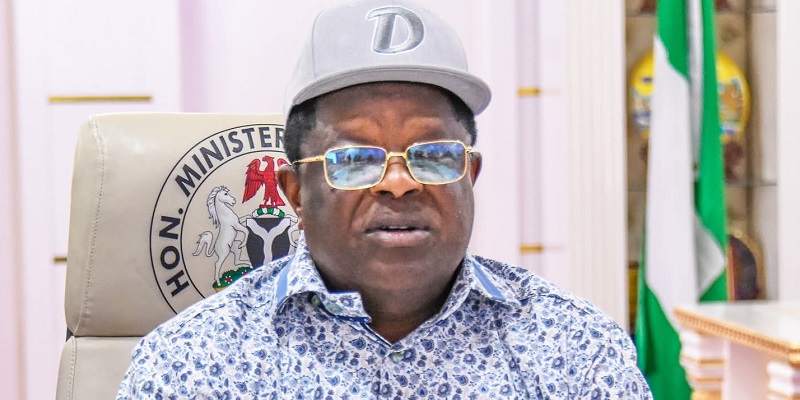

TDBy every measurable standard, Dave Umahi has become one of the most controversial Igbo political figures of this era — not because he lacks influence or access to power, but because many now see him as a politician who consistently speaks against the emotional, political, and historical aspirations of his own people.
At a time when millions of Igbos feel alienated within the Nigerian federation, Umahi has chosen not the language of solidarity, but the language of appeasement.
Instead of articulating the frustrations of the South-East over insecurity, political exclusion, economic neglect, and the continued detention of Igbo political prisoners, he has repeatedly positioned himself as a defender of the Abuja establishment against Igbo dissent.
Nothing symbolises this more than his infamous declaration that Tinubu is “the Biafra” the Igbo need.
That statement was not merely insensitive.
It was profoundly insulting to a people whose collective memory of Biafra is tied to suffering, starvation, massacre, displacement, and resistance during one of the darkest periods in African history.

Biafra is not a slogan. It is not a compliment to be handed to a sitting president for political patronage.
For many Igbos, Biafra represents the graves of millions who died abandoned by the world.
To casually reduce that painful historical experience into praise poetry for political power reveals either astonishing political tone-deafness or deliberate disregard for Igbo historical consciousness.
Umahi’s defenders claim he is simply being pragmatic. But there is a difference between pragmatism and submission.
There is a difference between political negotiation and political surrender.
Throughout the 2023 elections and beyond, while many Nigerians rallied around Peter Obi as a symbol of merit, reform, and long-denied South-East inclusion at the highest level of national politics, Umahi repeatedly undermined that movement.

Rather than recognising the historic significance of an Igbo candidate energising millions across ethnic and religious lines, he chose instead to attack the movement.
He aligned himself fully with the very power structure many Igbos believe has marginalised them for decades.
His critics, therefore, ask a legitimate question: when exactly does Umahi speak with passion about Igbo dignity the way he speaks with passion about loyalty to the federal government?
Again and again, his rhetoric suggests that the South-East must constantly prove loyalty before deserving fairness.
He speaks as though justice for Igbos is something to be negotiated through obedience rather than demanded as a constitutional right of equal citizenship.
Even his approach to IPOB and Biafra agitation reflects this pattern.

One does not need to support IPOB to recognise that the agitation emerged from genuine grievances — insecurity, political exclusion, economic frustration, and deep distrust of the Nigerian state.
Yet Umahi has often spoken about the agitators with more hostility than he speaks about the structural injustices that gave rise to the agitation in the first place.
Leadership requires empathy.
It requires understanding the emotional pulse of one’s people even when disagreeing with their methods.
Umahi instead often sounds dismissive, impatient, and eager to reassure federal power brokers that he is different from “those troublesome Igbos.”
This is why many in the South-East increasingly see him, not as a defender of Igbo interests but, as a politician more invested in federal approval than regional advocacy.
History will ultimately judge whether Dave Umahi’s strategy of accommodation delivers meaningful long-term gains for the South-East.
But what cannot be denied is that his public posture has created a deep perception crisis.
To many Igbos, especially younger generations, he represents a style of politics that prioritises access to power over courage, patronage over principle, and acceptance by the centre over solidarity with his own people.
And in a region still struggling with questions of identity, justice, and belonging within Nigeria, that perception carries enormous political consequences.