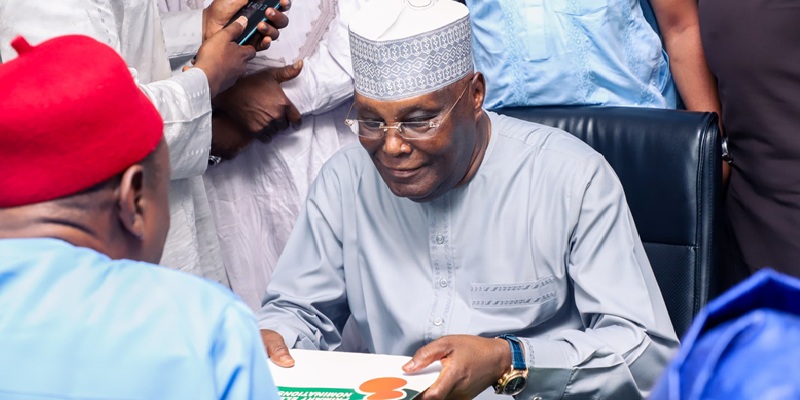
TDFormer Vice President Atiku Abubakar has formally declared his intention to run for the presidency in the 2027 general elections. He submitted his ADC Presidential Nomination Form, signaling his entry into what promises to be a fiercely contested race.
Atiku’s declaration comes amid growing political realignments, with his campaign machinery unveiling a message of national restoration and unity. His move to the African Democratic Congress (ADC) is seen as a strategic shift, positioning himself outside the traditional PDP–APC rivalry that has dominated Nigeria’s politics for decades.
Political observers note that Atiku’s candidacy could dramatically reshape the electoral landscape. His strong base in the North, combined with support across the South, places him in a formidable position. Meanwhile, the struggles of President Bola Tinubu’s administration, Peter Obi’s disruptive influence, and Rabiu Kwankwaso’s uncertain footing are expected to fracture the opposition field, potentially working in Atiku’s favor.
While the declaration has sparked intense debate, one thing is clear: Atiku’s entry has raised the stakes for 2027, setting the stage for a high-stakes contest that will test Nigeria’s political alliances and voter sentiment.

Atiku Abubakar’s Declaration
With his submission of the ADC Presidential Nomination Form, Atiku Abubakar has formally entered the 2027 race. His move to the African Democratic Congress signals a break from the PDP and positions him as a candidate seeking to capitalize on voter disillusionment with Nigeria’s dominant parties.
Atiku Abubakar
- Strengths:
- Long-standing political presence with deep networks across the North.
- Strong appeal in the North-West and North-East, regions historically decisive in Nigerian elections.
- His campaign theme of “Reset Nigeria” resonates with widespread frustration over economic hardship and governance failures.
- Challenges:
- Running under ADC means limited nationwide structures compared to APC and PDP.
- Must convince voters that a third-force party can deliver victory at the national level.
Bola Tinubu
- Strengths:
- Incumbency advantage as sitting president.
- Strong political machinery in the South-West and established APC structures nationwide.
- Weaknesses:
- Growing discontent in the North due to economic hardship, subsidy removal, and unmet promises.
- Risk of losing the northern bloc votes that secured his 2023 victory.
- Struggles with public perception as hardship dominates national discourse.
Peter Obi
- Strengths:
- Maintains strong grassroots appeal among youths and urban voters.
- Solid base in the South-East and South-South, with growing influence in parts of the South-West.
- Seen as a reformist voice and symbol of accountability.
- Weaknesses:
- Limited reach in the North, where bloc votes often decide elections.
- Risk of being perceived as a spoiler candidate — pulling votes away from Tinubu without securing enough to win outright.
- Reliance on fragmented opposition alliances, which may weaken his national impact.
The Electoral Picture
Atiku’s entry reshapes the 2027 contest. Analysts note that:

- Tinubu faces erosion of northern support, a critical blow to his reelection chances.
- Obi remains influential but may function more as a spoiler, weakening Tinubu’s southern base rather than building a winning coalition.
- Atiku benefits from northern consolidation and opposition fragmentation, positioning him as a formidable contender.
The 2027 race is shaping into a three-way contest where Atiku’s northern strength, Tinubu’s incumbency, and Obi’s disruptive appeal will define the outcome.
The dynamics suggest a fractured opposition field that could tilt momentum toward Atiku, though the final verdict will rest with Nigerian voters at the ballot box.