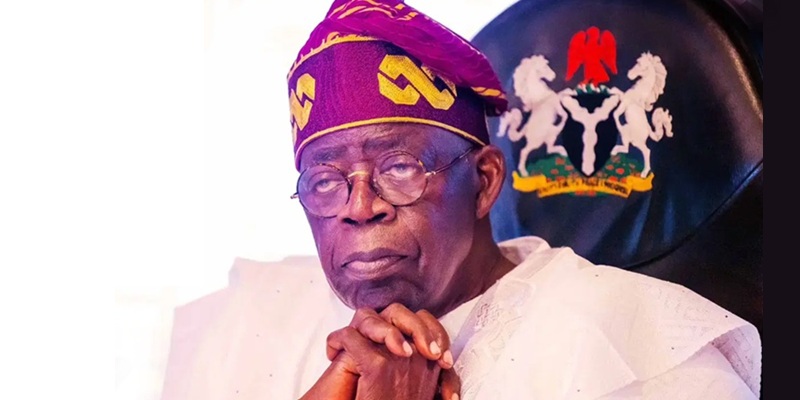
TD Questions are mounting over President Bola Ahmed Tinubu’s absence from the United States for a presidential meeting or major bilateral engagement since assuming office, with a legal practitioner, E.P. Aninze, asking whether the situation reflects deliberate diplomatic strategy or circumstances surrounding the Nigerian President.
In a commentary shared on social media, Aninze, writing under the handle @EkeneAninze, compared Tinubu’s international travel record with those of Nigeria’s presidents since 1999.
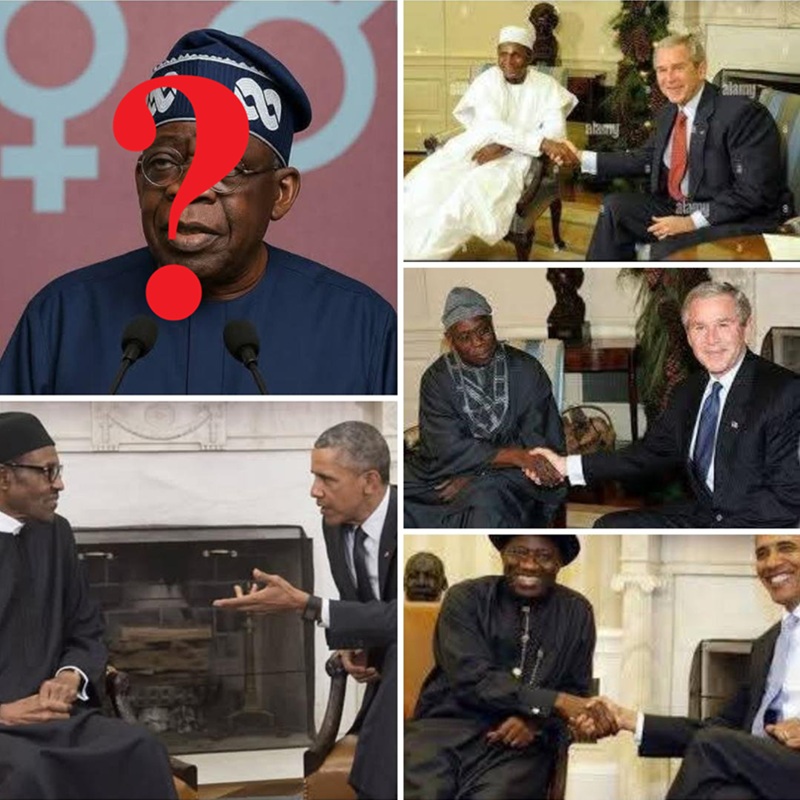
He noted that former President Olusegun Obasanjo made nine separate visits to the United States during his tenure.
Obasanjo, Yar’Adua and Jonathan Made US Engagements
According to Aninze, five of Obasanjo’s visits were working visits, while two involved private meetings with then-U.S. President George W. Bush.
He said Obasanjo also travelled to the United States to attend the G8 Economic Summit in Georgia and the funeral of former President Ronald Reagan.
Aninze noted that despite his relatively short tenure, the late President Umaru Musa Yar’Adua made two working visits to the United States, including a meeting with President Bush at the White House.

Former President Goodluck Jonathan, according to the commentary, made four major diplomatic visits to the United States.
These included a working visit, attendance at the Nuclear Security Summit while serving as Acting President, a meeting with President Barack Obama and participation in the landmark U.S.-Africa Leaders Summit.
Buhari Also Maintained US Engagement
Aninze further recalled that former President Muhammadu Buhari travelled to the United States for four major bilateral and multilateral engagements.
The visits reflected the importance successive Nigerian administrations attached to Washington as a strategic diplomatic partner.
Nigeria and the United States maintain extensive relations covering security cooperation, trade, investment, energy, counterterrorism, development assistance and diplomatic affairs.
‘Tinubu Appears Different’
Against this background, Aninze argued that Tinubu appears to be the only Nigerian President since 1999 who has not visited the United States for a presidential meeting, working visit, major diplomatic engagement, nuclear summit or comparable bilateral event.

He also pointed to Tinubu’s absence from the most recent United Nations General Assembly high-level meetings in New York, where Vice President Kashim Shettima represented Nigeria.
The observation has generated questions because Tinubu is not generally regarded as a president who avoids international travel.
“President Tinubu is certainly not known as a President who dislikes travelling,” Aninze wrote, adding that travelling has been “one of the most visible aspects” of the administration.
Why Has Washington Been Different?
The central question raised by Aninze is why the United States appears to have been an exception.
He questioned whether there is a deliberate diplomatic reason behind Tinubu’s absence from Washington or whether circumstances have prevented a presidential engagement with the U.S. administration.
“Is there something stopping him from following the footsteps of his predecessors by visiting the United States and meeting President Donald Trump?” he asked.

He also suggested that the situation could simply reflect a strategic decision by the Nigerian government rather than any underlying diplomatic problem.
No Explanation Offered in the Commentary
Aninze did not provide evidence establishing that Tinubu has deliberately avoided the United States, nor did he identify any official restriction or diplomatic disagreement preventing a presidential visit.
The commentary instead raises questions based on the travel patterns of previous Nigerian presidents and Tinubu’s broader record of international engagements.
Consequently, the absence of a presidential visit to Washington should not by itself be interpreted as evidence of strained Nigeria-U.S. relations.
The United States remains an important strategic partner for Nigeria, particularly on security, economic cooperation and diplomatic matters.
Whether Tinubu’s limited presidential engagement with Washington represents a deliberate recalibration of Nigeria’s foreign-policy priorities, scheduling considerations or other undisclosed factors remains a matter for clarification from the Presidency and Nigeria’s diplomatic authorities.
The questions nevertheless highlight the symbolic and strategic importance of direct engagement between the Nigerian and U.S. presidents, particularly at a time when Nigeria continues to seek American cooperation on security, investment, economic development and international diplomacy.