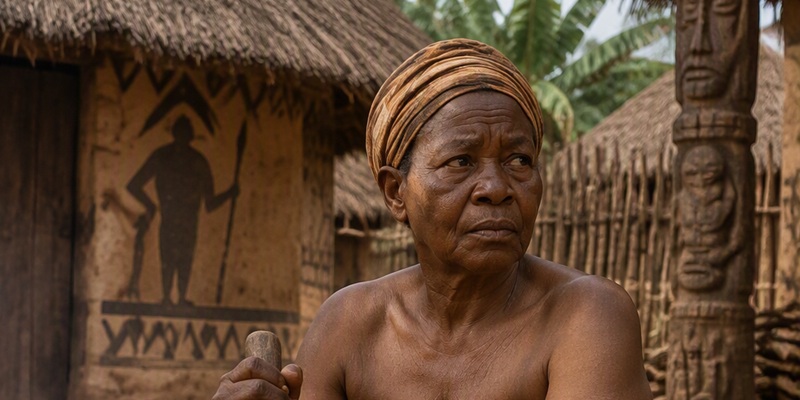
TD IME OBI ANAMBRA SERIES — In Igbo land, particularly within Anambra State, the act of a mature woman laying a curse by holding up her breast or appearing naked remains one of the most feared traditional sanctions.
This practice draws from deep-rooted beliefs in the dual power of the female body as both the source of life and an instrument capable of withdrawing it.
When an elderly woman exposes her breasts or fully disrobes in public, she invokes a spiritual force believed to bring misfortune, social isolation, impotence, or death upon the offender.
The gesture is never casual rather it is reserved for extreme violations of communal ethics, such as the abuse of power, the unjust seizure of land, or the shedding of innocent blood.

Psycho-spiritually, the act rests on the Igbo understanding of the body as a sacred vessel linked to Ala, the earth goddess, and the ancestors.
The breast, which once nourished life, and the genitals, through which life enters the world, become channels of moral authority when deliberately revealed.

To look upon an elderly woman’s nakedness is regarded as a profound transgression, almost incestuous within the moral order of the community.
The curse is believed to operate beyond the physical realm, disrupting the offender’s spiritual balance and inviting the wrath of the land itself.
In this sense, the woman’s body becomes both altar and weapon, a living rebuke that restores equilibrium when ordinary means of justice have failed.
In Anambra, this tradition has surfaced repeatedly in moments of collective distress.
In November 2023, women in Awka marched naked through the streets to protest cult-related killings and alleged police complicity, their exposed bodies serving as a public curse against those they held responsible for the bloodshed.
More recently, elderly women from Nimo in Njikoka Local Government Area bared their breasts at the State Government House, demanding the removal of their traditional ruler over the sale of communal farmland known as Ana Owa.

These actions are not mere spectacles; participants understand them as spiritual interventions that place the offender under ancestral judgment.
The enduring power of the practice in Anambra reflects the persistence of indigenous cosmology even amid Christianity, formal law, and modern governance.
While some dismiss it as outdated, many still experience genuine dread at the sight of an elder woman lifting her breast or stripping in anger.
For the women themselves, the act affirms their moral authority as mothers and guardians of the land.
It transforms personal or communal pain into a psycho-spiritual force capable of shaming the powerful and demanding accountability.
In a society where formal institutions often falter, this traditional curse continues to function as a last, solemn appeal to the unseen order that binds the living, the dead, and the earth.