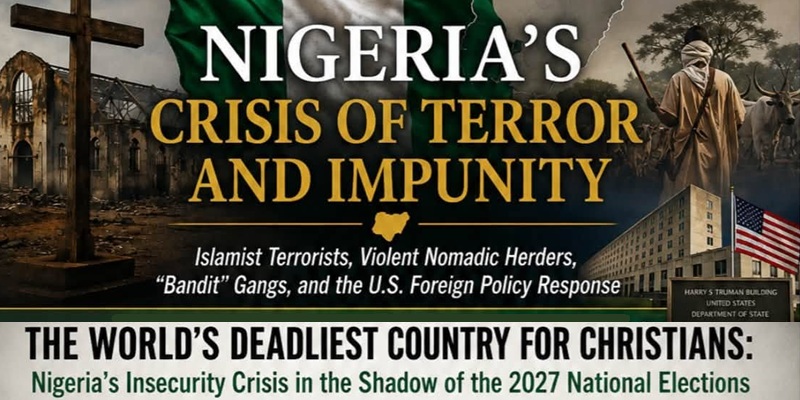
TD Washington, D.C. — At the Hudson Institute, leading voices on African affairs convened to examine Nigeria’s worsening insecurity and its implications for U.S. foreign policy.

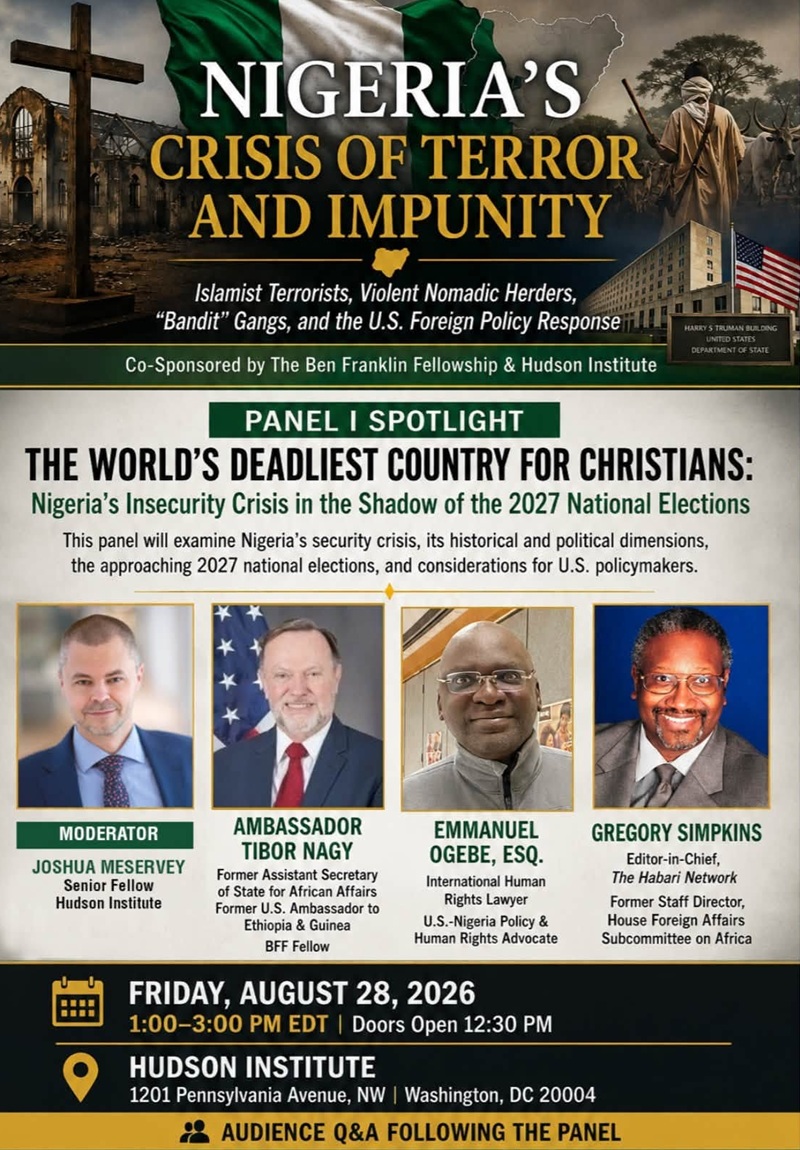
The event, “Nigeria’s Crisis: Islamist Terrorists, Violent Herders, Bandit Gangs & U.S. Foreign Policy Response”, brought together a distinguished panel.
It was moderated by Joshua Meservey, featuring Ambassador Tibor Nagy, Emmanuel Ogebe, and Gregory Simpkins.
Their discussion underscored the intersection of politics, religion, and violence in Nigeria, and the difficult choices facing U.S. policymakers.
Key Highlights
-
Historical Context & Religious Tensions
Emmanuel Ogebe opened with a stark reminder: the 15th anniversary of the UN Abuja bombing, one of the deadliest attacks on the United Nations.
He lamented that U.S. authorities still fail to acknowledge American victims of Boko Haram, reflecting a broader reluctance to confront Nigeria’s crisis.
Ogebe traced the roots of Nigeria’s instability to colonial-era decisions in the 1950s that placed Christian minorities under Northern Muslim dominance, a move that sowed decades of conflict.
He recalled the destruction of 700 churches in just 48 hours during post-election violence in 2011, calling it “the worst single calamity in contemporary Christendom.”
Against this backdrop, he warned that President Bola Tinubu’s Muslim-Muslim ticket risks deepening divisions.
He urged a symbolic but powerful gesture: appointing a Northern Christian vice president to restore balance and trust.
-
Security Failures & U.S. Cooperation
Gregory Simpkins highlighted Nigeria’s chronic failure to coordinate internally.
He noted that while the army receives intelligence from U.S. partners, it often fails to share critical details with the police, creating dangerous gaps.
Simpkins also raised alarms about weapons misuse, recalling the Nigerian Air Force’s accidental bombing of an IDP camp in 2017 and reports of arms being sold to extremists.
He argued that Washington must continue providing support but also hold Abuja accountable.
He warned that without stronger oversight, U.S. assistance risks perpetuating abuses rather than solving them.
-
Balancing Humanitarian and Commercial Interests
Ambassador Tibor Nagy, drawing on his experience as a U.S. diplomat in Nigeria, stressed that “the U.S. is not going to solve Nigeria’s problem—Nigerians have to solve their problem.”
Yet he acknowledged the policy dilemma in Washington: humanitarian groups demand accountability for human rights violations.
Meanwhile, trade and investment lobbies push for engagement with Nigeria’s $15 billion trade relationship.
Nagy suggested a dual approach—sanctions on politicians complicit in violence, alongside cooperative measures such as training, local security reforms, and economic initiatives that could reduce tensions between herders and farmers.
-
Case Studies of U.S.-Nigeria Partnership
Ogebe offered examples of successful collaboration.
He recounted how U.S. pressure led to the release of Sunday Jackson, a Christian farmer freed from death row after 11 years.
Yet he contrasted this with Kano State’s refusal to release abducted Christian orphans, despite federal intervention.
He argued that U.S. military presence in Nigeria is critical, noting that drone strikes against ISIS leaders succeeded only when American forces were on the ground.
Without U.S. troops, intelligence leaks allowed terrorists to evade attacks, underscoring the fragility of Nigeria’s security apparatus.
-
Immigration Policy & Human Rights
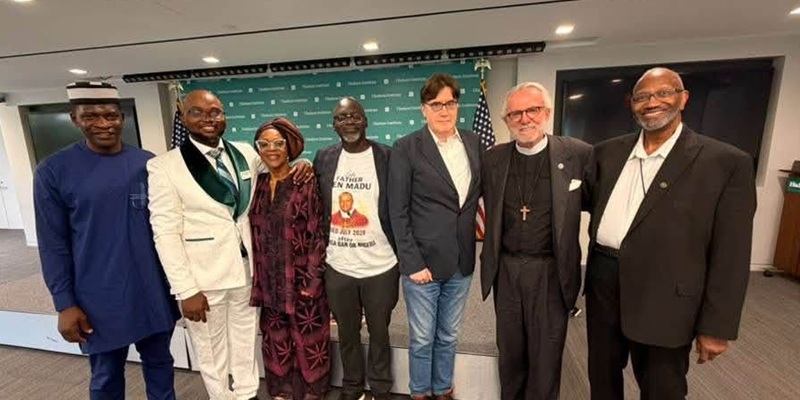
Ogebe also criticized U.S. immigration policy, recounting the tragic suicide of Father Ben Madu, who feared returning to Nigeria amid Boko Haram threats after his U.S. visa expired.
He pointed out contradictions in American politics: Democrats downplay Nigeria’s crisis but resettle refugees, while Republicans acknowledge the crisis yet block resettlement.
This policy dissonance, he argued, leaves thousands of Nigerian Christians stranded in Cameroon and vulnerable to violence.
Closing Note
The panelists agreed that Nigeria’s crisis is both political and religious, with devastating humanitarian consequences.
While the U.S. cannot “solve Nigeria’s problems,” its policies—whether through sanctions, military cooperation, or refugee resettlement—will significantly influence Nigeria’s trajectory ahead of the 2027 elections.
The debate revealed both the limits of U.S. power and the urgency of sustained engagement, as Nigeria’s instability threatens not only its citizens but regional and global security.
Watch the full episode here.