





TD WASHINGTON, D.C., USA— A new sworn declaration filed by the United States Federal Bureau of Investigation (FBI) has reignited controversy over Nigerian President Bola Ahmed Tinubu’s alleged links to a 1990s heroin-trafficking investigation, with a Washington-based Republican lobbying firm claiming that the FBI has identified 399 pages of responsive records relating to the Nigerian president.
The development emerged from a long-running Freedom of Information Act (FOIA) lawsuit brought by American transparency campaigner Aaron Greenspan against several U.S. government agencies, including the FBI and Drug Enforcement Administration (DEA).
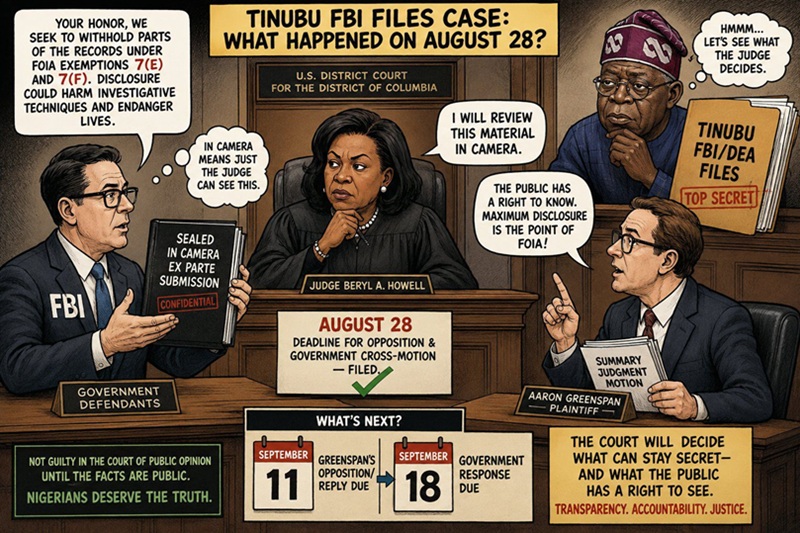
The latest disclosure centres on an FBI declaration submitted to the U.S. District Court for the District of Columbia on August 28, 2026, in proceedings before U.S. District Judge Beryl Howell.
According to excerpts published by Von Batten-Montague-York, L.C., a Washington, D.C.-based Republican lobbying firm, the FBI told the court that the responsive records were compiled as part of an investigation involving multiple individuals and drug-trafficking crimes.
The firm quoted the FBI as stating:
“The responsive records herein were compiled in furtherance of the FBI’s investigation of multiple individuals for drug trafficking crimes.”

The lobbying firm argues that the declaration puts to rest claims that Tinubu was never the subject of a criminal investigation in the United States.
Court had already acknowledged Tinubu investigation
The central legal point, however, predates the latest FBI declaration.
In an April 8, 2025 memorandum opinion, Judge Howell ruled that publicly filed documents originating from the U.S. Department of Justice had already officially acknowledged that Tinubu was one of the subjects of a criminal investigation involving the FBI and DEA.
The judge specifically examined an affidavit by IRS Special Agent Kevin Moss that had been incorporated into a 1993 federal civil forfeiture complaint involving funds in a bank account held in Tinubu’s name.
According to Judge Howell, the affidavit stated that there was probable cause to believe that funds in accounts controlled by Tinubu were involved in financial transactions allegedly violating U.S. money-laundering statutes and represented proceeds of drug trafficking.
The judge wrote that the investigation concerned the proceeds of a heroin-distribution organisation in the Chicago area and involved information from IRS, DEA and FBI agents.

Judge Howell subsequently concluded:
“Taken together, the information in the affidavit constitutes an official acknowledgment that Tinubu was one subject of a criminal investigation…”
The court held that because the disclosure had been adopted by the Department of Justice through its incorporation into the publicly filed forfeiture complaint, both the FBI and DEA were bound by that official acknowledgment and could not use a Glomar response to refuse even to confirm the existence of an investigation concerning Tinubu.
A Glomar response is a FOIA mechanism through which an agency refuses to confirm or deny whether responsive records exist.
FBI case number resurfaces
The controversy also involves FBI case 245-IP-71386-UUUUUU, covering the 1992–1993 period.
Court records show that Greenspan specifically asked the FBI in 2023 for FBI Form 302 interview records involving Tinubu from that case.

The FBI initially refused to confirm or deny whether such records existed, citing FOIA privacy exemptions.
The 2025 court ruling, however, required the FBI and DEA to lift their Glomar responses concerning Tinubu and to search for and process non-exempt responsive records.
The litigation subsequently continued over what material could lawfully be withheld or redacted.
399 pages identified
The latest development has intensified attention because Von Batten-Montague-York says the FBI’s search generated 399 pages of records responsive to the Tinubu-related requests.
The firm claims the material includes references to investigative activities such as:
- heroin-residue laboratory testing;
- controlled drug purchases involving cooperating witnesses;
- confidential informants;
- federal grand-jury activity;
- prosecutorial reports and meetings;
- surveillance and undercover operations;
- financial seizures;
- bank-account seizure warrants;
- IRS criminal-investigation material; and,
- international investigative coordination.
These details are being highlighted by the lobbying firm as evidence that the records extend well beyond the 1993 civil forfeiture proceedings involving approximately $460,000 in funds associated with Tinubu.
The firm has questioned why hundreds of pages of federal law-enforcement material were generated in connection with Tinubu and what information they contain.
Records remain under seal
Despite the dramatic claims surrounding the documents, the 399 pages have not been publicly released in full.
Reports indicate that the FBI submitted records and supporting material to Judge Howell under seal for ex parte, in-camera review. That means the judge is examining the material privately to determine which portions can be released and which may lawfully remain withheld or redacted.
The FBI has invoked several FOIA exemptions, including provisions covering personal privacy, confidential sources, investigative techniques and information whose disclosure could endanger individuals.
Consequently, the existence of 399 pages of responsive records does not, by itself, establish what every page contains or prove that Tinubu personally committed a drug-trafficking offence.
What the court actually established
The distinction is important.
Judge Howell’s 2025 ruling did not find Tinubu guilty of heroin trafficking, money laundering or any other crime.
Nor did it determine that Tinubu personally participated in a heroin-distribution organisation.
What the court did determine was that publicly filed DOJ material constituted an official acknowledgment that Tinubu had been a subject of a criminal investigation conducted with the involvement of the FBI and DEA.
The court’s ruling was specifically about whether the agencies could continue using Glomar responses to refuse to acknowledge the existence of investigative records—not about Tinubu’s criminal liability.
That distinction is likely to become increasingly important as Judge Howell reviews the newly submitted material.
Tinubu’s legal position
Tinubu intervened in the FOIA litigation in 2023, citing privacy interests in confidential tax records and federal law-enforcement documents.
His legal position has centred on privacy protections and the scope of FOIA, rather than an admission of criminal wrongdoing.
The latest dispute therefore moves the controversy into a new phase: not whether the U.S. government has acknowledged that Tinubu was investigated, but how much of the underlying investigative material can legally be made public.
For now, the FBI records remain largely shielded from public scrutiny while Judge Howell conducts her review.
The central unanswered question is consequently no longer whether federal law-enforcement records concerning Tinubu exist.
The 2025 judicial ruling already established the official acknowledgment of the investigation, while the latest proceedings indicate that the FBI has located a substantial body of responsive material.
The question now is what those 399 pages contain—and how much of them Judge Howell will ultimately order released.
This framing is deliberately explicit while avoiding the legally inaccurate claim that the FBI declaration proves Tinubu committed heroin trafficking.
The court record supports the narrower—and significant—finding that Tinubu was officially acknowledged as a subject of a criminal investigation involving the FBI and DEA.