


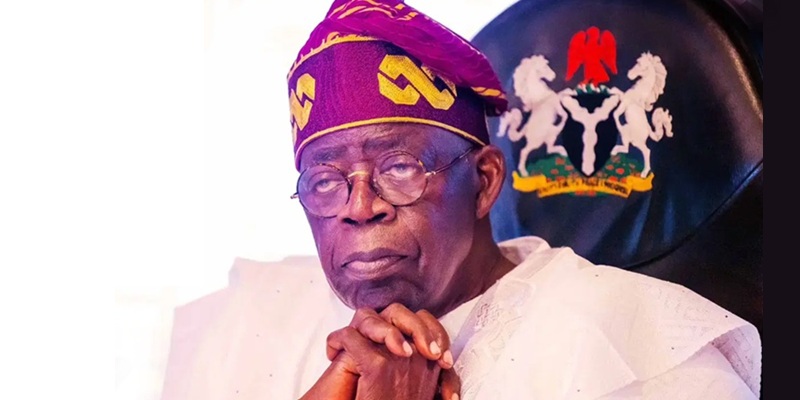

TDThe Nigerian Government led by President Bola Ahmed Tinubu is borrowing at an astronomical speed that should concern every citizen — but the real story is not what you’re being told.
Let’s cut through the noise.
Yes, billions of dollars have been borrowed under the current administration.
Yes, Nigeria’s total debt has surged dramatically in just a few years.
And yes — over 80% of government revenue is now going into servicing debt.
Let’s take a load down of verified debts incurred by the Tinubu Administration.

Foreign Loans
- $2.7 billion from the World Bank.
- $750 million for renewable energy expansion.
- $700 million for adolescent girls’ secondary education.
- $500 million for the Nigeria for Women programme.
- $750 million for power sector recovery.
- Another $4.25 billion from the World Bank.
- $1.57 billion to strengthen human capital, improve health for women and children, and build climate resilience.
- $357 million, $57 million, and $86 million for rural road access, agricultural marketing projects, economic stabilisation, resource mobilisation reform, primary healthcare, and dam safety.
- Another $2.695 billion from the World Bank.
- $500 million for education under the HOPE Education loan.
- $80 million for nutrition programmes.
- $253 million and $247 million for NG-CARES, broadband expansion, health security, livelihoods for vulnerable households, and MSME finance.
- $500 million for a women’s programme.
- $800 million to “cushion the effects” of fuel subsidy removal.
- $1.5 billion for the Economic Stabilisation Act.
- $500 million from the African Development Bank for energy and electricity reform.
- $1 billion from UK Export Finance via Citibank London for Lagos Port rehabilitation.
- $902 million from UK Export Finance.
- $5 billion from First Abu Dhabi Bank to finance deficits.
- $400 million from the African Development Bank for agriculture and digital economy.
- $2.3 billion approved by the National Assembly in 2026 for the budget deficit.
- $516 million from Deutsche Bank approved in April 2026, for the Sokoto-Badagry Super Highway.
Domestic Loans
- N22.7 trillion in CBN Ways and Means advances securitized in 2023 alone.
- N9.62 trillion borrowing plan in 2023, with N5.05 trillion raised mid-year.
- N7.81 trillion in bonds and treasury bills in 2024.
- N8.54 trillion in bonds and treasury bills in 2025.
- N10.07 trillion projected for 2026.
- N1.15 trillion for budget deficit financing.
- N757 billion bond to clear outstanding pension liabilities.
- Another N1.15 trillion submitted to the Senate late 2025.
Incoming Loans
- $21.5 billion external borrowing plan for 2025 to 2026 for infrastructure, agriculture, health, education, water, security, and employment.
- $2 billion domestic foreign currency bond programme approved alongside the above.
Grand Total
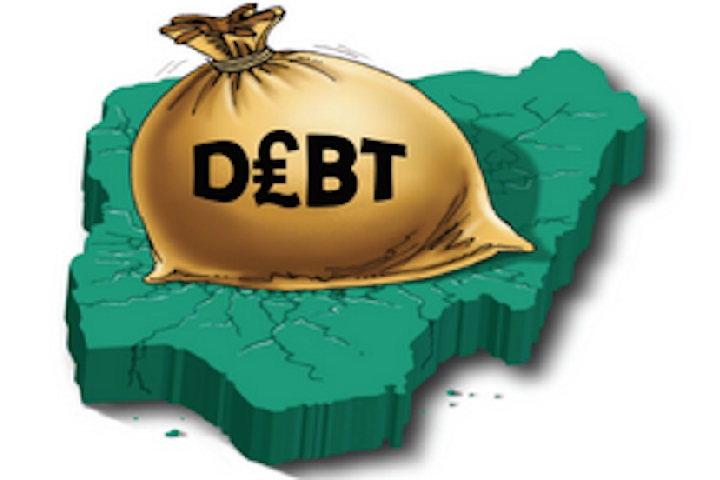
- Nigeria’s total public debt from from N87 trillion under the late President Muhammadu Buhari in 2023 to N159 trillion as of December 2025.
That is N72 trillion added in less than 3 years.
NOTE:
- External debt servicing alone cost Nigeria $9.9 billion between June 2023 and August 2025.
- In 2023, debt servicing cost N7.8 trillion, a 121% increase from the year before.
- In 2024, it rose again to N13.12 trillion, another 68% increase.
- Nigeria’s total public debt will rise from the current N159 trillion to over N183 trillion by the end of 2026.
- Over 80% of government revenue currently goes to servicing debt. Not building schools. Not fixing hospitals. Not paying doctors. Just paying back loans!
The Hidden Danger
Here’s where the conversation is being dangerously oversimplified.
The problem is NOT that Nigeria is borrowing for “nutrition,” “women programmes,” or “education.”
Those are standard development investments used by countries across the world.
So why does it feel like something is wrong?
Because something is wrong — just not where most people are looking.

THE REAL SCANDAL NOBODY IS EXPLAINING
Nigeria is not collapsing because of what it is borrowing for.
Nigeria is drifting toward a fiscal crisis because of three deeper failures:
1. BORROWING WITHOUT VISIBLE RESULTS
Billions go into:
- Power sector recovery
- Healthcare systems
- Education
- Social programmes
Yet:
- Electricity is highly unstable
- Schools remain underfunded
- Poverty levels remain high
Where is the impact?
When loans don’t translate into real economic growth, they become a burden — not an investment.
2. VAGUE PROJECTS, ZERO ACCOUNTABILITY
Terms like:

- “Human capital development”
- “Economic stabilisation”
- “Climate resilience”
Sound impressive — but to the average Nigerian, they mean nothing.
And that’s the issue.
No clear breakdown. No measurable outcomes. No transparency.
This is how public trust erodes.
3. BORROWING TO SURVIVE — NOT TO GROW
This is the most dangerous part.
Nigeria is increasingly borrowing to:
- Support budgets
- Cushion economic shocks
- Finance deficits
Not to:
- Build industries
- Expand exports
- Create sustainable revenue
That is a red flag.
Because debts taken for survival do not pay themselves back.
THE HARD TRUTH
Nigeria is not yet in a debt trap.
But it is moving in that direction — steadily.
And if nothing changes:
- More revenue will go into debt servicing
- Less will go into development
- The economy will tighten further
SO WHAT SHOULD YOU ACTUALLY BE WORRIED ABOUT?
Not “nutrition loans.”
Not “women empowerment funding.”
Be worried about this:
A system that borrows billions but struggles to show results, track impact, or grow revenue!
That is how nations slide — not suddenly, but gradually.
FINAL TAKE
The outrage is understandable.
But misdirected anger won’t solve the problem.
Nigeria doesn’t just need to borrow less.
Nigeria needs to:
- Spend better
- Show results
- Grow revenue
Until then, the numbers will keep rising — and so will the risk.