



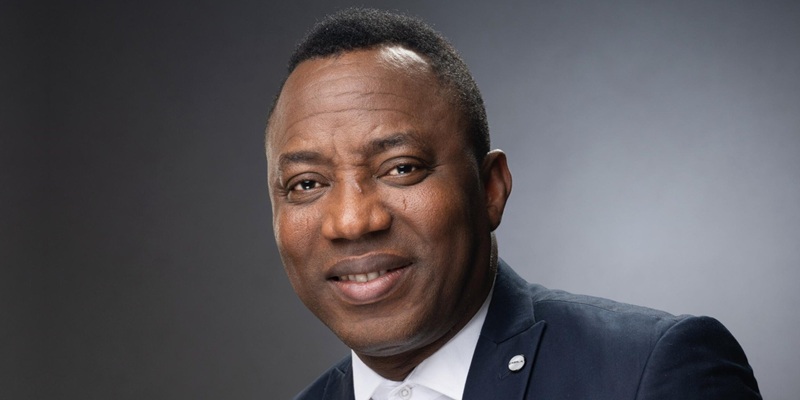

TDIn his final year at the University of Lagos, Omoyele Sowore sat in an examination hall, pen in hand, focused on his paper.
Outside, security operatives waited to arrest him.
That image—an activist writing his exam while the state prepared to drag him away—captures the essence of Sowore’s life story: a man whose existence has been defined by confrontation with authority.
From 1998 to date, Sowore has been arrested 548 times, remanded in detention facilities 46 times, and faced trial in court 98 times.
These numbers are staggering. They tell the story of a man who has spent nearly three decades locked in a cycle of protest, arrest, detention, and trial.
For most people, such relentless persecution would have been enough to silence them. For Sowore, it has only sharpened his resolve.

A Life in Courtrooms and Cells
Sowore’s activism has never been confined to the streets.
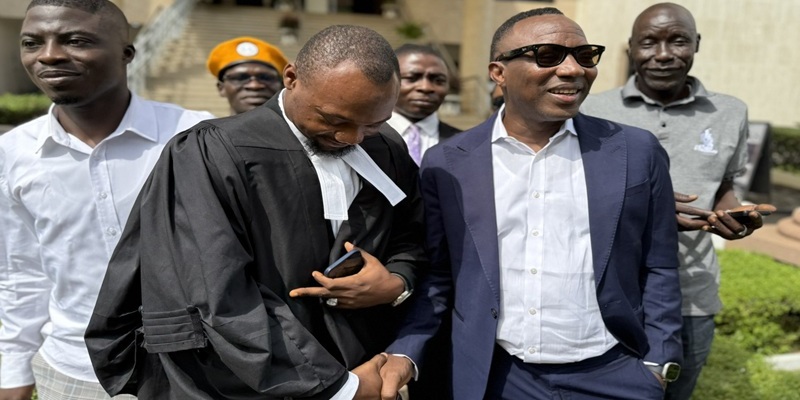
He has taken governors, senators, lawmakers, security agencies, and even the President of Nigeria to court.
His legal battles are not just about personal freedom; they are about testing the limits of Nigeria’s democracy.
Each case he files, each detention he endures, becomes part of a larger narrative about the state’s intolerance of dissent.
The sheer volume of his arrests—548 in total—suggests a deliberate strategy by successive governments to wear him down.
Yet, Sowore’s persistence demonstrates that repression does not always achieve its intended effect.

Instead of breaking him, the arrests have made him a symbol of resistance.
The Cost of Defiance
It is easy to romanticize Sowore’s struggle, but the personal cost cannot be ignored.
Detention is not just about losing freedom; it is about psychological trauma, physical hardship, and the erosion of personal relationships.
To be remanded 46 times means spending weeks, months, even years in facilities designed to crush the human spirit.
And yet, Sowore emerges from each ordeal with renewed energy. His critics accuse him of being reckless, of seeking attention, of refusing to compromise.
But perhaps recklessness is precisely what Nigeria needs in an era when compromise often means complicity.

The State vs. the Citizen
Sowore’s story is not just about one man. It is about the Nigerian state’s relationship with its citizens.
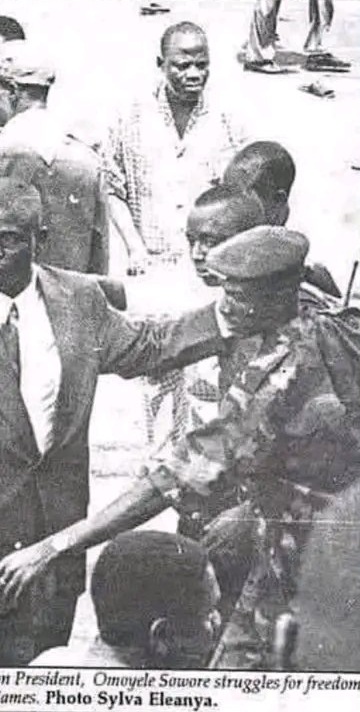
His repeated arrests highlight a pattern: when confronted with dissent, the state reaches for handcuffs instead of dialogue.
This reflex betrays a deep insecurity within Nigeria’s political class.
Democracy thrives on dissent.
Without voices like Sowore’s, the system risks becoming a hollow ritual of elections without accountability.
His confrontations with power remind us that democracy is not just about casting ballots; it is about holding leaders accountable every day.
Why Sowore Matters
Some dismiss Sowore as a perpetual troublemaker. But troublemakers are often the conscience of society.
His activism forces uncomfortable questions:
-
Why are Nigerians still struggling with basic freedoms decades after military rule?
-
Why does the state fear criticism so intensely?
-
Why do institutions designed to protect citizens often serve as instruments of repression?
Sowore matters because he refuses to accept silence as the price of survival. His life is a reminder that democracy is not given; it is fought for.
The Larger Lesson
Nigeria’s democracy is fragile, not because of activists like Sowore, but because of the state’s inability to tolerate dissent.
Arresting one man 548 times does not strengthen democracy; it weakens it.
It signals to citizens that their voices are dangerous, that their rights are conditional, that their freedom is negotiable.
The lesson from Sowore’s struggle is clear: democracy cannot coexist with perpetual repression.
If Nigeria is to move forward, it must learn to embrace dissent as a vital part of governance.
Conclusion
Omoyele Sowore’s life is a testament to resilience.
From the examination hall at the University of Lagos to countless detention cells across Nigeria, he has lived as a perpetual defendant in the court of state power.
His arrests, trials, and remands are not just statistics; they are chapters in the story of Nigeria’s democratic struggle.
Whether one agrees with his methods or not, Sowore embodies the principle that freedom must be defended, even at great personal cost.
His story is not just about him—it is about Nigeria, about the kind of democracy we want, and about whether we are willing to fight for it.