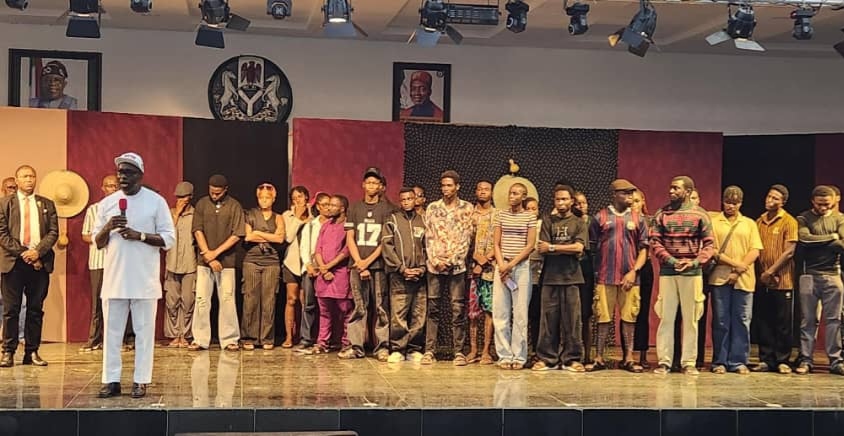
TD Governor Chukwuma Charles Soludo of Anambra State has called for a deeper and more structured intellectual examination of the “Igbo Question” within Nigeria, urging stakeholders to embrace dialogue, research, and reasoned debate rather than agitation.

The governor made the remarks at the Light House in Awka after watching The Tale of Two Nnamdis, a stage production written by Tobe Osigwe and directed by Prof. Uche Nwaozuzu.
The play was performed by students of the Department of Theatre Arts and Film Studies, University of Nigeria, Nsukka (UNN).
Speaking after the performance, Soludo commended the students for initiating what he described as a long-overdue conversation on the place of the Igbo people in Nigeria and the challenges confronting the region.
According to the governor, the issues surrounding the Igbo nation require serious academic and political engagement, supported by facts, historical understanding, and constructive dialogue.
Recalling a recent visit to UNN, Soludo noted the institution’s historical significance in the Nigerian Civil War and expressed satisfaction that students were taking the lead in promoting critical discussions on the subject.
“I was at UNN last month, and I recalled that the Biafran War was literally declared there.
“I am glad that you people are now leading the way. That conversation must begin in a very structured manner,” he said.
The governor also criticized methods of agitation that, in his view, have negatively affected the people they were intended to help.
He cited the prolonged sit-at-home orders in the South-East, arguing that such actions inflicted economic and social hardship on local communities.
Drawing from personal experience, Soludo reflected on the devastating impact of the Civil War on his family, revealing that his mother died during the conflict while his father lived with a bullet lodged in his body for 11 years after the war.
“I saw the war very clearly,” he said. “I am a Pan-Africanist and a proud Nigerian.
“Ndị Igbo need Nigerians, Nigerians need ndị Igbo, just as we all need the wider world.
“Our prosperity will grow faster when we take advantage of a broader space.”
While acknowledging the diversity of opinions within the Igbo community, the governor emphasized the importance of negotiation, engagement, and political bargaining.
He drew inspiration from the legacy of Nigeria’s foremost nationalist, Nnamdi Azikiwe.
“Zik helped us through the politics of negotiation and bargaining in the First and Second Republics.
“He showed us that engagement remains a powerful tool,” Soludo stated.
The governor further challenged the Igbo political class and the wider population to address what he described as a contradiction between seeking greater participation in Nigeria’s political leadership and expressing deep skepticism about the Nigerian state.
“It is true that Ndi Igbo desire the presidency, but that paradox must be confronted.
“As a people, where exactly do we stand?
“How can anyone effectively lead a people whose collective position remains unclear?” he asked.
Soludo reiterated his willingness to participate in a structured and civil dialogue on the future of the Igbo people, including engagement with different groups and perspectives, among them the faction led by Nnamdi Kanu.
He concluded by stressing the need for tolerance, openness to opposing viewpoints, and sustained intellectual engagement.
He assured support for initiatives that promote constructive discussions on the Igbo question.
“Any group that advances the conversation about the Igbo Question in Nigeria through civil and intellectual engagement will have our support.
“The strength of our republican culture is that no one can impose ideas by force; persuasion and dialogue remain the way forward,” the governor said.