



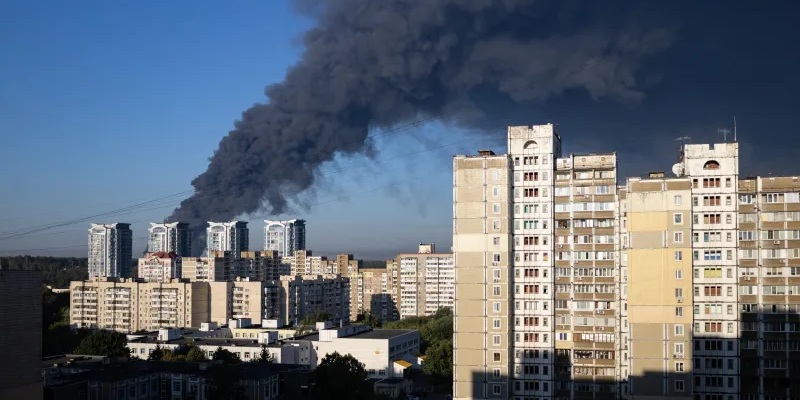

TD KYIV, Ukraine — At least 37 people have been killed and dozens wounded after a Russian drone strike hit an ammunition storage facility in Ukraine’s Bucha district near Kyiv, triggering a massive fire followed by hours of powerful explosions.
The incident occurred amid more than two days of intense Russian aerial attacks across Ukraine.
Ukrainian officials said the warehouse contained shells, mines, other ammunition and drones, whose detonation dramatically amplified the consequences of the initial strike.
Kyiv region military administration chief Tymur Tkachenko said 37 deaths had been confirmed by Saturday afternoon, warning that the toll could rise.
“This is a terrible and irreparable loss,” Tkachenko said, extending condolences to the families of those killed.
Zelensky condemns ammunition storage
President Volodymyr Zelensky blamed what he described as serious negligence for the scale of the disaster.

According to Zelensky, the Russian strike hit an ammunition storage facility that “should not have been there”, because of its proximity to residential communities.
He said the explosions involved ammunition, mines, shells and drones stored at the site.
“It is a horrific situation, and there has been appalling negligence by those who stored explosive materials right next to where people were living,” Zelensky said.
He added that a criminal investigation had been launched into the circumstances surrounding the storage of the explosives.
Ukraine’s Prosecutor General separately confirmed that explosive objects and materials had been stored at the facility.
He said investigators would examine the actions of officials responsible for the premises.

Residential buildings destroyed in Ukraine
The explosions caused extensive destruction in the surrounding area.
Images and videos reportedly showed buildings reduced to fragments, with some structures left as little more than scorched walls and debris.
Zelensky said dozens of buildings were damaged, including a care facility serving elderly people and individuals with disabilities.
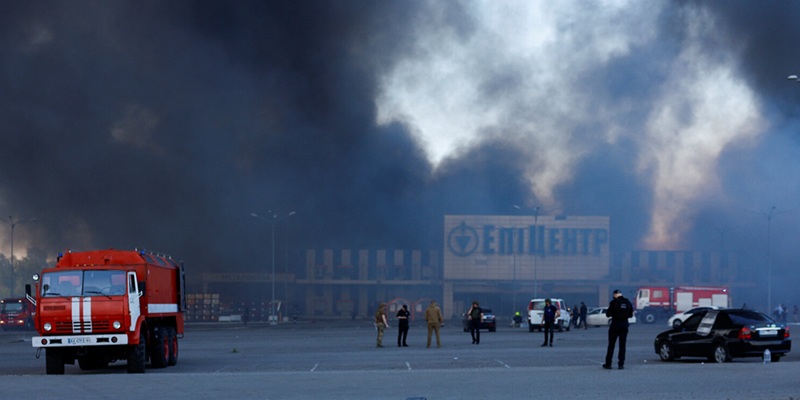
More than 300 emergency personnel were deployed to the scene as rescue and recovery operations continued.
Among those killed was Taras Didych, the longtime head of the local municipality, who reportedly arrived at the site to assist residents.
Ukraine’s Minister for Recovery, Infrastructure and Transport, Mykola Kalashnyk, described Didych as a community leader who had remained with residents even during the Russian occupation.

Another ammunition warehouse hit weeks earlier
The disaster has heightened concerns about the storage of military explosives near populated areas.
Just weeks earlier, seven people were killed after another Russian strike hit a warehouse containing large quantities of ammunition in the residential area of Vyshneve, approximately 20 kilometres from Saturday’s incident.
The latest explosion is therefore likely to intensify scrutiny of Ukraine’s military logistics and the location of ammunition facilities during wartime.
Kyiv faces relentless aerial attacks
The deadly warehouse explosion came as Kyiv and other Ukrainian regions faced a sustained barrage of Russian drones and missiles.
According to the account cited in the report, Kyiv experienced 28 air-raid alerts between midnight Thursday and midday Saturday, lasting more than 28 hours in total.
Kyiv Mayor Vitali Klitschko also announced that a two-year-old girl seriously wounded during one of Saturday’s attacks had died from her injuries.
Five other people were reported injured in the city.
Russian attacks were also reported across Odesa, Dnipro, Zaporizhzhia, Sumy, Kherson, Kharkiv, Mykolaiv, Donetsk and Chernihiv regions.
Zelensky said more than 260 attack drones, including Banderol drones, were involved in the latest wave of attacks.
Ukraine struggles against faster drones
Ukrainian officials say Russia has increasingly deployed jet-powered unmanned aerial vehicles (UAVs), creating new challenges for the country’s air-defence systems.
The drones can reportedly reach speeds of up to 500 kilometres per hour (310 mph), making them considerably more difficult to intercept.
Pavlo Palisa, deputy head of Zelensky’s Presidential Office, said Russia had significantly increased its use of the technology.
He noted that Russia was likely to deploy even more of the drones because of their effectiveness.
Ukraine’s existing mobile fire groups reportedly struggle to intercept the faster aircraft, leaving surface-to-air missiles and fighter jets as the principal options—both of which are in limited supply.
Palisa acknowledged that Ukraine was working on new defensive solutions but warned that developing effective countermeasures would take time.
The latest attack underscores the mounting pressure on Ukraine as Russian aerial strikes continue to combine large numbers of drones with increasingly sophisticated and faster weapons.
Meanwhile, the country faces the additional challenge of protecting civilians from the consequences of military infrastructure located near populated areas.