


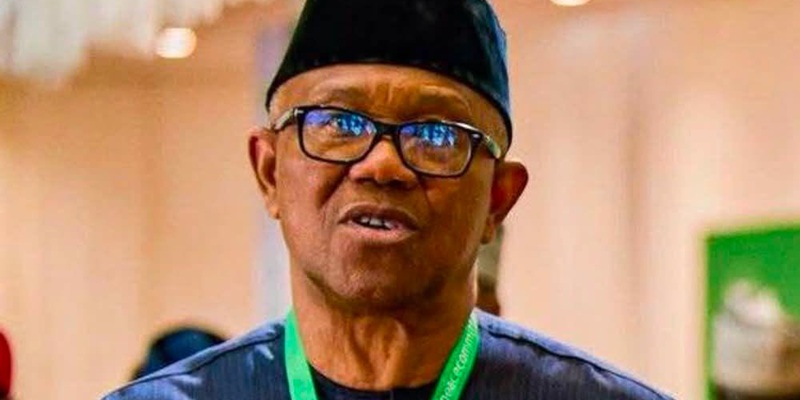

TD PORT HARCOURT, RIVERS STATE — Former Anambra State governor and Nigeria Democratic Congress (NDC) presidential candidate, Mr. Peter Obi, has blamed Nigeria’s persistent poverty and hunger on the country’s failure to build a productive economy.
Mr. Obi argued that the nation must urgently move from a consumption-driven model to one based on production, entrepreneurship and investment.
Obi made the remarks during the ongoing 66th Annual General Conference of the Nigerian Bar Association (NBA) in Port Harcourt, Rivers State.
Obi had participated in an interaction with political leaders and presidential contenders at the event.
‘Nigeria Is Not a Productive Country’
Obi said Nigeria’s economic crisis could not be solved merely through welfare interventions, insisting that the fundamental problem was the country’s inadequate productive capacity.
According to him, Nigeria has become increasingly vulnerable to food insecurity because it has failed to sufficiently invest in agriculture and other productive sectors.

He cited Nigeria’s dependence on external assistance during periods of food shortages, noting that even Ukraine, despite being involved in war, had supplied grain to Nigeria to help address hunger.
Obi argued that Nigeria possesses sufficient land and human resources to become a major agricultural power but lacks the political commitment and investment required to exploit them.
Agriculture Can Pull Millions Out of Poverty
The former governor said agriculture should be treated as a major economic investment rather than merely a subsistence activity.
He compared Nigeria’s agricultural output with that of countries such as Bangladesh, the Netherlands, Ethiopia and Israel.
He argued that countries with significantly smaller land areas have developed globally competitive agricultural sectors.
Obi particularly highlighted Bangladesh’s rice production and said Nigeria’s vast land resources should enable it to produce significantly more food.

He also pointed to the agricultural potential of states such as Niger and Borno.
He argued that the land available in those states alone demonstrates Nigeria’s capacity to become self-sufficient in food production.
‘Move Nigeria from Consumption to Production’
Obi said the central economic objective should be to transform Nigeria from a country that primarily consumes imported goods into one that produces goods and services for domestic consumption and export.
“We need to move the country from consumption to production,” he said.
According to him, excessive dependence on consumption without corresponding production creates poverty, unemployment and economic vulnerability.
He also warned that corruption has consequences beyond the money stolen from government coffers.

Corruption Kills Entrepreneurship and Hard Work
Obi argued that corruption undermines the foundations of a productive economy by rewarding individuals who accumulate wealth without creating corresponding economic value.
He said widespread corruption “kills entrepreneurship,” “kills professionalism” and “kills hard work”.
This, he said, is because people begin to see political connections and access to public resources as more profitable than legitimate economic activity.
The former governor maintained that a functional economy must reward productivity, innovation, professional competence and legitimate enterprise.
‘Nobody Is Stronger Than Government’
Obi addressed questions surrounding insecurity, ethnic divisions and the influence of non-state actors.
He rejected the suggestion that individuals or groups were inherently stronger than the Nigerian government.
He argued that the continuing activities of criminal and violent groups reflect failures of governance rather than the superior strength of those groups.
According to him, “Nobody is stronger than government”, stressing that government institutions have the authority and responsibility to enforce the law.
Politicians Are Dividing Nigerians
Obi also rejected the argument that Nigeria’s major divisions are fundamentally ethnic or religious.
He said politicians frequently exploit ethnic and religious identities for political purposes.
He argued that ordinary Nigerians have more in common than the country’s political class often acknowledges.
“We don’t have ethnic or religious problems. It is politicians that are dividing us,” he said.
He called for Nigerians to reject political manipulation based on ethnicity and religion and instead focus on shared national interests.
Raises Questions Over Qualification for Public Office
The former governor also turned attention to constitutional governance and electoral laws.
He questioning how political disputes surrounding candidates’ qualifications are handled.
He insisted that the qualification requirements for the presidency are contained in the Constitution and expressed concern about what he described as weaknesses in the electoral justice system.
Obi maintained that the process through which leaders emerge is as important as what those leaders subsequently do in office.
His comments generated considerable attention among delegates, particularly his warning against weakening legal and electoral safeguards.
‘The Process Matters’
Obi concluded by stressing that Nigeria’s transformation requires more than changing individuals in government.
He called for stronger institutions, respect for the rule of law, investment in productive sectors and an electoral system capable of ensuring that competent leaders emerge.
For Obi, the path out of Nigeria’s poverty crisis ultimately lies in production, investment, accountability and institutional reform rather than continued dependence on borrowing and consumption.
His address at the NBA conference has since generated debate online, particularly over his economic comparisons, agricultural proposals and criticisms of Nigeria’s political and electoral system.