


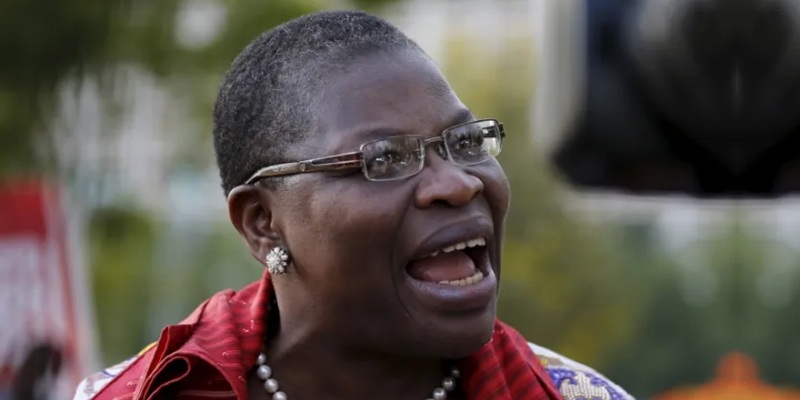

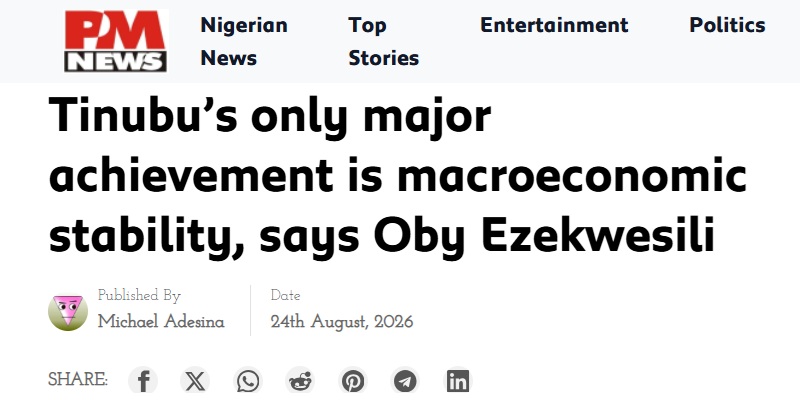
TD Former Minister of Education, Dr. Oby Ezekwesili, has launched a scathing attack on P.M. News after the newspaper published a report portraying her as praising President Bola Ahmed Tinubu’s administration for its economic performance.
Ezekwesili described the report as a “barefaced lie” and accused the publication of manufacturing her words in an apparent attempt to obtain political approval from her.
In a strongly worded post directed at P.M. News, Ezekwesili wrote:
“If you have any iota of credibility left, delete this falsehood.”
She further questioned the newspaper’s journalistic standards, asking:
“What kind of rag-sheet journalism is this?”
Ezekwesili said she was particularly angered by the headline, “Tinubu’s only major achievement is macroeconomic stability, says Oby Ezekwesili”.
She said it misrepresented the substance of her interview with News Central TV.

She urged the publication to watch the original interview rather than attribute statements to her that, according to her, distorted her position.
What Ezekwesili Actually Said
In the interview referenced by Ezekwesili, she did acknowledge what she considered a limited improvement under the Tinubu administration: greater stability in the foreign-exchange market.
She said the government was “getting a handle on macroeconomic stability,” particularly because of its movement toward market-based foreign-exchange policies.
But Ezekwesili immediately placed that observation within a much broader criticism of the administration’s economic record.
She argued that improved macroeconomic indicators had not translated into meaningful relief for ordinary Nigerians, particularly because the cost of living remains high.
On inflation, she said the spike in prices was not inevitable.

She described it instead as the consequence of poor management and the interaction of several policy decisions.
“The inflation that spiked did not have to happen,” she said.
She added that poor policy management contributed to the “runaway” inflation Nigeria experienced.
‘Nigeria Is Not Out of the Woods’
Ezekwesili also challenged the idea that Nigeria’s economic problems could be considered resolved because certain macroeconomic indicators have improved.
She identified low productivity, weak institutions, insecurity, poverty, inadequate job creation and poor fiscal management as major structural problems.
According to her, productivity is fundamental to Nigeria’s competitiveness.

“Without productivity, you can’t even be competitive globally,” she said.
She also criticised what she described as the government’s operation of multiple budget cycles simultaneously, calling the situation “recklessness in terms of fiscal choices and decisions.”
Ezekwesili further faulted the administration for failing to provide Nigerians with sufficient performance records through which its achievements could be independently assessed.
Institutions and Insecurity
The former minister’s criticism extended beyond economic policy.
She argued that Nigeria’s difficulties are also rooted in weak institutions and insecurity, including questions surrounding territorial control, public-service delivery, social cohesion and equitable access to opportunities.
For Ezekwesili, strong institutions are indispensable to sustainable economic development because they establish predictable rules under which citizens, businesses and governments operate.
She therefore rejected any assessment of Nigeria’s progress based solely on selected macroeconomic indicators.
‘The Real Test Is the Nigerian Household’
Ezekwesili’s response has now turned the controversy into a wider debate about the responsibility of the media to accurately represent political and economic commentary.
Her central argument was that macroeconomic stability is not synonymous with economic prosperity.
While she acknowledged some movement toward greater foreign-exchange stability, she maintained that Nigerians must ultimately judge economic reforms by whether they produce better living standards, stronger incomes, greater productivity, more jobs and expanded opportunities.
The dispute also highlights the difference between acknowledging a specific policy development and endorsing an administration’s overall performance.
Ezekwesili has made clear that, in her view, the two are not the same.
Her demand that P.M. News delete the report places pressure on the publication to either defend its characterization of her interview or correct what she has publicly described as a deliberate distortion of her position.