TD Abuja, Nigeria – President Bola Ahmed Tinubu’s submission of personal particulars and academic credentials to the Independent National Electoral Commission (INEC) for the 2027 presidential election has sparked renewed controversy.
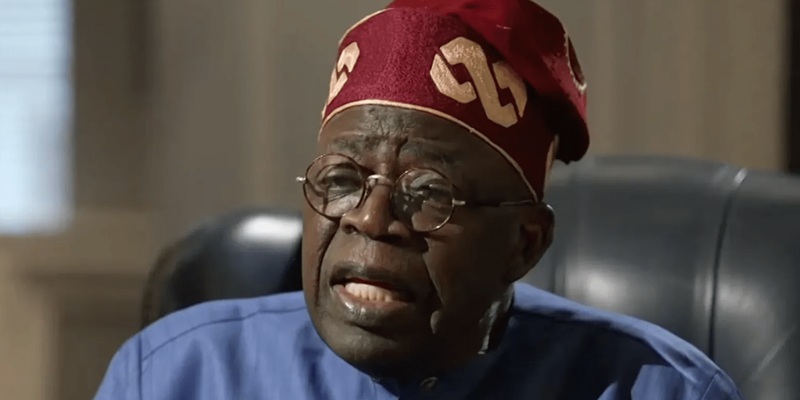
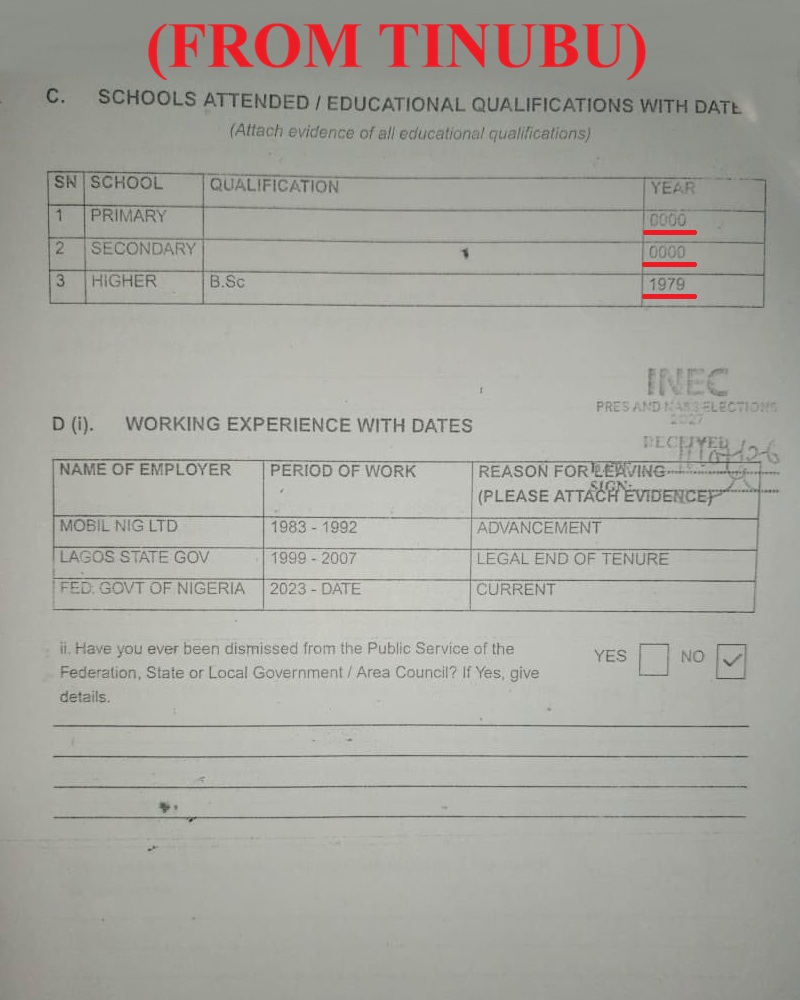
Questions have arisen over the omission of primary and secondary school qualifications in his EC9 Nomination Form.
The documents were published by INEC on Saturday in line with its revised timetable and schedule of activities for the 2027 General Election.
They form part of the nomination papers filed by candidates seeking to contest the January 16, 2027, presidential poll.
Alongside Tinubu’s papers, the commission also released documents belonging to vice-presidential candidates of various political parties.
A review of Tinubu’s EC9 Form shows that under the section for educational qualifications, the President listed only a Bachelor of Science (B.Sc.) in Business Administration obtained from Chicago State University, United States, in 1979.
The spaces provided for primary and secondary school qualifications were left blank.

Despite this omission, Tinubu attached copies of his Chicago State University degree certificate and his National Youth Service Corps (NYSC) certificate as supporting documents.
He also declared his date of birth as March 29, 1952, in Lagos, and listed his occupation as “Politician.”
INEC Form Requirements
The INEC EC9 Nomination Form explicitly states that candidates must “attach evidence of ALL educational qualifications”.
This stipulation has fueled debate among legal experts, opposition figures, and civil society groups.
These argue that leaving the primary and secondary school sections blank raises questions about compliance with electoral requirements.

Critics contend that the omission could reignite longstanding controversies surrounding Tinubu’s educational background.
These backgrounds have been the subject of litigation, media investigations, and political debate for decades.
Supporters, however, argue that the President has fulfilled the constitutional requirement of presenting at least a school certificate or its equivalent.
They point to his university degree and NYSC certificate as sufficient evidence.
Public Reaction
The publication of Tinubu’s documents has already triggered heated discussions across social media platforms and political forums.

Some commentators insist that the President must provide full documentation of his early education to dispel doubts, while others dismiss the uproar as politically motivated.
Observers note that this development adds to the series of identity and credential-related controversies that have trailed Tinubu’s political career.
Such controversies include disputes over his academic records and questions about document authenticity.
Legal and Political Implications
Legal analysts suggest that if challenged, the matter could end up in court.
Legally, interpretations of INEC’s requirement for “ALL educational qualifications” would be tested against constitutional provisions.
The controversy also risks becoming a campaign issue as Nigeria heads toward the 2027 elections.
Opposition parties may likely seize on the matter to question Tinubu’s transparency and credibility.
Bottom Line
It is granted that Tinubu has provided evidence of his university degree and NYSC certificate.
However, the absence of primary and secondary school qualifications in his INEC form has opened a fresh chapter in the ongoing debate over his educational history.
Whether this omission constitutes a legal breach or simply a procedural gap remains to be seen.
In the meantime, the controversy underscores the heightened scrutiny facing the President as he seeks reelection in 2027.