TD For centuries, the narrative of pre-colonial Africa was often framed as a void of technological advancement, a continent waiting to be “discovered” or “civilized” by outsiders.
However, the archaeological discoveries in Igboland, present-day southeastern Nigeria, paint a radically different picture—one of deep indigenous innovation, sophisticated metallurgy, and complex social organization.
The history of this region, stretching from the prehistoric iron smelting at Lejja to the intricate bronzes of Igbo-Ukwu, and through the demographic catastrophe of the Atlantic slave trade, reveals a civilization of tremendous resilience that did not vanish but was profoundly transformed by immense external pressures.
The story of technological achievement in Igboland begins in the deep past, far earlier than the famous bronzes.
Prehistoric evidence of iron smelting in the Nsukka area, particularly at sites like Lejja and Opi, pushes the timeline of West African metallurgy back to an astonishing era.
Radiocarbon dates from Lejja have been calibrated to around 2000 BC, with Opi dating to approximately 750 BC.
This establishes the region as one of the earliest independent centers of iron smelting in West Africa, if not the world.

The scale of this industry is staggering; at Lejja’s village square alone, over 800 massive slag blocks, each weighing between 34 and 57 kilograms, remain in situ as silent testaments to a bustling industrial past.
The presence of shaft and pit furnaces indicates a technological evolution, and critically, the lack of any foreign precursors and the local abundance of iron ore strongly suggest that this technology was an autochthonous invention—a homegrown advancement that arose from local ingenuity rather than diffusion from North Africa.
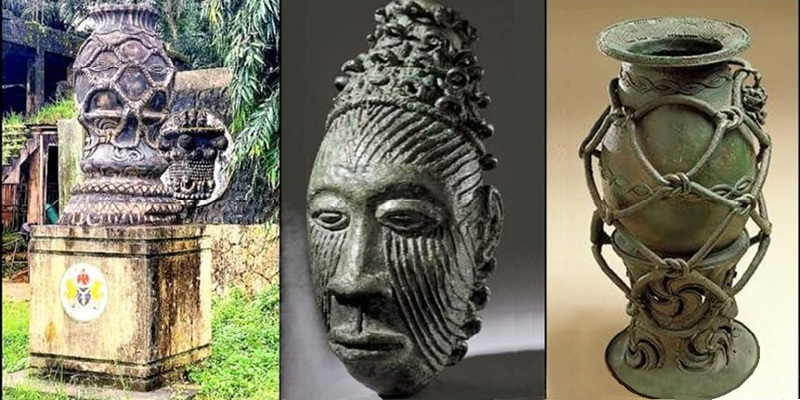
This long tradition of metallurgical expertise culminated centuries later in the extraordinary bronze and copper artifacts of Igbo-Ukwu, which date to the 9th century CE.
Accidentally discovered in 1938 by farmer Isaiah Anozie, and later professionally excavated by Thurstan Shaw, these objects represent the oldest known bronzes in West Africa.
Thousands of intricate artifacts, including elaborate ritual vessels, ornate staffs, and thousands of glass beads, point to a wealthy, highly stratified ceremonial center with sophisticated trade networks.

This was not a primitive society but one capable of technically demanding lost-wax casting, artistic expression, and long-distance commerce.
Together, the iron smelting sites and the Igbo-Ukwu bronzes prove that the region was a hub of human activity and innovation for millennia.
Given this deep history of large-scale industry and complex society, a significant historical puzzle emerges: why was the area of apparently low population around 300 years ago, in the 18th century?
The answer lies not in the collapse of the civilization but in its catastrophic demographic depletion due to the Atlantic slave trade.
By the 18th century, the Igbo heartland had become one of the primary sources of human cargo from the Bight of Biafra.

Conservative estimates suggest that hundreds of thousands, and possibly up to 5.6 million people, were forcibly exported from this region.
This scale of forced migration represented a demographic hemorrhage that hollowed out communities, creating a direct and devastating population decline.
The “low population” 300 years ago is a direct statistical reflection of this violent extraction of human life.
However, demography does not tell the whole story.
The nature of Igbo political organization profoundly influenced how the region responded to, and was affected by, these shocks.
Unlike the powerful, centralized kingdoms of the savanna, such as Oyo or Benin, the Igbo operated under a decentralized, village-based system governed by councils of elders, age grades, and titleholders like the Ọzọ.
This “kingless” system, while democratic and resilient in normal times, made it exceedingly difficult to mount a unified military defense against the slave raiders or to negotiate as a single political bloc with European powers.
This political fragmentation made the region more vulnerable to the external shock, as there was no central authority capable of stemming the tide of exploitation.
Furthermore, the ancient technological and cultural landscape itself underwent a profound shift.
The ancient iron-smelting industry that had thrived for over 3,000 years eventually became extinct in places like Lejja.
While the massive slag blocks are preserved by local taboo, the active knowledge of smelting is no longer practiced by any community members.
This loss of specialized technical knowledge represents a significant cultural and economic transformation.
Similarly, the arrival of colonialism and Christian missions in the 19th century led to the abandonment of many traditional religious and social institutions, including the sacred elements of the Ọzọ title system.
These practices were later reconstructed, often stripped of their spiritual components, as a way to survive and adapt to the new colonial reality.
In conclusion, the civilization of Igboland did not “disappear.” Instead, it underwent a dramatic transformation driven by immense external pressures.
The ancient forges fell silent, the population was ravaged by the slave trade, and traditional institutions were reshaped by colonialism.
Yet, the people endured.
The 800+ slag blocks remain in the village squares as physical anchors to a glorious industrial past, and the resilient, democratic social structures that allowed the community to survive the chaos of the slave trade persist to this day.
The story of Igboland is not one of extinction, but of survival, adaptation, and the enduring continuity of a people whose deep history stands as a testament to African technological ingenuity and resilience.