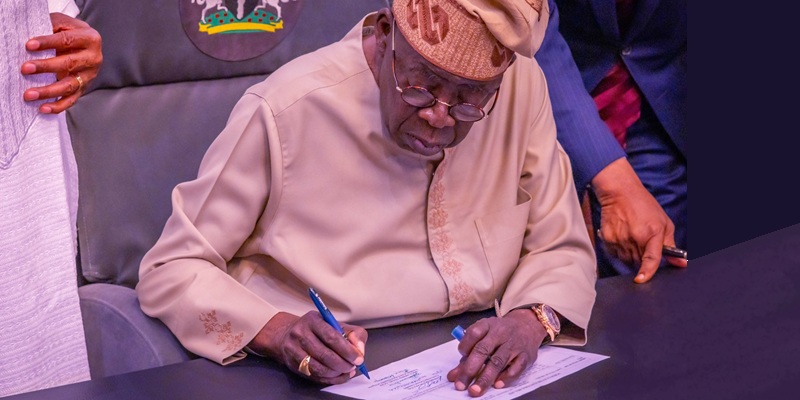
TDPresident Bola Tinubu has formally requested the approval of the Senate for a fresh external loan of $516,333,070 to support infrastructure development, specifically the proposed Sokoto–Badagry Super Highway project.

The request was conveyed in a letter addressed to the President of the Senate, Godswill Akpabio, and read during plenary on Thursday.
According to the correspondence, the loan is to be sourced from Deutsche Bank and forms part of the federal government’s already approved borrowing framework.
Loan Purpose and Legislative Action
In the letter, President Tinubu emphasized the strategic importance of the Sokoto–Badagry Super Highway, a 1,000-kilometre road project designed to enhance connectivity across Nigeria from the North-West to the South-West.
The administration argues that the project will significantly boost trade, regional integration, and economic productivity.
The President urged lawmakers to grant expeditious approval, citing the urgency of mobilizing funds to sustain project timelines.
Following the reading of the letter, Senate President Akpabio referred the request to the Senate Committee on Local and Foreign Debts for detailed legislative scrutiny.
The committee has been mandated to report back within one week.
Growing Debt Concerns
The latest loan request comes amid ongoing public debate about Nigeria’s rising debt profile and the sustainability of its borrowing strategy.
Economic analysts have repeatedly called for transparency in loan utilization and stronger revenue-generation mechanisms to offset debt obligations.
The Tinubu administration maintains that its borrowing is targeted at capital-intensive infrastructure with long-term economic benefits.
However, critics warn that continued reliance on external financing could strain fiscal stability.
Timeline of Recent Borrowings by the Tinubu Administration
Below is a structured timeline highlighting key borrowing moves since the administration assumed office in May 2023:
May 2023 – Inheritance of Existing Debt Portfolio
- Upon assuming office, President Tinubu inherited a debt stock exceeding $100 billion from previous administrations.
- The government signaled intent to restructure and optimize borrowing rather than halt it entirely.
November 2023 – $7.86 Billion and €100 Million Borrowing Plan
- The Federal Government sought National Assembly approval for a comprehensive external borrowing plan.
- The package included multilateral and bilateral loans aimed at infrastructure, health, and education sectors.
December 2023 – Senate Approval of Borrowing Plan
- The National Assembly approved the administration’s external borrowing framework.
- Funds were earmarked for projects under transportation, power, and social development programs.
February 2024 – Eurobond Market Re-entry Plans
- The government announced intentions to return to the international capital market to raise funds via Eurobonds.
- This move aimed at improving liquidity and financing budget deficits.
Mid-2024 – Multilateral Loan Engagements
- Nigeria intensified engagements with institutions such as the World Bank and the International Monetary Fund for concessional financing.
- Focus areas included social safety nets and economic reforms.
Late 2024 – Domestic Borrowing Expansion
- Increased reliance on treasury bills and bonds in the domestic market to fund budgetary shortfalls.
- This contributed to rising interest obligations within the national budget.
Early 2025 – Infrastructure-Focused Borrowing
- The administration prioritized loans tied to specific infrastructure projects, including roads, rail, and energy.
- Public-private partnership models were also explored to reduce direct sovereign borrowing.
April 2026 – $516 Million Loan Request for Sokoto–Badagry Highway
- Latest request submitted to the Senate for approval.
- Loan to be sourced from Deutsche Bank.
- Specifically targeted at financing the Sokoto–Badagry Super Highway project.
Outlook
As Nigeria continues to pursue ambitious infrastructure expansion under President Tinubu, the balance between development financing and debt sustainability remains a central policy challenge.
The Senate’s decision on the latest loan request will likely shape both investor confidence and public perception of the administration’s economic direction.