



TDNigeria’s fragile democracy is once again on trial—not at the ballot box, but in the courtroom.
The deepening leadership crisis within the African Democratic Congress (ADC), now hurtling toward a decisive hearing at the Supreme Court on April 22, is no longer just an internal party dispute.
It has evolved into a troubling case study of how political power, institutional interference, and a compromised judicial process can converge to stifle opposition and distort democratic competition.
At the center of this unfolding drama is a party that, until recently, showed signs of becoming a formidable coalition platform capable of challenging the dominance of the ruling All Progressives Congress (APC).
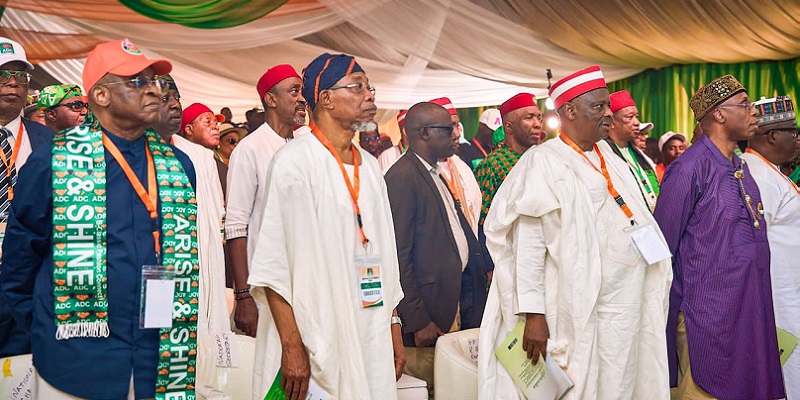
The influx of high-profile political heavyweights—most notably Peter Obi, David Mark, Atiku Abubakar, and Rabiu Musa Kwankwaso—signaled the emergence of a credible opposition force ahead of the 2027 general elections.

Yet, almost as quickly as that promise materialized, it has been ensnared in a web of legal and institutional hurdles that raise serious questions about the health of Nigeria’s democratic ecosystem.

The most immediate concern lies in the actions—and inactions—of the Independent National Electoral Commission (INEC).
By derecognising key figures such as Mark and Aregbesola while citing a “status quo ante bellum” order, INEC has effectively rendered the ADC leaderless at the national level.
This bureaucratic paralysis is not neutral in effect, regardless of how it is framed.
In practical terms, it incapacitates the party, preventing it from organizing conventions, mobilizing supporters, or even presenting a coherent leadership structure to the electorate.
This is where the judiciary’s role becomes deeply contentious.
The conflicting and overlapping orders emanating from different courts—ranging from the Court of Appeal’s ambiguous directive to the Federal High Court’s insistence on maintaining state-level structures—have created a legal quagmire.

Rather than resolving the crisis, the courts have inadvertently (or perhaps predictably) entrenched it.
Take the Federal High Court’s recent ruling preserving the state executive committees. While ostensibly a stabilizing measure, it effectively freezes the party’s internal evolution.
No meaningful restructuring can occur, no reconciliation process can be enforced, and no unified leadership can emerge while such orders remain in place.
The judiciary, in this instance, is not merely interpreting the law—it is shaping the political destiny of a party.
More troubling, however, is the growing perception that the judicial process itself is susceptible to political influence.
In a polity where the ruling APC wields enormous institutional power, it is difficult to ignore the possibility that these legal obstacles serve a broader strategic purpose: to weaken, fragment, and ultimately neutralize a rising opposition coalition before it can pose a real electoral threat.

This perception is reinforced by the timing and sequence of events.
The rapid escalation of litigation, the speed with which conflicting orders have been issued, and the apparent reluctance to grant decisive relief all point to a system that is, at best, inefficient—and at worst, compromised.
The accelerated hearing now granted by the Supreme Court, while welcome, does little to erase the damage already done.
For the ADC, the implications are existential. A political party cannot function in a vacuum of leadership.
It cannot inspire confidence among voters when its own internal legitimacy is under judicial siege.
And it certainly cannot mount a credible challenge in a national election while entangled in protracted legal uncertainty.
Yet, the stakes extend far beyond the ADC itself.
What is unfolding is a test of whether Nigeria’s democratic institutions can operate independently and fairly in a highly polarized political environment.
If opposition parties are systematically weakened through a combination of administrative bottlenecks and judicial interventions, then the very principle of multiparty democracy is at risk.
The Supreme Court now carries an enormous burden.
Its April 22 hearing must go beyond procedural technicalities to address the substantive issues at the heart of this crisis.
Clarity, finality, and fairness are urgently needed—not just to rescue the ADC, but to restore public confidence in the rule of law.
Nigeria cannot afford a judiciary that is perceived as an extension of political power, nor an electoral body whose neutrality results in functional paralysis.
Democracy thrives on competition, dissent, and the free organization of political alternatives. When those elements are undermined, the entire system begins to erode.
The ADC’s crisis, therefore, is not just about leadership—it is about the future of opposition politics in Nigeria.
And unless the current trajectory is corrected, it may well become a cautionary tale of how democracy can be weakened, not by force, but by the slow, deliberate constriction of its institutional lifelines.