



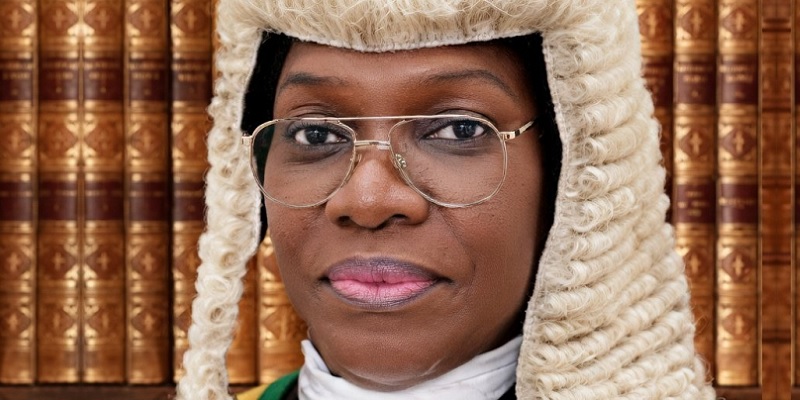

The African Democratic Congress (ADC) has once again found itself at the center of judicial drama, as two rulings delivered by the same judge—Justice Joyce Abdulmalik of the Federal High Court, Abuja—have exposed a glaring irony in the interpretation of party autonomy and judicial jurisdiction.
In October 2025, Abdulmalik dismissed a suit filed by Dumebi Kachikwu, the party’s former presidential candidate, against the David Mark-led caretaker leadership of the ADC.
The judge ruled that disputes over party leadership and membership were “internal matters of voluntary associations” and therefore non-justiciable.
The case, marked FHC/ABJ/CS/1331/2025, was thrown out on the grounds that the judiciary had no business interfering in the internal affairs of political parties.
Justice Abdulmalik — April 2026
Fast forward to April 2026, and the same court, presided over by the same judge, issued a contrasting judgment.

The judge directly restrained the Independent National Electoral Commission (INEC) from recognising any state congresses conducted by committees appointed by the David Mark-led caretaker leadership.
The suit, number FHC/ABJ/CS/581/2026, was filed by a coalition of state chairmen and executive committees.
Justice Abdulmalik emphatically declared that the responsibility for conducting state congresses lies squarely with the party’s state executive committees, not the national caretaker leadership.
The ruling went further, affirming that the four-year tenure of the ADC’s State Working Committees and State Executive Committees remains valid and subsisting until properly constituted congresses are held and a national convention convened.
In a scathing rebuke of the caretaker leadership, Abdulmalik stressed that neither the Nigerian Constitution nor the ADC constitution empowers David Mark’s interim committee to appoint bodies to oversee state congresses.

The Irony of Judicial Contradiction
The contradiction is as stark as it is unsettling.

In 2025, Abdulmalik washed her hands of ADC’s internal crisis, insisting that the courts could not meddle in party affairs.
Yet in 2026, she not only meddled but went as far as restraining INEC, a statutory body, from recognising congresses conducted under the authority of the same caretaker leadership she previously shielded from judicial scrutiny.
Observers are left scratching their heads: how can the same judge, within a span of months, declare party disputes non-justiciable in one case, only to assert judicial authority over party congresses in another?
The irony is not lost on political analysts, who see the rulings as emblematic of Nigeria’s inconsistent judicial interventions in party politics.
Winners and Losers
For Dumebi Kachikwu, the 2025 ruling was a devastating blow.
His attempt to challenge the legitimacy of David Mark and Rauf Aregbesola’s leadership was shut down, effectively consolidating their grip on the party.

The ADC leadership celebrated the dismissal as a “victory for party autonomy,” emboldening the caretaker committee to tighten its control.
But for Don Norman Obinna and the coalition of state chairmen who filed the 2026 suit, Abdulmalik’s ruling was a lifeline.
By affirming the validity of state executives and restraining INEC from recognising caretaker-appointed congresses, the judgment restored power to grassroots structures and clipped the wings of the national caretaker leadership.
The losers, ironically, are the same David Mark-led leadership that benefited from Abdulmalik’s earlier refusal to intervene.
What was once judicial protection has now morphed into judicial repudiation.
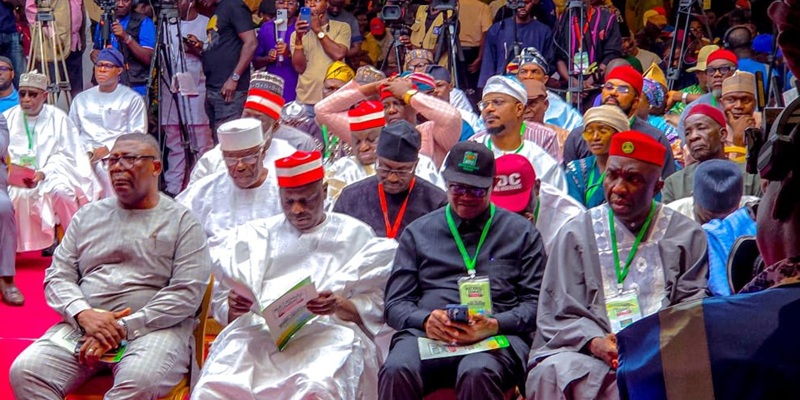
Implications for 2027
The timing of the 2026 ruling is politically explosive. With the 2027 general elections looming, the ADC’s internal power dynamics are being reshaped in real time.
State executives, emboldened by the court’s affirmation of their tenure, are likely to resist any attempts by the caretaker leadership to impose congresses or candidates.
INEC, now restrained by the court, must tread carefully in recognising ADC’s internal processes.
The ruling effectively forces the commission to acknowledge only congresses conducted by state executives, undermining the caretaker committee’s authority.
The broader implication is a troubling inconsistency in judicial reasoning.
If party disputes are truly internal and non-justiciable, as Abdulmalik declared in 2025, then the 2026 ruling amounts to judicial overreach.
A Judiciary in Contradiction
Conversely, if the judiciary does have a role in safeguarding constitutional and procedural integrity within parties, then the 2025 dismissal was a dereliction of duty.
Either way, the ADC saga has exposed the judiciary’s wavering stance on political party autonomy.
The irony is biting: the same judge who once told aggrieved members to resolve their disputes internally has now inserted the court squarely into the heart of those disputes, reshaping the party’s future in the process.
The ADC’s legal battles are far from over, but the juxtaposition of these two rulings has already left a deep mark on Nigeria’s political landscape.
For party members, the lesson is clear: today’s judicial shield may become tomorrow’s judicial sword.
For the judiciary, the challenge is to reconcile these contradictions and restore consistency to its role in party politics.
Until then, the ADC remains a case study in the irony of Nigerian justice—where the same gavel can both silence and empower, depending on which side of the political divide one stands.