




The reported withdrawal of admission offers to Nigerian students by some British universities has renewed concerns about the future of international education, migration opportunities (japa) and the growing influence of anti-immigration politics in Europe and the United States.
For thousands of Nigerian families who view foreign education as a pathway to better opportunities, the development raises difficult questions: Is the traditional route to studying, working and settling abroad becoming more difficult?
Are political shifts in Western countries changing attitudes towards migrants? And what happens if the opportunities Nigerians have relied on for decades become increasingly inaccessible?
The debate extends beyond university admissions and visa applications.
It touches on economic hardship at home, the politics of national identity abroad, and the difficult choices facing Nigerians who hope to build their futures outside the country.

This report examines these developments, distinguishing reported policy changes from political commentary and exploring their implications for Nigeria.
1. UK Universities Tighten Admissions Amid Tougher Visa Rules
Under revised rules that took effect on June 1, 2026, UK universities and other student sponsors applying for a compliance assessment must maintain a visa refusal rate below 5%, an enrolment rate of at least 95%, and a course-completion rate of at least 85%.
Failure to meet the applicable requirements can expose institutions to sanctions, including the loss of their licence to recruit international students.
The rules have created additional pressure on universities to scrutinise the applicants they recruit from overseas.

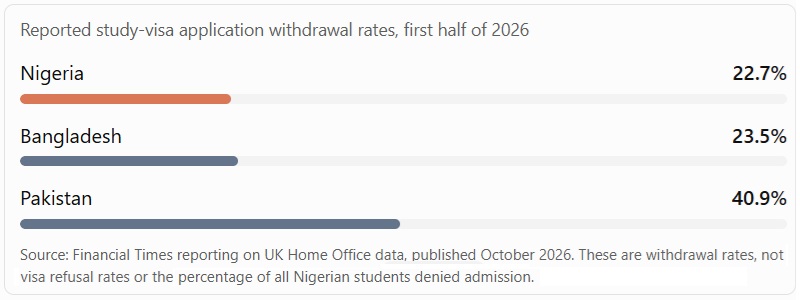
A report published by the Financial Times on October 10 said some British universities were withdrawing admission offers to international students, including applicants from Nigeria, Pakistan and Bangladesh, amid concerns about visa refusal rates and the risk of breaching the new requirements.
The reported figures are particularly concerning for Nigerian applicants. The distinction matters.

A withdrawn application is not necessarily a refusal, and these figures do not establish that every Nigerian applicant faces the same risk.
Nevertheless, they point to a more difficult environment for prospective students.
For families who have already paid application fees, deposits, examination costs and other expenses, a withdrawn offer can mean financial losses, disrupted academic plans and uncertainty about the next admission cycle.
The wider implications could also affect educational consultants, recruitment agents and Nigerian students who have made substantial financial commitments in anticipation of studying abroad.
Reported study-visa application withdrawal rates, first half of 2026
2. Why the UK Government Is Tightening the Rules
The British government says the reforms are intended to strengthen the integrity of the student-visa system and ensure that universities recruit and support international students responsibly.

In a statement published on June 4, 2026, the Home Office said asylum claims from people entering through work, study and visitor routes had increased substantially under the previous government.
It also reported a 30% decline in student asylum claims over the preceding year, which it attributed to government action.
The new rules are therefore part of a wider immigration-control strategy, rather than a measure directed exclusively at Nigeria.
However, the impact can vary considerably by nationality, university, course and individual circumstances.
Where universities fear that applications from a particular recruitment market could increase their refusal rate, they may respond by restricting recruitment or withdrawing offers before a student’s visa application is decided.
This creates a difficult situation: a student may have an academic offer but still face uncertainty because the university is concerned about its own regulatory compliance.
The central question for affected Nigerians is whether institutions are making individual assessments or imposing broad restrictions that may disadvantage otherwise qualified applicants.
3. Europe’s Rightward Shift and the Immigration Debate

The British visa debate is unfolding amid wider political changes across Europe, where immigration, border security, national identity and integration have become major electoral issues.
Germany provides a prominent example.
In the February 2025 federal election, the Alternative for Germany (AfD) won 20.8% of the second votes and 152 seats in the Bundestag, finishing second behind the Christian Democratic Union.
The result marked a major advance for a party known for its restrictive immigration positions.
More recently, the AfD won the largest share of votes in Saxony-Anhalt’s September 2026 state election, although it fell short of an absolute majority.
Its difficulty in forming a government illustrates that electoral gains do not automatically translate into executive power.
The party’s rise reflects a wider debate over immigration, economic insecurity, national sovereignty and public confidence in established political parties.
Its opponents have also raised concerns about extremism and discrimination.
For migrants, the significance is that immigration policy can become more restrictive when parties campaigning on border control gain influence—even where those parties do not form the national government.
Reform UK and Britain’s immigration debate
In the United Kingdom, Reform UK has made immigration control a central part of its political platform, challenging the established parties over border enforcement, asylum and the scale of migration.
The prospect of a government led by Reform UK is a concern raised by the author of the commentary supplied to This Dawn News.
The claim that such a government would make UK visas harder to obtain than US visas under President Donald Trump is, however, a prediction rather than an established fact.
Visa requirements depend on legislation, administrative rules, bilateral arrangements and the immigration category involved. Any future policy would need to be assessed on its actual terms.
Britain’s current student-sponsor restrictions also demonstrate that tighter immigration controls are not exclusive to right-wing parties. The Labour government introduced the 2026 compliance changes itself.
4. National Identity, Ancestry and the Question of Belonging

In the United States, debates over immigration have become closely associated with the Make America Great Again (MAGA) movement and wider disagreements over border security, citizenship and national belonging.
The distinction between a constitutional understanding of national identity and one centred on ancestry is politically significant.
Under the former, citizenship and allegiance to constitutional principles are central; under the latter, some political voices place greater emphasis on inherited culture, historical origins or ancestry.
However, the description of a growing MAGA consensus around the term “Heritage American” should be treated cautiously.
It would be inaccurate to assume that all Trump supporters share the same understanding of citizenship or that naturalised American citizens are generally denied their legal status because of their ancestry.
Similar debates exist in Britain over the distinction between being English and being British.
Such distinctions can reflect cultural, national or constitutional identities, but they do not by themselves establish that all political movements on the right reject immigrants (japa) or naturalised citizens.
The concern raised by the author is that increasingly restrictive immigration politics could make migrants feel less welcome, even when they comply with the law, contribute economically and become citizens of their adopted countries.
For Nigerians living abroad, the practical issue is whether these political debates will translate into more restrictive visa rules, reduced opportunities for settlement or greater uncertainty about their long-term prospects.
5. Nigeria’s Economic Challenges and the Japa Question

Nigeria’s economic difficulties help explain why many citizens consider leaving.
Inflation, limited employment opportunities, concerns about public services and insecurity have contributed to the desire among some Nigerians to pursue opportunities overseas.
But migration is not determined by poverty alone.
Educational qualifications, access to funding, language skills, family connections, labour-market demand and the immigration rules of destination countries also influence who can migrate and under what conditions.
The UK developments nevertheless expose a vulnerability: when a large number of people seek opportunities abroad, changes in the immigration policies of popular destinations can disrupt the plans of students, families and employers.
The consequences may extend beyond individuals who lose admission offers.
Nigeria could also lose opportunities to develop international professional networks, attract investment from its diaspora and benefit from the knowledge and skills acquired by citizens overseas.
At the same time, emigration is not inherently a national loss.
Nigerians abroad can contribute through remittances, business investment, research partnerships and the transfer of expertise.
The challenge is to ensure that leaving the country remains a genuine choice rather than something people feel compelled to do because of conditions at home.
Could other destinations become Japa alternatives?
Some affected students may consider Canada, other European countries or destinations in Asia.
However, these options should not be treated as guaranteed japa alternatives.
Each country has its own admissions standards, tuition fees, visa requirements, post-study work arrangements and settlement policies.
Immigration rules can change, and a university admission offer does not automatically guarantee a visa or a right to remain after graduation.
Prospective students should therefore assess each destination independently and verify the latest rules through official government websites.
They must avoid making additional financial commitments based solely on social media reports or recruitment agents’ assurances.
6. What the Developments Mean for Japa in Nigeria
The emerging picture raises three major policy questions for Nigerians planning for japa.
First, how can the country protect its citizens’ educational opportunities?
Nigeria’s diplomatic and educational institutions can engage British authorities and universities to clarify the reasons behind rising visa withdrawals, identify procedural problems and ensure that qualified applicants receive fair and consistent assessments.
Second, how can Nigeria reduce the pressure to emigrate?
Improving the domestic economy requires sustained attention to job creation, electricity, security, education, healthcare, industrial development and the reliability of public institutions.
A country that offers credible opportunities at home gives its citizens greater freedom to decide whether to remain, study abroad temporarily or migrate permanently.
Third, how can public accountability improve governance?
The author’s commentary argues that the deterioration of conditions at home makes the quality of political leadership particularly important.
That argument points to the need for transparent public spending, credible economic policies, effective institutions and measurable improvements in living standards.
These are long-term governance challenges.
They cannot be resolved by election campaigns alone, nor can any single party’s removal automatically guarantee better outcomes.
7. The 2027 Elections: The Author’s Political Argument
The commentary concludes with a direct appeal to Nigerians to obtain their Permanent Voter Cards (PVCs), participate in the 2027 general elections and vote the All Progressives Congress (APC) out of power.
The author argues that Nigeria cannot indefinitely rely on emigration as an escape from domestic difficulties and that citizens must take greater responsibility for the country’s political direction.
That is the author’s political position.
Whether voters support or reject it is a matter for their own assessment of the APC’s record, the opposition’s proposals and the credibility of the available candidates.
For voters, the practical questions include:
-
Which candidates have credible, costed plans for job creation and economic growth?
-
What specific measures would improve electricity, education, healthcare and public security?
-
How would candidates address corruption, public-sector accountability and the cost of living?
-
What evidence from their previous records supports their promises?
-
How would their proposed policies improve opportunities for young Nigerians, including those who want to build careers at home?
The PVC is an important instrument of electoral participation, but meaningful democratic accountability also requires informed choices, peaceful participation, credible elections and scrutiny of elected officials after they take office.
Conclusion: The Future of Japa May Depend on More Than Foreign Visa Rules
The reported withdrawal of Nigerian students’ admission offers by UK universities highlights the vulnerability of international education plans to changes in immigration (japa) regulation.
The rise of anti-immigration politics in parts of Europe and the United States adds another layer of uncertainty, although the policies and political circumstances differ from one country to another.
For Nigeria, the immediate priority is to understand the actual reasons for visa withdrawals, support affected students with accurate information and engage relevant institutions to clarify the new requirements.
The longer-term challenge is domestic.
Better governance, economic opportunity, security and reliable public services would give Nigerians stronger reasons to build their futures at home.
Meanwhile, they allowing those who choose to travel abroad to do so from a position of opportunity rather than desperation.
The message behind the supplied commentary is clear: Nigeria’s future cannot depend entirely on whether other countries keep their doors open.
The country’s institutions, economic policies and political choices will play a decisive role in determining how attractive life at home becomes for the next generation.