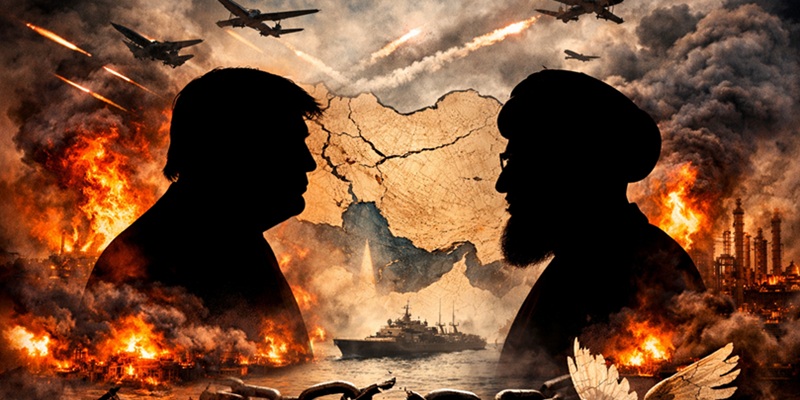
TDDUBAI, UAE — Tensions in the Middle East escalated dramatically on Sunday after Iran launched missile and drone attacks on several Gulf countries hosting United States military facilities.

The attacks happened hours after Washington carried out a third wave of airstrikes against Iranian military targets.
The latest exchange marks one of the most dangerous phases of the conflict between the United States and Iran, raising fears of a broader regional war and renewed disruption to global energy supplies.
Iran announced that it had closed the strategic Strait of Hormuz “until further notice”.
It accused the United States of violating a memorandum of understanding (MoU) signed between both countries last month.
Tehran said the closure would remain in place until what it described as “the end of US interference in the region.”
US Launches Third Round of Airstrikes
The escalation followed fresh US military operations targeting Iranian radar installations, missile launch sites, drone facilities and coastal military infrastructure across southern Iran.
According to the US Central Command (CENTCOM), approximately 140 military targets were struck during the latest operation.
The attacks bringing the total number of Iranian military sites attacked over three nights to more than 300.
Washington said the strikes were intended to weaken Iran’s ability to threaten international shipping in the Strait of Hormuz following recent attacks on commercial vessels.
Iranian state media reported explosions in several provinces, including Bushehr and Lorestan, with authorities saying assessments of casualties and damage were ongoing.
Iran Retaliates Across the Gulf
In response, Iran’s Islamic Revolutionary Guard Corps (IRGC) launched coordinated missile and drone attacks targeting US military installations across Bahrain, Kuwait, Qatar, Oman and Jordan.
Iran claimed it struck logistics facilities at the Port of Duqm in Oman, Al Udeid Air Base in Qatar, US military infrastructure in Kuwait and Bahrain, and Prince Hassan Air Base in Jordan.
Qatar confirmed that its air defence systems intercepted incoming missiles but said three people, including a child, were injured by falling debris.
Kuwait reported engaging hostile aerial targets, while Bahrain activated nationwide air raid sirens.
Strait of Hormuz Shut
Iran’s declaration that the Strait of Hormuz had been closed has heightened global concerns over energy security.
The narrow waterway carries roughly one-fifth of the world’s traded oil and significant volumes of liquefied natural gas, making it one of the world’s most important maritime chokepoints.
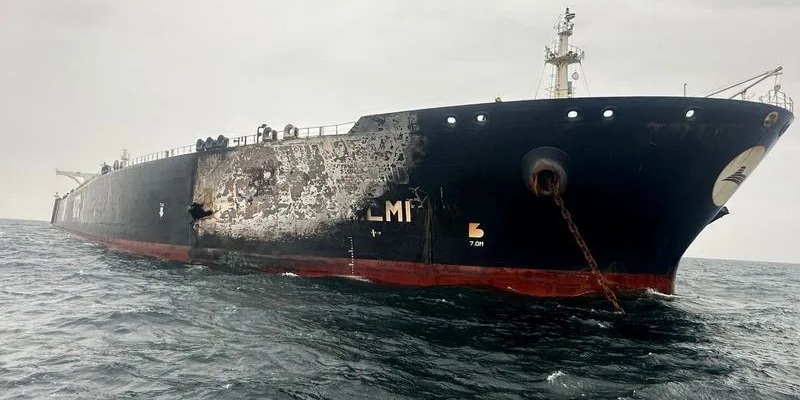
Iran said the closure followed incidents involving commercial vessels it accused of travelling through what it described as “unauthorised routes.”
However, US officials maintained that commercial shipping continued through the strait despite Tehran’s announcement, signifying conflicting claims over the status of maritime traffic.
Regional Condemnation
Gulf countries swiftly condemned Iran’s attacks.
Qatar described the strikes as a “flagrant violation” of its sovereignty and international law.
It warned that the continued escalation threatened regional security.
Oman also condemned the attacks despite hosting Iranian Foreign Minister Abbas Araghchi only hours earlier for talks on maritime security.
Authorities across several Gulf states raised security alert levels, urging residents to remain indoors as air defence systems responded to incoming missiles and drones.
Ceasefire Collapses
The latest violence effectively ends the fragile ceasefire that had been negotiated under last month’s memorandum of understanding between Washington and Tehran.
US President Donald Trump earlier declared that the ceasefire was over following repeated Iranian attacks on commercial shipping.
Meanwhile, Iranian leaders vowed retaliation after renewed American military operations.
Diplomatic efforts led by Oman continue, but Sunday’s military exchanges have significantly reduced hopes for a near-term de-escalation.
Global Impact
Analysts warn that continued fighting around the Strait of Hormuz could disrupt global oil and gas supplies, trigger higher energy prices and deepen economic uncertainty worldwide.
Both sides are continuing military operations, while regional governments are placed on high alert.
In the meantime, international observers fear the conflict could expand further unless urgent diplomatic efforts succeed in halting the violence.