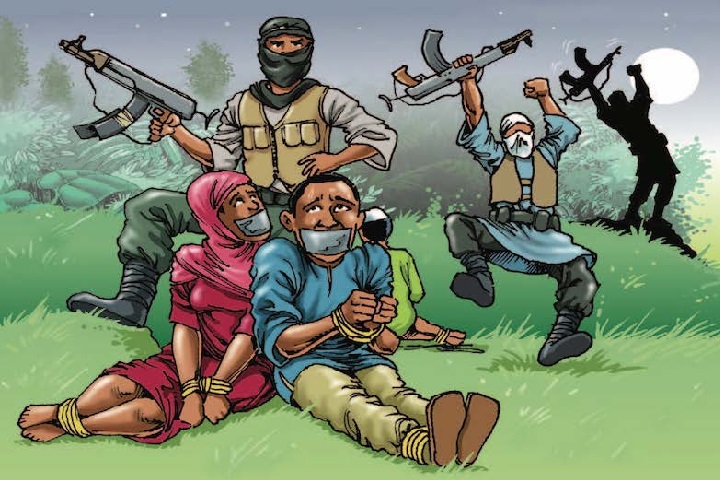
TD ENUGU, Nigeria — The International Society for Civil Liberties and Rule of Law (InterSociety) has raised the alarm over what it describes as a disturbing wave of mass abductions targeting predominantly Eastern Christian travellers along major highways linking the South-East and South-South with the South-West and North-Central regions of Nigeria.
According to field statistics released by the organisation, no fewer than 92 travellers were allegedly abducted in seven separate incidents on Sunday, August 9, and Thursday, August 13, 2026, across parts of Kogi, Benue and Ondo states.
InterSociety said approximately 30 victims had either escaped or been rescued, while 62 remained unaccounted for or were feared to still be in captivity as of the time of its report.
The organisation attributed the attacks to what it described as “Jihadist Fulani Herdsmen and allied Jihadist Fulani Bandits,” allegedly operating from forests and bushes close to major inter-state highways.
However, the specific identity and religious or ethnic affiliation of the attackers have not been independently established in every incident.
Police and other security agencies have generally referred to the perpetrators as armed kidnappers or gunmen.

Kogi Highway Attacks Trigger Fresh Security Concerns
One of the most serious incidents occurred on Sunday, August 9, along the Itobe–Achigili–Anyigba highway in Ofu Local Government Area of Kogi State.
Local reports said several passenger vehicles were attacked at separate locations within roughly two hours.
A Peace Mass Transit Hummer bus, reportedly bearing fleet number 2838, was intercepted at about 4 p.m. between Ojuwo Ajengo and Mamerebo.
The Kogi State Police Command subsequently confirmed that passengers had been abducted from the bus and launched a joint rescue operation.
The police said 15 victims were rescued following a gun battle with the abductors.
The operation involved security personnel and local vigilantes.

One local hunter was reportedly killed while a police officer sustained injuries.
Survivors later described a traumatic experience in captivity.
Among those rescued were Ngozi Stephen and Joshua Daniel, who said the kidnappers demanded large ransoms from victims’ families.
Daniel also said he suffered a serious cutlass injury while attempting to escape.
The survivors reported that the abductors spoke Igala, Fulani and Hausa among themselves, although that testimony alone does not establish the identity or organisational affiliation of the attackers.
Multiple Vehicles Reportedly Targeted
Separate accounts cited by InterSociety and local media said a Sharon bus and a Toyota Sienna were also attacked later the same day along the Kogi highway.

The vehicles were identified as a Sharon bus with registration Kogi ERE 138 AE and a Sienna with registration BB 362 MKA.
Local reports said the attackers erected barricades and forced passengers from the vehicles before taking them into surrounding bushland.
InterSociety’s compilation puts the number abducted in the different Kogi incidents at about 60, although the publicly confirmed police figure is narrower and relates principally to the Peace Mass Transit incident.
This distinction is significant because the organisation’s overall figure of 92 is a field estimate, rather than a figure independently confirmed by Nigerian security agencies.
Survivors Recount Ordeal
The experiences of those rescued from the Kogi incident have provided further evidence of the seriousness of the security crisis along the route.
Ngozi Stephen said the abductors allegedly demanded ransoms ranging from tens of millions of naira to as much as N100 million for some victims.
Joshua Daniel said he attempted to escape but was pursued and attacked with a cutlass, leaving him bleeding through the night before he managed to treat the wound with herbs.
The rescued victims reportedly included six adult men, six women and four children and were subjected to documentation, medical assessment and reunification procedures.
Ondo Incident Adds to Growing Concern
InterSociety also reported another major incident on Thursday, August 13, around Ore in Ondo State, a strategic transit point linking the South-East and South-South with Lagos and the wider South-West.
The organisation said an Eastern-origin 18-seater bus travelling towards Lagos and another Eastern-origin bus reportedly travelling from Enugu towards Abuja were attacked.
It put the number of people allegedly abducted in the Ondo incident at 32.
Independent confirmation of that precise figure was not immediately available from the security agencies.
Consequently, the 32-person figure should be treated as an allegation contained in InterSociety’s field report.
16 Travellers Rescued After Kogi Abduction
The Kogi operation also produced an important breakthrough the following day.
Reports published after the August 9 attacks said 15 victims were rescued by the police, while other accounts referred to 16 rescued victims in the wider operation.
The discrepancy appears to reflect differences in the number of victims counted at different stages of the rescue and documentation process.
The rescue followed a coordinated operation involving security agencies and local security personnel.
The abandoned buses and the testimonies of survivors subsequently provided investigators with information about the circumstances surrounding the attacks.
InterSociety: Eastern Travellers Increasingly Vulnerable
InterSociety argues that the incidents demonstrate the growing vulnerability of Eastern travellers using major highways outside the South-East.
The organisation describes the routes connecting the South-East with Lagos, Abuja and other parts of the country as increasingly dangerous, particularly where highways pass through heavily forested areas.
It identified seven broad categories of locations that it considers particularly vulnerable:
- Forests allegedly occupied or used as hideouts by armed groups;
- Bushes and undeveloped communal lands close to highways;
- Farm settlements and remote agricultural communities;
- Forest areas regarded by local communities as traditional or sacred lands;
- Forests and settlements around boundary areas between the South-East and neighbouring states;
- Areas around major security formations where criminal groups allegedly exploit difficult terrain and gaps in surveillance; and,
- Forest and bush corridors along routes linking the South-East with Edo, Ondo, Ogun, Kogi, Benue, Nasarawa, Taraba, Kaduna and Abuja, among others.
InterSociety said the concentration of attacks along such routes requires urgent attention from governments, security agencies, transport operators and community organisations.
Security Agencies Face Pressure to Secure Inter-State Highways
The latest incidents have renewed concerns about the vulnerability of Nigeria’s major inter-state highways to kidnapping.
The Kogi Police Command’s response demonstrates that security agencies can successfully mount rescue operations when intelligence, tactical units, military personnel, police and community-based security groups work together.
But the repeated use of forested corridors by kidnappers presents a more complicated challenge.
Security experts have repeatedly identified difficult terrain, limited surveillance coverage, inadequate rapid-response capacity and the enormous distances covered by major highways as factors that can enable kidnappers to operate with relative impunity.
Need for Independent Verification of Victim Numbers
While InterSociety’s claim of 92 abducted travellers and 62 still missing or feared dead represents a serious allegation requiring urgent investigation, the figures should not be interpreted as confirmed fatalities.
Being untraced after an abduction does not necessarily establish that a victim has been killed.
Some victims may remain in captivity, may have escaped without immediately contacting authorities or families, or may subsequently be rescued.
Similarly, allegations concerning the ethnic or religious identity of perpetrators require independent investigation rather than assumption.
What is beyond dispute, however, is that kidnapping attacks have occurred along the Kogi corridor, and security authorities have confirmed the rescue of abducted passengers.
Survivors’ accounts further demonstrate the brutality and financial demands associated with the criminal gangs operating in the area.
Calls for Urgent Action
InterSociety called on political leaders in the South-East, diaspora organisations, transport companies and security agencies to take urgent steps to protect travellers using the major highways connecting Eastern Nigeria to the rest of the country.
The organisation urged stronger intelligence gathering, sustained surveillance of known kidnapping corridors, and improved highway patrols.
It also called for rapid-response mechanisms capable of reaching attacked vehicles before abductors disappear into surrounding forests.
The latest incidents also highlight the need for transport operators to maintain accurate passenger manifests and establish emergency communication procedures for buses travelling through identified kidnapping hotspots.
For families whose relatives remain missing, the immediate priority is establishing the whereabouts and safety of each individual rather than assuming the worst.
The challenges ahead
The alleged mass abductions of August 9 and 13 have exposed once again the vulnerability of travellers on Nigeria’s major inter-regional highways.
InterSociety’s aggregate figure of 92 abducted persons and 62 still unaccounted for requires further investigation and verification.
The confirmed Kogi incidents, the rescue operations and survivors’ accounts demonstrate that the kidnapping threat along the Kogi corridor is real and potentially lethal.
The Federal Government, state governments and security agencies now face renewed pressure to prevent forests and isolated highway corridors from becoming safe havens for kidnappers.
The safety of Nigerians travelling between the South-East, South-South, South-West and North-Central regions cannot depend solely on luck or the ability of individual drivers and passengers to escape an ambush.
This Dawn News will continue to monitor developments and report verified updates on the whereabouts of the missing travellers and ongoing security operations.