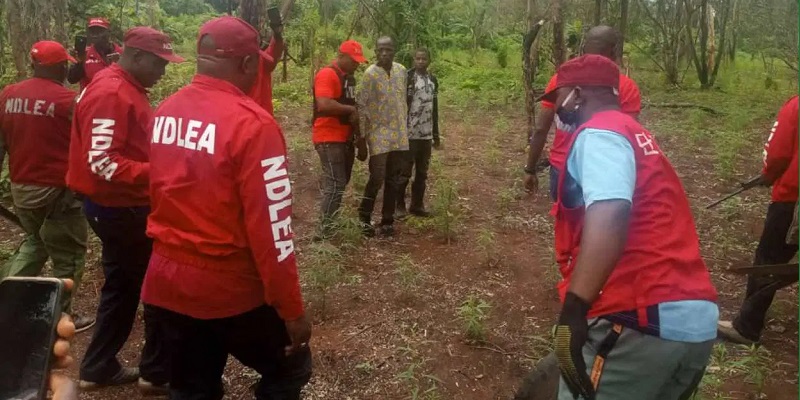
TD In the dense forests of Ogun State, far from the bustling streets of Lagos, Nigerian authorities recently uncovered a grim symbol of a dangerous new reality.

An industrial-scale methamphetamine laboratory, linked to Mexican nationals and valued at roughly $363 million in drugs and precursor chemicals, was dismantled by the National Drug Law Enforcement Agency (NDLEA).
Ten suspects were arrested, including three Mexicans described as expert “cooks.”
The bust, one of the largest of its kind in the country’s history, has sparked urgent warnings.
Nigeria, long a transit hub for cocaine and other narcotics moving between Latin America, Europe and Asia, is showing clear signs of shifting toward becoming a production base.
Mexican cartels, under pressure at home and seeking cheaper labour, weaker enforcement and strategic access to African and European markets, appear to be testing West Africa as a new manufacturing frontier.

This is not an isolated incident. Earlier discoveries of meth labs, some also involving Mexican operators, had already raised red flags.
The latest forest-based facility marks a troubling evolution: production moving into remote, poorly governed spaces where detection is harder and the risk of links to local armed groups or terrorists grows.
Experts point to a pattern seen elsewhere. When Mexican cartels establish production footholds abroad, the host country rarely escapes unscathed.
Corruption deepens. Violence rises as rival networks compete.
Young people are drawn into the trade as cheap labour or couriers. Public health systems buckle under the weight of addiction.
National security is compromised as drug money intersects with existing conflicts.
For Nigeria, the stakes are especially high. The country already battles multiple security challenges — from insurgency in the northeast to banditry and kidnapping in other regions.
Adding a sophisticated transnational drug production industry would pour fuel on these fires.
Forests that should support agriculture and tourism risk becoming no-go zones for clandestine factories.
Ports and highways that drive legitimate commerce become conduits for chemical precursors and finished product.
The NDLEA’s success in this case is commendable and demonstrates that Nigerian institutions can strike hard when intelligence and determination align.
Chairman Buba Marwa and his officers have made clear that Nigeria must not become hospitable ground for foreign cartels.
Yet one major seizure does not reverse a trend. Precursor chemicals still enter the country.
Technical expertise is being transferred. Local collaborators exist. And the economic incentives remain powerful.
If Nigeria continues down this path — if Mexican cartels succeed in embedding industrial meth production on Nigerian soil — the consequences will be profound.
The nation’s reputation, already strained by security and governance challenges, will suffer further damage.
International partners will grow more wary. Investors will hesitate.
Ordinary citizens will pay the heaviest price through increased crime, addiction and eroded trust in institutions.
In that scenario, the proud name “Nigeria” risks becoming associated less with potential and resilience, and more with regret.
It risks becoming, in the bitter vernacular of those who suffer the fallout, simply SORRY.
The choice remains open.
Stronger inter-agency coordination, better surveillance of remote areas, tighter control of chemical imports, and sustained pressure on both local and foreign networks can still prevent the worst outcome.
The forest lab in Ogun State should serve as a wake-up call, not a preview of the future.
Nigeria does not have to become a production outpost for foreign cartels.
But if it does, the apology will be written in the language of lost opportunities, broken communities and a name that once stood for so much more.