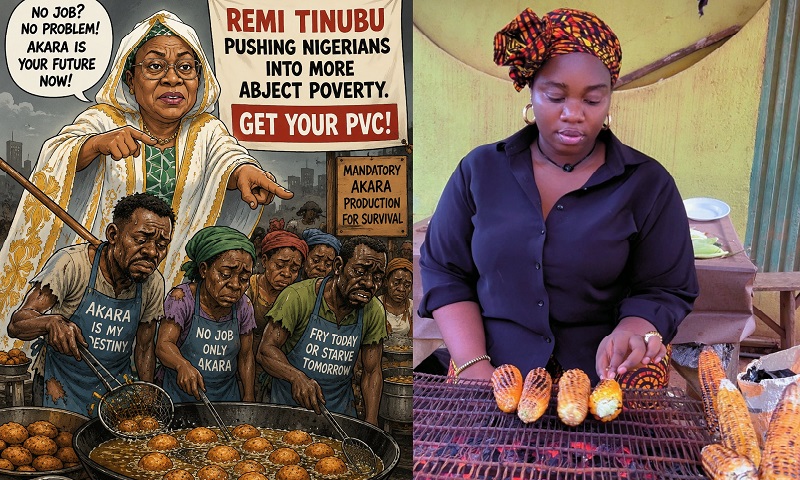
Barrister Inibehe Effiong, a Nigerian human rights lawyer, has sharply criticized First Lady Oluremi Tinubu for urging low-income women to pursue small-scale ventures like selling roasted corn, akara (fried bean cakes), and kuli-kuli (spiced peanut snacks) with grants to cover rent, school fees, and basics.
Taking to his “X” handle, Effiong accused the Tinubu couple of hypocrisy and danger to the nation.
He claimed that their leadership harms current and future generations amid ongoing economic pressures in Nigeria.
Replies from the public reveal deep polarization, with some praising the comments as practical empowerment for vulnerable women through small grants.
Meanwhile, others view them as out-of-touch with widespread hardships.


Nigerian Youths React to First Lady Oluremi Tinubu’s “Akara, Corn, and Kuli-Kuli” Remarks
A video circulating online has captured the frustration of several Nigerian women reacting to comments made by the First Lady.
Tinubu had recently advised citizens to consider small-scale businesses such as selling akara, roasted corn, and kuli-kuli as a way to cope with the country’s economic hardship.
The remarks, delivered on June 24, 2026, during a Renewed Hope Initiative meeting with wives of state governors in Abuja, were intended to encourage entrepreneurship and highlight government grants aimed at supporting small businesses.
“We’re trying to give hope, and to start Akara business doesn’t take a lot of money.
“To start roasting corn, or somebody even said kuli kuli doesn’t take much.
“We didn’t give them a loan, we gave them a grant,” Tinubu stated.

However, the comments quickly went viral, sparking widespread backlash among Nigerian youths who viewed them as dismissive of the country’s deeper economic challenges.
Social Media Outrage
A viral post came from Revolutionary Youth! (@torty_mercy), who sarcastically claimed to have started a roasted corn business using academic certificates as firewood:
“Dear @SenRemiTinubu, I have started roasted agbado business as instructed by you.
“I used my certificates to lit up the fire.
“Do well to ensure bandits do not attack me on my way to farm.
“And do well to ensure price of transportation doesn’t run me out of business.
Lastly, while you and governor’s wives cruise in exotic cars, please stop by and buy my corn.”

These posts reflect the anger and sarcasm that dominated online discourse.
Many Nigerians are mocking the idea that such ventures could realistically cover rent, school fees, healthcare, or transportation costs in today’s economy.
Key Issues Raised by Youths
- High Startup Costs – Critics noted that beans, maize, groundnuts, cooking oil, and firewood/gas are expensive, making it difficult to sustain such businesses.
- Low Purchasing Power – With inflation and naira devaluation, consumers have less disposable income, limiting profitability for small vendors.
- Structural Problems Ignored – Many argued that the First Lady’s advice trivializes systemic issues like unemployment, fuel subsidy removal, and poor infrastructure.
- Elite Disconnect – Viral memes highlighted the contrast between political elites living in luxury and ordinary Nigerians being told to fry akara for survival.
Influencers and Commentators Weigh In
Arise TV anchor Ayo Mario-Ese criticized the remarks as “insulting to Nigerian women in 2026″.
She questioned whether any of the First Lady’s family members had succeeded through such ventures.

Comedian and activist Isaac Fayose added: “Can akara/kuli-kuli earnings sustain a Mercedes-Benz lifestyle?”
His comment underscored the perceived inequality between the ruling class and everyday citizens.
Mixed Reactions
Not all responses were negative.
Some defended Oluremi Tinubu, arguing that akara, roasted corn, and kuli-kuli are legitimate livelihoods practiced globally.
Journalist Lere Olayinka pointed out that roasted corn is sold in Paris, suggesting that such businesses should not be dismissed outright.
Supporters claimed the advice promotes entrepreneurship and reduces dependency on government.
Generational Divide
The controversy revealed a sharp divide between leadership and Nigeria’s younger generation.
While small-scale trading remains vital in Nigeria’s informal economy, many Gen Z and millennial youths aspire to careers in technology, creative industries, and professional fields.
They demand broader reforms—job creation, infrastructure investment, and policy stability—rather than subsistence-level survival strategies.
Hashtags like #AkaraEconomy and #KuliKuliHope trended across platforms.
They symbolize disillusionment with governance and the perceived lack of vision for Nigeria’s future.
The uproar over Oluremi Tinubu’s remarks highlights a communication gap between Nigeria’s political elite and its youthful population.
While small businesses undeniably contribute to the economy, framing them as the primary solution to widespread hardship resonated poorly.
As one viral comment summarized: “Nobody is mocking akara… The problem is Nigerians are asking for a better economy.”