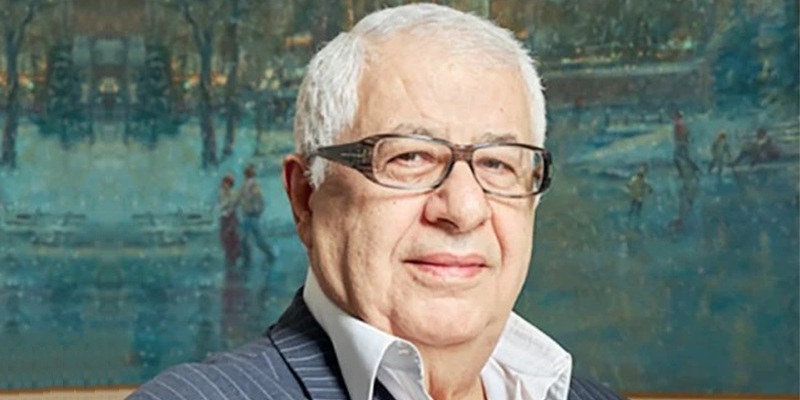
TD A new report by The Economist has drawn renewed international attention to the unusually close relationship between President Bola Ahmed Tinubu’s administration and Nigerian-Lebanese businessman Gilbert Chagoury, indicted in terrorism sponsorship.
The report cast particular light on his his growing role in some of Nigeria’s most valuable infrastructure projects.
The article, titled “Nigeria’s Builder-in-Chief”, examined Chagoury’s expanding influence over major construction and infrastructure projects under the Tinubu administration.
The report claimed that “about $20 billion of Nigeria’s foreign reserves vanished into Chagoury’s pocket”.
The controversy concerns the scale and concentration of government-backed infrastructure contracts and financing arrangements involving companies linked to Chagoury.
Chagoury’s Expanding Infrastructure Footprint
Gilbert Chagoury is a Nigerian-Lebanese businessman and co-founder of the Chagoury Group, which has extensive interests in construction, real estate, hospitality, manufacturing and infrastructure.

His construction interests have become increasingly prominent in Nigeria.
Hitech Construction Company, a Chagoury Group subsidiary, is the principal contractor on the controversial Lagos-Calabar Coastal Highway.
Meanwhile, ITB Nigeria, another company associated with the group, has been selected for major work on the Apapa and Tin Can Island ports.
The scale of these projects has generated questions about procurement, transparency, financing and the concentration of public infrastructure spending around companies connected to one business group.
The $20 Billion Claim
The Economist headline claimed that $20 billion of foreign reserves “vanished into Chagoury’s pocket”.
Nigeria’s foreign reserves are assets controlled and managed by the Central Bank of Nigeria.

The CBN describes external reserves as external assets available to monetary authorities for purposes including financing external payment imbalances and intervening in foreign-exchange markets.
The enormous volume of infrastructure projects associated with Chagoury’s companies have become a cause for concern to Nigerians.
The Lagos-Calabar Coastal Highway, for example, has been widely reported as an approximately $11 billion project, although its financing structure and implementation have evolved over time.
In addition, the Federal Government approved about $1 billion for the modernisation of the Apapa and Tin Can Island ports.
The project is being financed through a UK-backed arrangement involving UK Export Finance.
ITB Nigeria is identified as the construction company expected to execute the works.

These are project values or financing commitments—not equivalent to money deposited into Chagoury’s personal account.
That distinction is crucial.
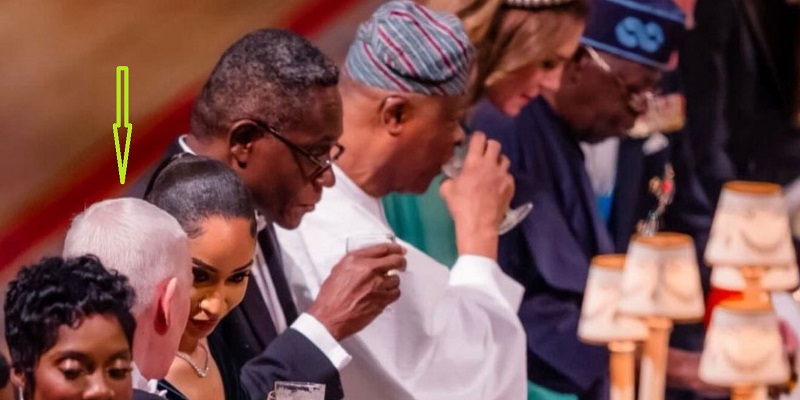
The Tinubu-Chagoury Relationship
The political dimension of the story is significant.
Chagoury has had a long-standing relationship with Tinubu dating back to the latter’s years as Lagos governor.
His companies subsequently became involved in major projects in Lagos and, increasingly, at the federal level.
In January 2026, Tinubu conferred the Grand Commander of the Order of the Niger (GCON)—Nigeria’s second-highest national honour—on Chagoury.
Tinubu cited his contributions and service to the country.
The timing and significance of the honour have inevitably intensified public scrutiny of Chagoury’s expanding business relationship with the Nigerian government.
The Lagos-Calabar Coastal Highway Controversy
The coastal highway has been one of the most politically contentious infrastructure projects of the Tinubu administration.
Hitech, a Chagoury Group company, was selected to execute the project.
Critics have questioned the procurement process, project cost, route and the government’s decision-making surrounding the contract.
Supporters of the project, however, argue that the highway is a strategic piece of national infrastructure capable of connecting major coastal economic centres and stimulating trade, tourism, logistics and investment.
The central question therefore is not whether Chagoury’s companies are involved—they clearly are.
The controversies include whether the contracts were awarded and implemented through transparent, competitive and economically defensible processes.
The Ports Deal Raises Another Set of Questions
The controversy intensified with the Apapa and Tin Can Island port project.
According to reports, Nigeria secured a £746 million financing arrangement with UK Export Finance during Tinubu’s 2026 state visit to Britain.
ITB Nigeria, owned by interests associated with Chagoury, is expected to undertake the construction component.
The arrangement effectively involves Nigeria borrowing money guaranteed by the British government, with the financing tied to procurement of British goods and services.
Critics, including opposition politicians, have questioned whether Nigeria is assuming additional debt primarily to finance foreign suppliers while awarding the implementation contract to a businessman closely associated with the Nigerian presidency.
The Federal Government, on the other hand, maintains that the port modernisation is a strategic infrastructure investment.
Chagoury’s Earlier Controversies
Chagoury’s business history also provides context for the current scrutiny.
TheCable reported that Chagoury had a close association with the late military ruler General Sani Abacha.
The report also claimed that he was convicted by a Swiss court in 2000 in connection with laundering proceeds linked to Abacha’s looted funds.
The report said Chagoury paid a fine and returned approximately $66 million to Nigeria, while Chagoury denied knowing that the money represented stolen Nigerian funds.
This history does not establish wrongdoing in his current government contracts, but it helps explain why new public contracts involving his companies attract intense scrutiny.
Rising Reserves Do Not Mean Nigerians Are Prosperous
This is where the underlying political and economic argument becomes more complicated.
A country can simultaneously accumulate foreign reserves while its citizens experience severe economic hardship.
Foreign reserves belong to the monetary authority and serve macroeconomic functions; they are not a cash account that can simply be distributed among citizens.
At the same time, higher reserves do not automatically translate into improved living standards.
The World Bank has previously warned that Nigeria’s economic reforms have produced significant macroeconomic improvements while high food prices and poverty continue to weigh heavily on households.
The IMF likewise acknowledged in 2026 that Nigeria’s reforms had strengthened macroeconomic stability while warning that the benefits had yet to reach millions of Nigerians.
A report citing the IMF put poverty at about 63 percent and highlighted continuing food insecurity and social strain.
This creates the fundamental contradiction confronting the Tinubu administration:
Nigeria can report stronger external buffers while ordinary Nigerians continue to struggle with the cost of food, transportation, housing, healthcare and electricity.
The Real Accountability Question
The most important question arising from The Economist report is therefore not whether $20 billion has literally disappeared into Chagoury’s pocket.
The more consequential question is:
How much public money, public borrowing and government-backed financing is being committed to companies associated with a businessman who maintains a longstanding relationship with the president—and whether Nigerians are receiving commensurate value for those commitments?
That question can be answered only through detailed disclosure of:
- procurement documents;
- contract awards and variations;
- project financing agreements;
- beneficial ownership structures;
- payment schedules;
- project milestones;
- independent cost assessments;
- performance guarantees;
- debt-service obligations; and
- independent audits of expenditure.
Such disclosure would separate legitimate infrastructure investment from allegations of preferential treatment.
A Relationship Under the Microscope
Chagoury’s influence over major Nigerian infrastructure projects has clearly grown under the Tinubu administration.
His companies are associated with some of the country’s most ambitious construction projects, while Chagoury himself has received the GCON national honour from the president.
What remains a legitimate subject for investigation is the value-for-money, procurement integrity.
Also controversial is the potential conflict-of-interest implications of the government’s extensive dealings with Chagoury-linked businesses.
Spotlight on the Tinubu, Chagoury Investment Deals
The Economist report has placed an important spotlight on one of the most powerful private-sector figures in Nigeria’s infrastructure landscape.
But sensational claims surrounding the report should be distinguished from verifiable facts.
The genuine issue is nevertheless substantial: the concentration of extraordinarily large infrastructure contracts and government-backed financing around companies connected to a businessman with a longstanding relationship with the president.
That deserves rigorous public scrutiny.
For Nigerians facing rising living costs and widespread economic hardship, the ultimate test is not the size of the contracts announced, nor the wealth of the contractors.
It is whether these projects deliver transparent procurement, value for money, jobs, infrastructure and measurable improvements in living standards.
This Dawn News will continue to distinguish documented facts from allegations and political claims as further information emerges.