



TD About a decade after its establishment in May 1975 through the Treaty of Lagos, the Economic Community of West African States (ECOWAS) faced a myriad of political conflicts that made peace and security a priority over its core economic development and integration agenda.
In response to the civil wars in Liberia (1989-2003), Sierra Leone (1991-2002) and Guinea-Bissau (1998-1999), and security threats in several other countries in the region, ECOWAS cut its teeth in preventive diplomacy, conflict management and resolution, which earned the regional bloc international acclaim.
However, the achievements in this crucial domain, especially through the exploits of the ECOWAS Ceasefire Monitoring Group (ECOMOG) formed in 1990 and its successor Missions, had become a subject of speculation and unsavoury intellectual narratives, including by revisionists trying to deny ECOWAS the deserved accolade and glory.
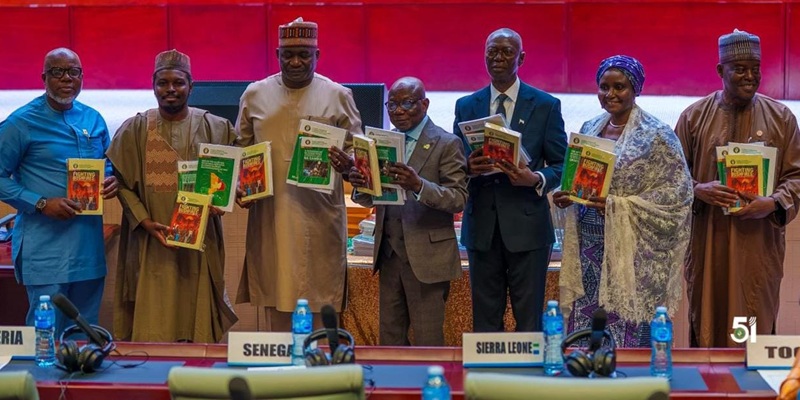
All that changed from 27 August 2026 when the ECOWAS Commission through its Department of Political Affairs, Peace and Security (PAPS), unveiled a landmark book titled ‘Fighting Bushfires. ECOWAS and Peacemaking in West Africa,’ one of four major publications presented to a high-profile audience, including members of the diplomatic community, Nigeria’s Defence Minister Gen. Christopher Musa as Special Guest, ECOWAS Commission officials and journalists.
The book and the three other publications:
- ‘Two Decades of Peace Processes in West Africa: Achievements, Failures and Lessons,’
- ‘After-Action Review of ECOWAS’ Initiatives and Responses to the Multidimensional Crises in Mali,’ and,
- ‘The ECOWAS Intervention From the Peaceful Transfer of Democratic Power in The Gambia’.
They all contain critical analyses and recommendations on best practices to improve ECOWAS’ peacemaking, peacebuilding and peace support operations.

In 2006, the ECOWAS Commission engaged the services of an accomplished International Relations Scholar, Prof. Amadu Sesay, to undertake, on its behalf, the exercise of documenting its complex interventions of ‘fighting the fires’ in Liberia, Sierra Leone and Guinea-Bissau, between 1990 and 2003.
In the 448-page book with nine chapters, Prof. Sesay, represented by Prof. Charles Ukeje during the presentation ceremony at the ECOWAS Commission’s new Headquarters in Abuja, made deliberate efforts to situate the interventions within a conceptual framework.
“Bushfires, both as concept and a framework of analysis, is more than just a metaphor because by investigating their nature, causes, consequences, cost, and how to mitigate their impacts on the environment and people, we can better construct conceptual parallels… not only about the conflicts in Liberia, Sierra Leone and Guinea-Bissau, but also in other parts of Africa,” the author said on page 19.
The book narrates the difficult experiences during the conflict based on wide-ranging interviews with major actors, including politicians, such as Heads of State of several member countries, military and civil society groups, some ECOMOG Field Commanders, ECOWAS Commission officials and extensive desk research and Internet sources.
At the request of President Samuel Doe, who was threatened by the Charles Taylor-led rebels, ECOMOG was formally deployed to Liberia under the command of Ghanaian Lt.-Gen. Arnold Quainoo from Freetown, Sierra Leone, on 23 August 1990. The initial 3,000 troops from Nigeria, Ghana, Guinea, Sierra Leone and the Gambia later grew to about 12,000 with contributions from other member States.
A total of 15 peace accords were signed by the Liberian protagonists, including 13 with the main rebel leader Charles Taylor.

President Samuel Doe was captured at the ECOMOG Headquarters and executed by another rebel leader, Prince Yormie Johnson, in September 1990.
The first stage of the civil war ended with the July 1997 presidential election, which Taylor won. Nigeria’s Gen. Victor Malu was the ECOMOG Commander at the time. He died in 2017.
The second stage of the civil war was ignited in 1999 until 2003, when Taylor went into exile in Nigeria, followed by his eventual trial, conviction and sentencing to 50 years at the Hague for supporting the RUF rebels in Sierra Leone’s civil war.
The book also chronicled Sierra Leone’s President Ahmad Tejan Kabbah’s running battles with the rebels; his overthrow in 1997 and reinstatement by ECOMOG in 1998 under the command of Nigerian Col. Maxwell Kobe, who later became Sierra Leone’s Chief of Defence Staff until he died in 2000.
The book also discussed post-conflict scenarios, and the spread of the “bush fires” to other countries in the region, including Côte d’Ivoire (2002-2011), Niger, The Gambia and Togo, all of which required ECOWAS interventions.
In his short remarks read by Prof. Ukeje, Prof. Sesay noted that ECOMOG interventions were unprecedented for many reasons – “ECOWAS (is) a Regional Economic Community (REC)…,” there was no prior approval of the deployment by the UN Security Council; and it was the first time that a REC would intervene militarily in another sovereign member State, he said, adding that it was “…a clear and bold determination by West African leaders to be their brother’s keeper.”

Prof Eghosa Osaghae, Director-General of the Nigerian Institute of International Affairs (NIIA), who reviewed the book, was in his element. Speaking without any written note, he held the audience spellbound with his deep knowledge of the ECOWAS conflict prevention, management and resolution initiatives.
He commended Prof Sesay as a “master on the subject” who tried to “fill the gaps and clarify misconceptions,” especially regarding the roles played by various actors, adding that the reason for Nigeria’s intervention was not to “dominate West Africa,” but in response to a regional threat.
Other examples include the roles played by the pioneer ECOMOG Commander Lt-Gen. Quainoo, and an unnamed foreign power in the death of Samuel Doe. The book also debunked the narrative that Britain, which deployed a few hundred soldiers, ended the civil war in Sierra Leone, and not ECOMOG, which did the heavy lifting, or that America. which abandoned Liberia at its hour of need, and not ECOWAS, deserves credit for the restoration of peace in the West African country.
Prof. Osaghae said, Africa, in this case, West African leaders rallied support for troubled neighbouring countries when the rest of the world looked away, with ECOMOG as a mechanism of African solution to an African problem, adding that the “power-sharing model” of conflict resolution and peacemaking adopted by ECOWAS has now become popular.
He also noted that family ties were identified as a major factor in the conflicts in Liberia, Sierra Leone and Guinea-Bissau, and underscored the central role of the media in peacekeeping and peacebuilding operations, adding that ECOWAS might have won the “peace, but not the propaganda war”
Guest of Honour, Gen Musa, added a human dimension by disclosing that he lost 10 of his course-mates from the Nigerian Defence Academy in ECOMG Missions. The Minister also challenged narratives that foreign powers liberated Liberia and Sierra Leone, insisting that “the decisive sacrifices were made by African troops under the banner of ECOMOG.”
In his own remarks, Amb. Abdel-fatau Musah, the ECOWAS Commissioner for Political Affairs, Peace and Security, said the unveiling of the publications “marks a critical milestone in the documentation of some legacy projects and events recorded by ECOWAS.”
“The descent of countries into anarchy and the daring interventions in the 1990s occurred following the dissolution of the Soviet Union and the emergence of a unipolar world,” he said “ECOWAS single-handedly mustered the political will and mobilized the resources to overcome the threats faced by the region.”
“Today, the region is evolving in the emergence of multipolarity. Fighting Bushfires and two Decades teach us one lesson: the region should be inspired by the sacrifices of the 1990s to confront yet another existential threat enabled by multipolarity – terrorism and violent extremism,” Dr Musah added.
Describing the publications as of “…singular importance given that they are the first official definitive account by the ECOWAS Commission of the landmark peace interventions” in response to “the devastating civil wars in West Africa,” he requested a minute of silence “in memory and reverence” of “many of the actors in this drama (who) are no more with us today.”
In his welcome address, Dr Babatunde Afolabi, the Director of Political Affairs, said the objectives of the publications included the “the need for ECOWAS to tell its own story on the famed ECOMOG interventions, for the sake of posterity,” putting events in proper perspective, to draw lessons, especially in view of the prevailing security situation in the region, and “the need to accord due recognition to Member States and Community citizens, …our heroes, who made huge sacrifices, some paying the ultimate price, in their attempts to restore peace and stability across the region.”
The ceremony featured a drama presentation on the ‘Power of Peace,’ a Documentary on ECOWAS’ Peace Interventions and presentation of Plaque/Tributes to Heroes, including some ECOMOG Field Commanders and Journalists.
Other attendees included former senior ECOWAS officials, who played important roles in the publication project, such as ex-Commissioner Salamatu Suleiman, Dr Remi Ajibewa, Mr Sunny Ugoh, Mrs Florence Iheme and soon-to-be inaugurated ECOWAS Judge Henrietta Didigu.
ECOWAS has used its conflict prevention, management and resolution mechanisms, including ECOMOG, the Early Warning System, the 1999 and 2001 Protocols, and the ECOWAS Conflict Prevention Framework effectively, to achieve relative peace and stability in the region.
The achievements would not have been possible without the support of the international community and other stakeholders, notably the UN, African Union, and partners such as the EU, GIZ, DANIDA, SIDA, and civil society groups such as WANEP and the Media.
Still, the ECOWAS Department of Political Affairs, Peace and Security deserves commendation for the four publications as a rich source of reference materials on conflict management and resolution.
With the persistent insecurity, terrorism, insurgencies and political conflicts in the region, including the resurgence of military coups and the withdrawal of Mali, Burkina Faso and Niger from ECOWAS; bad governance and undemocratic dispositions of political leaders in the region, the incoming management of the ECOWAS Commission has its job cut out, beginning with Guinea-Bissau following the November 2025 self-coup by former President Umaro Sissoco Embaló.
Community citizens are yearning for urgent repositioning and the return of ECOWAS’ past glory.
A Global Affairs Analyst & Consultant on Strategic Governance Communications, Paul Ejime, is a War Correspondent, was embedded in ECOMOG during the Liberia and Sierra Leone Civil Wars.