





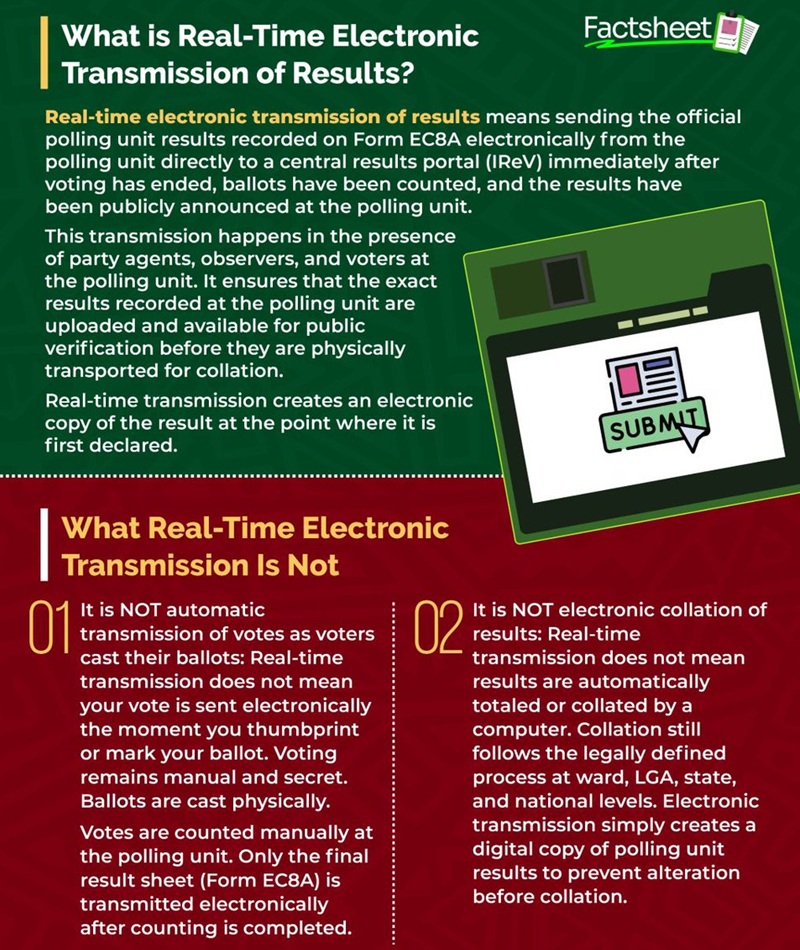
The Nigerian Senate has formally approved the electronic transmission of election results to the INEC Result Viewing Portal (IReV), following the completion of all statutory procedures at polling units.
Under the newly adopted provision, presiding officers must ensure that election results are duly signed by the presiding officer, party agents, and security officials present.
Afterwards, they will be electronically uploaded.
This safeguard is designed to strengthen credibility, promote transparency, and preserve the integrity of the electoral process.
At an emergency sitting on Tuesday, the Senate unanimously agreed that the amendment will boost public confidence while ensuring that the process remains orderly and verifiable.

Further Clarification
Lawmakers emphasized that transmitting results to IReV after certification represents a significant milestone in Nigeria’s democratic evolution.
The measure reinforces openness in result management and allows citizens to follow the electoral process more transparently.
The Senate stressed that it is aligned with the yearnings of Nigerians.’
It urged political parties, civil society organizations, and voters to support reforms that deepen trust in democratic institutions and strengthen the nation’s electoral framework.
The departure from its earlier position on the transmission of election results, revises Clause 60(3) of the proposed Electoral Act amendments.
The new provision now permits electronic transmission of results from polling units.

However, it is only on the condition that the system does not fail.
Key Provisions of the Revised Clause
Electronic Transmission: Results may be transmitted electronically from each polling unit, provided the system functions without failure.
Form EC8A as Primary Source: The Senate emphasized that Form EC8A will remain the primary source of election results.
This will ensure that manual documentation continues to serve as the official record.
This revised stance diverges from the House of Representatives, which has pushed for mandatory and immediate electronic transmission of results to the INEC central server and collation centres.
Conference Committee Expansion
In a related move, the Senate increased the number of its Conference Committee members to twelve, aligning with the House of Representatives’ committee size.

This adjustment is intended to facilitate harmonization between both chambers as they work toward a unified version of the Electoral Reform Bill.
Implications
- Transparency Concerns: Critics argue that making electronic transmission conditional undermines the push for full transparency and could leave room for manipulation.
- Public Confidence: The divergence between the Senate and House positions may fuel public skepticism and prolong debates over electoral credibility.
- Legislative Process: The expanded Conference Committee will now play a pivotal role in reconciling the differences, with Nigerians closely watching the outcome.
The Senate’s decision to revise Clause 60(3) marks a significant development in Nigeria’s electoral reform process.
While it opens the door to electronic transmission, the conditional nature of the provision and reliance on Form EC8A highlight ongoing tensions between modernization and traditional safeguards.
The harmonization process with the House of Representatives will determine whether Nigeria adopts a framework that fully embraces digital transparency ahead of the 2027 general elections.