

 YOLA, Nigeria — The Department of State Services (DSS) has recorded its seventh reported death sentence case of 2026 after an Adamawa State High Court sentenced three men to death over the kidnapping of two Catholic priests in February 2025.
The convicts were identified as Taledo Demiel, Namomai Medan and Mikaila Yusuf.
They were sentenced on Thursday by Justice Christopher Mapeo after being found guilty of multiple offences.
The offences were connected with the abduction of Reverend Fathers Matthew Dutsemi and Abraham Sauman in Numan Local Government Area of Adamawa State.
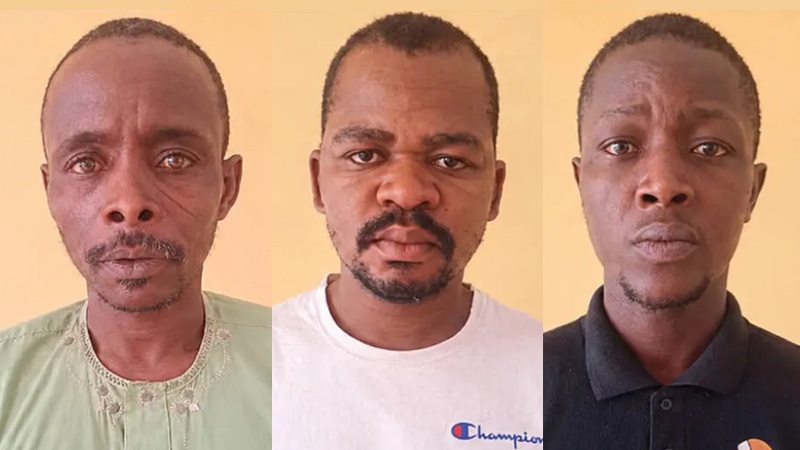
These include criminal conspiracy to commit kidnapping, kidnapping, conspiracy to commit armed robbery, armed robbery, harbouring kidnapped persons and negotiating to receive ransom.
The judgment adds to a series of capital convictions reportedly secured by the DSS in Nigerian courts this year.

The cases involve kidnapping, terrorism, arms-related offences and murder.
Court Convicts Three Men Over Priests’ Abduction
Reports published on October 22 identified the three defendants and the presiding judge.
The court found the defendants guilty of the offences brought against them and imposed the death sentence.
The case arose from the abduction of the two Catholic priests from their residence at a convent in Gweda Mallam, Numan Local Government Area, in February 2025.
The incident prompted security operations and renewed concerns over the safety of religious leaders and communities in parts of northern Nigeria.
In April 2025, Adamawa State Governor Ahmadu Umaru Fintiri commended the DSS for rescuing the priests and arresting suspects in connection with the abduction. Contemporary reports by The Guardian and TVC News said the priests were rescued without ransom being paid.

The latest judgment represents a subsequent stage in the criminal proceedings arising from the incident.
Seventh Reported Death Sentence Case in 2026
The Adamawa ruling follows six other death sentence cases reported by Nigerian news organisations between May and September 2026:
- May 20: an Ekiti State High Court sentenced Ibrahim Abubakar and Abdullahi Abubakar to death by hanging for kidnapping.
- June 3: a Federal High Court in Abuja sentenced four men to death by hanging over their roles in the June 2022 attack on St Francis Catholic Church in Owo, Ondo State, in which worshippers were massacred.
The four men were identified as Idris Abdulmalik Omeiza, Alqasim Idris, Jamiu Abdulmalik and Abdulkareem Idris.
- June 15: a Katsina State High Court sentenced Hauwa’u Mukhtar, described in reports as an arms courier, to death by hanging.
- June 16: a Kogi State High Court sentenced Jibrin Halilu to death over the kidnapping and murder of his neighbour in Obajana.
- June 22: a Sokoto State High Court sentenced three men — Muhammed Yusuf Sallau, Jabbi Ahlaji Yale and Kabiru Muhammed — to death by hanging in a case involving terrorism and arms-related offences.
The sixth reported case occurred on September 28.
- A Sokoto State High Court sentenced Ibrahim Usman, popularly known as Dan Iyali, to death over his involvement in the kidnapping and killing of three people.
The Adamawa judgment on October 22 brings the reported total to seven cases.
The number of defendants sentenced across those cases is higher than seven.

Kidnapping Remains a Major Security Challenge
Kidnapping for ransom continues to pose a serious security challenge in Nigeria, affecting religious leaders, students, travellers, rural communities and other civilians.
The abduction of the two Catholic priests in Adamawa demonstrated that religious institutions and their personnel remain vulnerable to criminal violence.
The DSS, Nigeria’s domestic intelligence and security agency, investigates security-related offences and prosecutes cases through the courts.
The agency’s role in the reported cases reflects the use of criminal prosecution alongside intelligence-led security operations.
However, a court’s imposition of a death sentence does not mean that an execution has taken place.
Capital sentences remain subject to applicable judicial and constitutional procedures, including any available appeal.
The reported convictions also concern different offences and incidents.
The Adamawa case should not automatically be classified as a terrorism conviction simply because other cases in the wider series involved terrorism.
What the Death Sentence Judgment Means
The latest death sentence ruling marks a significant development in the prosecution of the men convicted over the priests’ abduction.
It also adds to the reported number of capital sentences secured in cases involving serious violent crimes in Nigeria.
For affected religious communities, the case highlights the continuing importance of protecting clergy and worshippers.
It also highlights ensuring that kidnappings are investigated and prosecuted.
Further details concerning the full judgment, any appeal by the defendants and the next legal steps were not established in the reports reviewed for this publication.