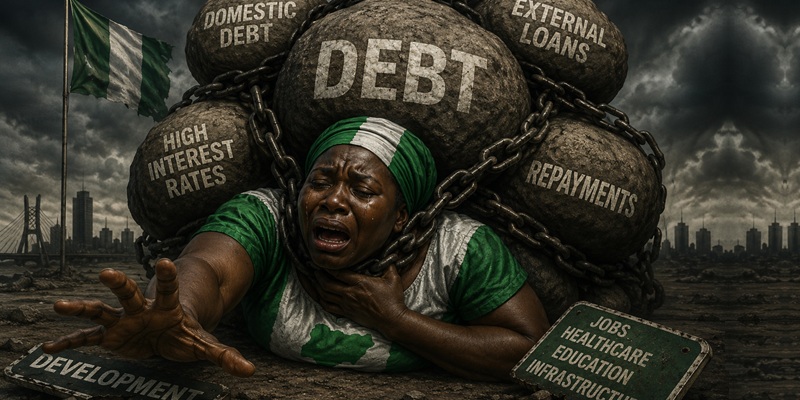

 ABUJA, FCT — President Bola Tinubu’s request for legislative approval of a new external borrowing plan worth $20.52 billion and €1.045 billion has reopened a fundamental question about Nigeria’s public finances: if successive borrowing plans were intended to fund government budgets and development projects, why are contractors reportedly still awaiting payment for capital projects?
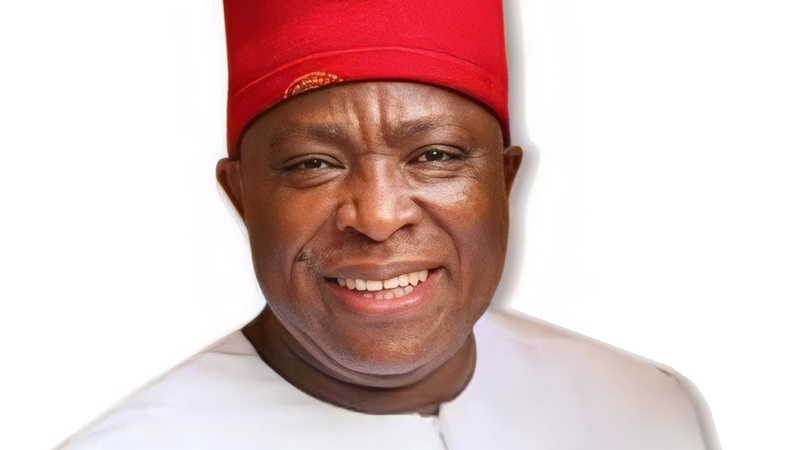
The question was raised by Senator Victor Umeh, who represents Anambra Central, during an appearance on Channels Television’s Politics Today on October 27.
Umeh questioned the relationship between previous borrowing approvals, budget implementation and outstanding government obligations, arguing that the public deserves an account of how borrowed funds have been applied.
His intervention comes as Tinubu seeks approval for the Federal Government’s 2026–2027 Supplementary External Borrowing Plan.
The Presidency says is intended to finance infrastructure and programmes across several sectors.
The request is real, and the government has publicly outlined its intended sectors of expenditure.

However, the central investigative question is:
- whether the government can provide a traceable account linking each proposed loan,
- the projects financed,
- the amounts disbursed,
- the work completed, and,
- the liabilities still outstanding.
This report examines what is established, what remains unanswered and what documentary evidence Nigerians should demand.
1. What exactly has Tinubu requested?
President Tinubu submitted a request to the National Assembly for a supplementary external borrowing plan comprising:
- US$20,517,755,901 — approximately $20.52 billion.
- €1,045,083,643 — approximately €1.045 billion.
The request was conveyed in a letter read by Senate President Godswill Akpabio during plenary on October 27.
According to the Presidency, the proposed financing would support infrastructure, agriculture, healthcare, education, water supply, security, employment generation and financial management reforms.
The government says the financing is needed to address Nigeria’s infrastructure deficit and bridge funding gaps affecting development programmes.

The proposed plan has not received final legislative approval based on the reports available at the time of publication.
The Senate referred it to the relevant debt committee, working with the committees on Appropriations and Finance, for scrutiny and a report within one week.
That distinction matters: the requested amount should not be described as money already borrowed or fully disbursed under this new proposal.
2. The question raised by Senator Umeh
Speaking on Politics Today, Umeh questioned why government borrowing had not prevented outstanding obligations to contractors handling capital projects.
He argued that previous requests had been justified as necessary to finance government budgets, yet budgetary obligations remained unmet.
The senator’s central question was straightforward: if money was borrowed to finance the budgets, why were contractors still reportedly unpaid?

That is a legitimate public-finance question.
But answering it requires more than comparing a borrowing announcement with reports of unpaid bills.
Borrowing proceeds may be disbursed over several years, tied to particular projects, subject to lender conditions or directed towards expenditure categories that do not cover every outstanding government contract.
Some borrowing arrangements may also refinance existing obligations rather than provide fresh cash for new construction.
Consequently, unpaid contractor bills do not, on their own, prove that borrowed money was diverted or missing.
The decisive evidence would be the approved borrowing plans, loan agreements, disbursement records, project accounts, payment certificates, audited expenditure and the government’s schedule of outstanding liabilities.
What has not yet been established from the publicly reported information reviewed for this article is a complete, reconciled account showing:
-
which specific previous loan proceeds were received,
-
which contractors were owed from those proceeds, and,
-
why the relevant payments remained outstanding.
That is the gap a serious investigation must address.
3. Broad sectors are not the same as a project-by-project account
The Presidency has identified sectors expected to benefit from the proposed borrowing.
These include infrastructure, agriculture, healthcare, education, water supply and security.
But sector descriptions alone do not tell Nigerians how the money will be spent.
For effective legislative and public scrutiny, the borrowing plan should identify, for each proposed project:
-
The project’s name, location and implementing ministry or agency.
-
The estimated cost and the amount to be financed by the proposed external facility.
-
The lender, currency, interest rate, fees, grace period and repayment schedule.
-
The contractor or implementing entity, where procurement has been completed.
-
The expected completion date and measurable deliverables.
-
The disbursement schedule and the conditions that must be met before funds are released.
-
The relationship between the proposed financing and any earlier borrowing approval for the same project.
The seventh question is particularly important.
If a project already appeared in a previous borrowing plan or budget, the National Assembly should establish whether the latest request represents additional financing, a revised cost estimate, a new phase or a different project altogether.
Without that reconciliation, the public cannot readily determine whether a proposed loan finances new development or overlaps with existing commitments.
A review of the material reported publicly on October 27 did not establish a complete project-by-project schedule for the entire proposed facility.
This does not prove that no detailed schedules exist in the documents submitted to lawmakers; it means that the public needs access to the underlying documents to evaluate the proposal independently.
4. The contractor-payment question: what records should be examined?
Umeh’s intervention points to a second line of inquiry: the reported failure to settle obligations to contractors responsible for capital projects.
To establish the scale and cause of those unpaid obligations, investigators would need to distinguish among at least four categories:
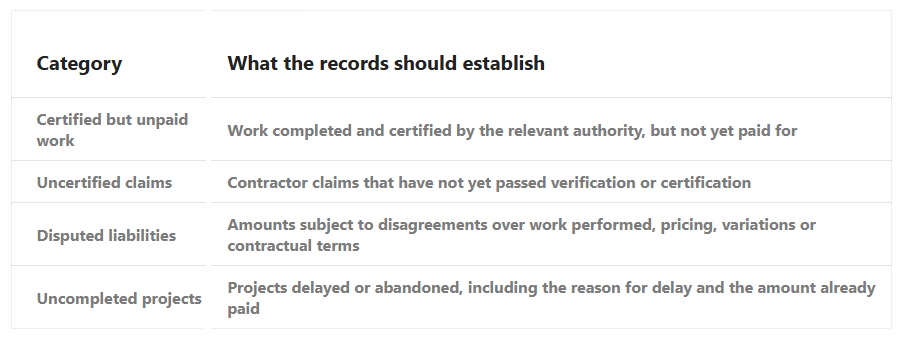
These categories cannot simply be combined into a single figure labelled “money owed.”
Each has different legal, accounting and project-management implications.
The investigation should obtain the government’s current schedule of verified unpaid capital-project liabilities, broken down by ministry, agency, project, contractor, amount, date certified and payment status.
That schedule should then be compared with capital releases, actual cash payments and the relevant borrowing disbursements.
If the government says a project was financed through a particular loan, the records should show the amount received, the amount spent, the work delivered and any outstanding balance.
If the loan was intended for a different purpose, the government should explain that distinction clearly.
At present, Umeh’s reported remarks establish that he has questioned the government’s handling of borrowing and contractor obligations.
They do not independently establish that any particular loan was diverted or that every reported contractor debt was supposed to be settled from external borrowing.
5. Nigeria needs a loan-to-project audit
A useful investigation should not stop at the amount announced in a presidential letter. It should trace the full lifecycle of earlier external loans.
For each borrowing facility, the government and its oversight institutions should disclose:
- Approval: The date, amount and legislative resolution authorising the borrowing.
- Agreement: The executed financing agreement, lender and applicable terms.
- Receipt: The dates and amounts actually disbursed.
- Allocation: The government account or project account that received the proceeds.
- Expenditure: Payments made, recipients and supporting documentation.
- Delivery: Physical progress, completed facilities and independently verified outcomes.
- Outstanding obligations: Unpaid certified work, undisbursed commitments and remaining balances.
- Repayment: Principal and interest paid, amounts due and future repayment obligations.
The audit should reconcile these figures with the Debt Management Office’s debt records, the Office of the Accountant-General of the Federation, relevant ministries and implementing agencies, and the Auditor-General’s reports.
Where a loan is tied to a lender-supervised project, the corresponding lender disclosures and implementation reports should also be examined.
The objective is not to assume wrongdoing. It is to establish, from records that can be independently checked, what Nigeria received in exchange for the liabilities it assumed.
6. What does the National Assembly need to establish?
The Senate’s referral of the request to its debt committee provides an opportunity for detailed examination before lawmakers reach a decision.
A substantive review should address five issues.
First, the total financing requirement. What is the evidence that the proposed amount is necessary, and how was it calculated?
Second, the terms of the loans. What are the interest rates, fees, repayment periods, grace periods, currencies and other conditions? How will currency movements affect the eventual naira cost?
Third, project-level justification. Which projects will receive the funds, where are they located, and what measurable benefits are expected?
Fourth, previous borrowing performance. What proportion of earlier approved facilities has actually been drawn, what has been completed, and what obligations remain unpaid?
Fifth, fiscal sustainability. How will debt service be accommodated alongside salaries, pensions, essential services and other public expenditure?
The committee should also identify any projects that have previously been approved for borrowing and determine whether the new proposal duplicates, extends or replaces existing financing arrangements.
The public should be able to read the committee’s findings and understand the evidence supporting its conclusions.
7. How much debt can Nigeria sustain?
A large borrowing request must be assessed in the context of the country’s overall public debt and capacity to repay.
However, the headline value of a proposed loan is not, by itself, a sufficient measure of fiscal risk.
The terms of the facility, the timing of disbursement, the currency composition, the projects’ economic returns and the government’s future revenue capacity all matter.
External borrowing can support development where it finances productive infrastructure and services that improve economic activity, public welfare or government revenue.
It can also create serious fiscal pressure when projects fail to deliver expected benefits or when repayments consume resources needed for essential services.
For that reason, the analysis should distinguish between:
- the amount requested for approval;
- the amount authorised by lawmakers;
- the amount contracted with lenders;
- the amount actually disbursed;
- the outstanding debt stock; and
- the principal and interest payments falling due.
These are related but different measures. Treating them as interchangeable would give the public an inaccurate picture of Nigeria’s obligations.
The Debt Management Office’s published debt statistics, financing agreements and debt-service records are essential to this assessment.
Any current claim about Nigeria’s total debt should be checked against the latest dated official release rather than inferred from the new borrowing request alone.
8. The government’s case must be tested against results
The Federal Government says the proposed facilities are intended to close infrastructure funding gaps and support development across key sectors.
That is the stated rationale.
Whether the borrowing delivers the promised benefits can only be evaluated against implementation records and measurable results.
For example, a power-sector loan should be assessed against the facilities completed, capacity made available and reliability improvements achieved.
A transport loan should be measured against the sections completed, their actual cost and their usefulness to commuters and commerce.
Healthcare financing should be assessed against the services, facilities and equipment delivered.
A project should not be classified as a development success merely because a loan was approved, a contract was awarded or funds were released.
Likewise, a delayed project should not automatically be treated as evidence of corruption. Investigators must establish the reasons for the delay, how funds were handled and whether contractual and procurement rules were followed.
This is why project-level documentation is indispensable: it allows citizens to distinguish implementation failures, legitimate financing constraints, disputed liabilities and possible misconduct.
9. Questions the Presidency should answer
In the interest of transparency, the Federal Government should publish or make accessible the following information:
- The complete project schedule attached to the 2026–2027 supplementary borrowing plan.
- The financing terms and expected repayment obligations for each proposed facility.
- A list of earlier external borrowing facilities linked to projects that remain incomplete.
- The latest verified schedule of unpaid federal capital-project obligations.
- A reconciliation of loan disbursements, project expenditure and completed work for major externally financed projects.
- Details of any overlapping financing arrangements or revised project costs.
- The audit findings and corrective measures arising from projects that have experienced significant delays or cost increases.
These requests do not presume that the government has misused borrowed funds.
They seek the information required to determine whether public borrowing has been properly authorised, spent and translated into results.
The National Assembly should also ensure that the public receives a meaningful summary of its review before any final decision is made.
Conclusion: Borrowing Must Be Measured by What It Delivers
Senator Victor Umeh’s question has placed the relationship between borrowing, budget implementation and unpaid contractor obligations at the centre of the debate over Nigeria’s proposed external loans.
The evidence currently available establishes that President Tinubu has requested approval for $20.52 billion and €1.045 billion in external financing, and that lawmakers have begun considering the proposal.
It also establishes that Umeh has raised concerns about previous borrowing and reportedly outstanding payments to contractors.
What remains unresolved is the full documentary link between earlier loan proceeds, specific project expenditure, completed work and outstanding liabilities.
That question cannot be answered responsibly through political claims alone.
It requires published financing agreements, disbursement records, audited accounts, project inspections and a reconciled schedule of outstanding obligations.
Nigeria can borrow for development.
But citizens should be able to trace the liabilities incurred in their name to the assets, services and economic benefits delivered in return.
Before the next borrowing approval, the public deserves a clear accounting of the previous one.
This Dawn News will continue to examine the documentary evidence, official responses and project-level records relevant to Nigeria’s external borrowing and capital-project obligations.