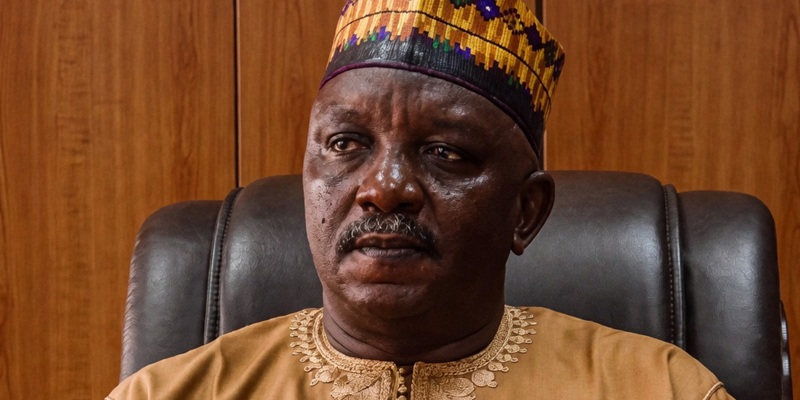
TDThe Economic and Financial Crimes Commission (EFCC) has apprehended former Minister of Power, Saleh Mamman, over allegations of a staggering ₦33.8 billion fraud tied to Nigeria’s troubled electricity sector.
Mamman, who served under former President Muhammadu Buhari, was picked up in Kaduna after months of investigation into financial irregularities during his tenure.
According to EFCC officials, billions of naira were allocated for critical power projects—including rural electrification, transmission upgrades, and renewable energy initiatives.
They were, however, siphoned off through fraudulent contracts and laundered via proxy companies.
Watch EFCC disclose the arrest here.
Background of the Mamman Case
- Mamman was appointed Minister of Power in 2019, a period marked by ambitious promises to overhaul Nigeria’s electricity infrastructure.
- Investigators allege that between 2019 and 2021, funds earmarked for key projects were diverted, leaving many initiatives abandoned or underfunded.
- The EFCC traced suspicious transactions amounting to ₦33.8 billion, raising concerns about systemic corruption within the ministry.
Legal Proceedings Against Mamman
- Mamman faces multiple charges, including fraud, money laundering, and abuse of office.
- His trial has drawn national attention, with the court set to rule on preliminary objections and admissibility of evidence on June 9, 2026.
- In a dramatic turn, Mamman was recently convicted and handed a 75-year prison sentence, one of the harshest anti-corruption judgments in Nigeria’s recent history. The ruling is seen as a watershed moment in the judiciary’s stance against high-level graft.

Implications for Nigeria’s Power Sector
The case has reignited debate about Nigeria’s chronic electricity crisis. Despite decades of investment, the country continues to grapple with erratic supply, dilapidated infrastructure, and widespread reliance on generators.

Analysts argue that Mamman’s case exemplifies how corruption has crippled progress:
- Abandoned Projects: Several rural electrification schemes reportedly stalled due to misappropriated funds.
- Investor Confidence: The scandal has further eroded trust among foreign investors in Nigeria’s energy sector.
- Public Outrage: Citizens, already burdened by high tariffs and poor service, view the case as proof of leadership failure.
Broader Anti-Corruption Drive
The EFCC’s successful prosecution of Mamman is being hailed as a milestone in Nigeria’s anti-corruption campaign. However, critics caution that isolated convictions are not enough. They call for:
- Stronger oversight mechanisms in ministries handling large budgets.
- Transparent procurement processes to prevent contract inflation and ghost projects.
- Institutional reforms to ensure accountability beyond individual prosecutions.
Former Minister of Power, Saleh Mamman, had been arrested and convicted in connection with a ₦33.8 billion fraud case.
His sentencing to 75 years imprisonment marks a landmark ruling in Nigeria’s fight against corruption.
Meanwhile, it also exposing the deep-rooted failures that continue to undermine the nation’s quest for reliable electricity.