TDIn politics, loyalty is often demanded but not always rewarded. Commitment is praised publicly, yet sometimes quietly overlooked when appointments are shared and power negotiations begin.
Across Imo State’s political landscape, particularly as conversations intensify ahead of another electoral cycle, one question appears to be hanging in the air: does steadfast service still matter in politics, or has influence networks overwhelmed the system?
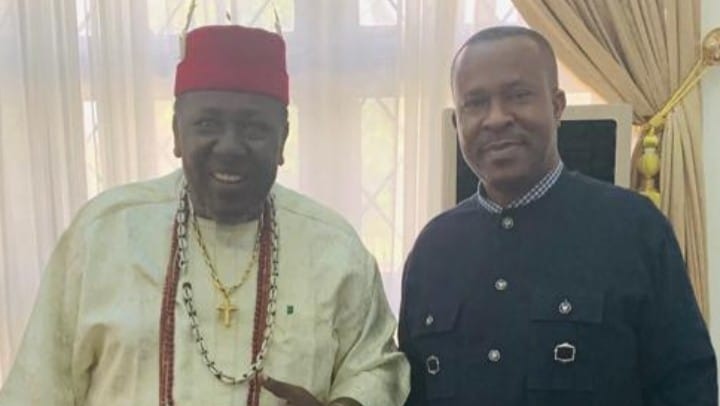
Dr. Ugorji Okechukwu Ugorji, an indigene of Lorji Nwekeukwu Autonomous Community in Aboh Mbaise Local Government Area and a son of the politically strategic Owerri Zone, represents a curious political phenomenon: a loyal party man whose visibility, dedication and technocratic sacrifice are seeking to translate into significant political elevation.
When Governor Hope Uzodimma established the Ministry of Homeland Security and Vigilante Affairs during his first tenure, Dr. Ugorji emerged as the pioneer commissioner — a role that demanded not merely ceremonial presence but institution building.
Being first is never easy.
The burden of pioneers is different. They build systems where none existed, create structures from confusion, absorb criticism, and define expectations for successors. Political insiders familiar with the workings of Government insist that Dr. Ugorji was not merely occupying the office; he was laying foundations for a ministry intended to address local security coordination, vigilante structure, and community safety concerns at an extremely difficult period.

Those who worked in government at the time recall his assertive commitment to duty and his unwavering defense of the administration’s agenda. Hon. Kenneth Chidi Nwogu, who served as SA Administration in the Ministry of Homeland Security says that his then boss reported for work at 8 am everyday – a practice that forced a change in the work attitudes of civil service workers in the ministry.
Yet politics, unlike administration, often remembers outcomes without acknowledging architects. Today, some observers quietly argue that others have benefited from structures and goodwill built during his tenure, while supporters insist his political reward has remained disproportionate to the sacrifices invested.
In Nigerian politics, especially at State level, loyalty is frequently transactional. Political actors change camps, switch allegiances and negotiate survival.
But supporters of Dr. Ugorji insist his defining political identity has been consistency. Hon. Chinedu Ogwuni, known as the “strong man of Amuzu politics,” says that Dr. Ugorji is remarkable in his refusal to speak from both sides of his mouth. “The man is consistent and upright,” says Ogwuni – traits that are yet to become standards in the ecosystem.
From the grassroots in Aboh Mbaise to wider mobilization efforts within the ruling All Progressives Congress (APC), he reportedly remained committed to the political philosophy and re-election ambition of Governor Uzodimma during a period many considered politically tense. “After Dr. Ugorji became an SA and later a commissioner, APC has for the first time consistently won votes in Lorji freely and fairly,” says Mrs. Ngozi Agharanya, who is the Gender Equity Leader for the “Ugorji For Imo” campaign council at the Lorji Ward level.
The argument from his supporters is straightforward: when the governor required trusted hands to defend, explain and promote the 3R Agenda— Reconstruction, Rehabilitation and Recovery — Dr. Ugorji stood visibly committed and delivered, including in the Ahiazu rerun election of 2023.

In private political circles, some describe him as one of those who “worked without noise,” like the security professional he is.
But therein lies perhaps the irony of politics. Those who work silently sometimes risk becoming invisible in a political culture where loudness occasionally overshadows labour.
There is another dimension to Dr. Ugorji’s story that deserves a closer examination.
For nearly four decades, he reportedly lived within the ecosystem of American mainstream politics and society, studying, growing and functioning in an environment where institutions, predictability, merit and strategic networking often shape political advancement.
Returning to Nigeria with such orientation can be both an advantage and a burden.
Advantage because exposure brings discipline, governance experience, systems thinking and administrative professionalism.

Burden because Nigerian politics, especially at sub-national levels, often runs through unwritten rules, godfather calculations, patronage networks, and power bargaining that sometimes defy conventional expectations.
Many politically exposed but less competent figures rise quickly, while experienced technocrats struggle to decode local political grammar.
No conversation about Imo succession politics is complete without Owerri Zone. The agitation for power rotation has persisted for years, rooted in arguments of fairness and political inclusion.
As succession permutations begin to gather momentum, names from Owerri Zone will inevitably come under scrutiny —not merely on popularity, but on competence, administrative experience, political loyalty and electability.
Now that the APC Senatorial ticket in the Owerri Zone has gone to Prince Dr. Alex Mbata of Owerri North (who Ugorji has backed since 2023), the attention for the party’s governorship ticket in 2027 will necessarily shift to the Mbaise block of Owerri Zone.
Supporters of Dr. Ugorji argue that he checks several boxes. He possesses bureaucratic experience, party loyalty, grassroots connection, diaspora exposure, governance understanding cultural grounding, and youthful charisma.
Beyond politics, he now bears an additional traditional responsibility as Regent of Lorji Nwekeukwu Autonomous Community, installed at the authorization of no less a personality than the Eze Imo and Chairman of the Southeast Council of Traditional Rulers, HRM Eze Dr. E. C. Okeke.
This installation was following the passing of his father, the late HRH Eze Stephen Ugorji, an unpaid position that places him within both political and traditional leadership circles.
In many communities, such dual legitimacy matters.
The question then becomes: should Imo continue recycling familiar political actors while overlooking tested hands who have shown patience and discipline? Would Governor Uzodimma present a refreshing homeboy as his successor?
Politics everywhere survives on incentives.
Reward systems matter.
Of course, no political office is inherited. No politician is owed power. Competence alone does not automatically translate into electoral opportunity. “We don’t say emilokan here in Mbaise, but our time for something different has come,” says Hon. Ukanwa Onyekwere, the Lorji Ward Coordinator of “Ugorji For Imo.”
Dr. Ugorji’s supporters believe he has earned a serious political consideration — not through entitlement, but through accumulated competent service, political heft, and uncompromised integrity.
Dr. Ugorji is unquestionably part of Imo’s political future.
Many people in Imo State are looking forward to the anchor that an Ugorji administration will be for the next phase of the 3R Shared Prosperity regime.