


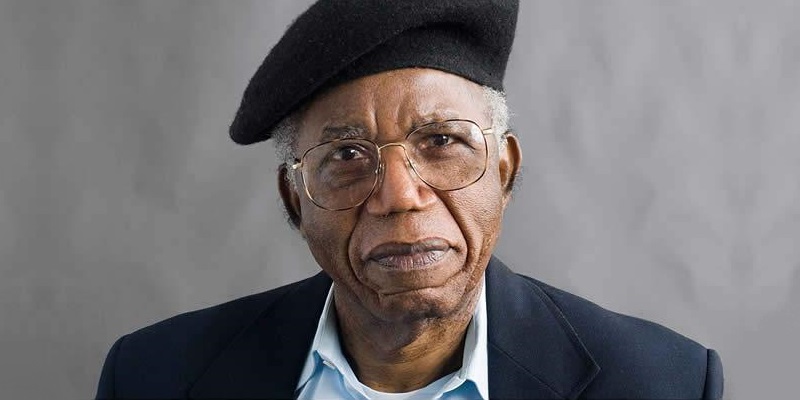

TD IME OBI ANAMBRA SERIES — Chinua Achebe was more than a writer. He was a defender of truth.
At a time when the world only heard one side of the African story, he stood up and told another side. The Igbo side. The human side.
Before Achebe, many books about Africa were written by foreigners. In those books, Africa looked empty.
No history. No laws. No wisdom. The people looked like they were waiting to be saved.
Achebe said no. He picked up his pen and gave Africa its voice back.
His first book, Things Fall Apart, changed everything.

He did not write about kings and queens in Europe. He wrote about Umuofia, an Igbo village.
He showed how the Igbo had courts, meetings, titles, farming, and religion long before the white man came.
He showed families that laughed, fought, and prayed.

For the first time, the world saw that the Igbo were not a crowd devoid of identity. They were people with names, with plans and with a way of life.
Prof. Achebe knew that to keep a people alive, you must keep their language and wisdom alive.
So, he filled his books with Igbo proverbs. He called proverbs the palm oil with which words are eaten.

One of his most powerful proverbs is this: “A man who does not know where the rain began to beat him cannot say where he dried his body.”
This means you must know your history before you can talk about your future. He used it to remind Igbo people to remember where they came from.
He also fought to correct false narratives with his essays.
In a famous speech, he criticized books that painted Africa as dark and without sense. He insisted that African writers must now teach their people who they are.
Prof.Chinua Achebe believed that if we do not tell our own story, someone else will tell it wrong.
Another proverb he loved was: “A toad does not run in the daytime for nothing.” This means that nothing happens without a reason.

He used stories to show the reasons behind Igbo customs, wars, and choices.
He did not want people to think Igbo life was magic or confusion. He wanted people to see the sense in our way of life.
Achebe did some work behind the scenes too.
With his wife Christie and legendary poet Christopher Okigbo he started a small publishing company called Citadel Press.
The goal was simple. Publish African books that big companies ignored especially high-quality, culturally relevant African children’s literature.
He wanted Igbo children to see their names and villages in books.
He also sat with elders in Ogidi and wrote down old folktales, songs, and sayings. He was afraid these things would die if no one wrote them down.
He taught at universities in America but he never left Igbo land in his heart.
In the classroom he told students, “The lizard that jumped from the high iroko tree to the ground said he would praise himself if no one else did.”
He meant that Africans must praise their own culture. We mustn’t wait for others to clap for us or seek validation.
In order to document the events that transpired during the Biafran war, Professor Achebe worked hard to keep the record straight.
In his last book, There Was a Country (published just months before his death in 2013 as a non-fiction memoir and historical account of the Nigerian Civil War ), he wrote about the pain and pride of that time.
He did not write to stir hate. He wrote so that the Igbo story would not be forgotten or twisted.
Another powerful proverb he used is: “It is the same bush that breeds the goat and the leopard.”
This means good and bad come from the same place.
He used it to show that Igbo society, like all societies, had wisdom and mistakes. He did not paint a fake picture. He painted a true one.
The last proverb (for this treatise ) is one the whole world now knows: “When a man is at peace with his gods and his ancestors, his farm will grow well.”
Achebe used this to show that Igbo people believed in balance. Balance with nature, with community and with spirit. That was the center of Igbo life.
Chinua Achebe did not just write books. He built a shield around the Igbo name.
He told the world that we had laws before courts, songs before radios, and wisdom before schools.
Because of him, an Igbo child in Anambra and an Igbo student in London can now read about Umuofia and feel proud.
The job is not finished. But because of one man with a pen, the Igbo narrative will never be silent again.
As Ndi Igbo, we must learn to pay more than mere lip service to efforts that promote and elevate the Igbo identity and belief system.
#IgboAmaka