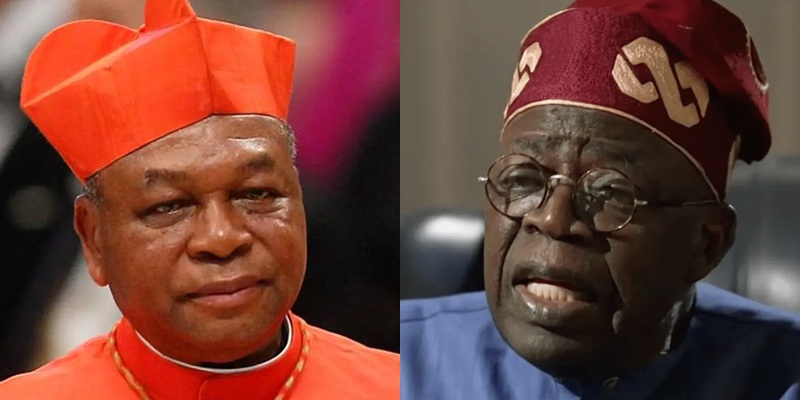
TD The Catholic Laity Council of Nigeria (CLCN) has thrown its weight behind His Eminence, Cardinal John Onaiyekan, rejecting the Presidency’s allegation that the respected cleric abused his privileged access to President Bola Ahmed Tinubu by publicly commenting on a private meeting between the President and the Catholic Bishops’ Conference of Nigeria (CBCN).
In a statement issued by its National Executive Council on August 2, 2026, the CLCN insisted that Cardinal Onaiyekan did not betray any confidence.
It, rather, insisted that Onaiyekan merely discharged the Church’s God-given responsibility to speak truth to power on issues affecting the welfare of Nigerians.
The Council’s reaction followed a strongly worded statement by the Presidency accusing the former Archbishop of Abuja of turning a confidential engagement into a public controversy.
Presidency Faults Cardinal’s Public Comments
In a statement signed by the Senior Special Assistant to the President on Media and Publicity, Temitope Ajayi, the Presidency described Cardinal Onaiyekan’s televised remarks on the meeting as an “abuse of clerical privilege.”
Ajayi explained that the audience with President Tinubu was requested by the Catholic bishops.
The bishops used the opportunity to express concerns over the country’s economic hardship, insecurity, and social conditions.

According to him, although the bishops’ presentation was “notably acerbic,” President Tinubu listened attentively and responded to each issue raised.
He said the President reminded the bishops that some of their requests, including the return of mission schools, fall within the constitutional responsibilities of state governments rather than the Federal Government.
Ajayi also highlighted what he described as the administration’s achievements in stabilising Nigeria’s economy, restoring fiscal discipline, and improving the payment of salaries and pensions across states.
“It is easy to compile a list of national problems.
“It is far more difficult to acknowledge the disasters that have been averted,” he said.

He argued that President Tinubu inherited a severe fiscal crisis but has implemented reforms that prevented economic collapse.
On security, Ajayi disagreed with the bishops’ assertion that “Nigeria is bleeding,” maintaining that the Armed Forces have recorded measurable gains against insecurity.
He added that, as Commander-in-Chief, President Tinubu has access to classified intelligence unavailable to the public, giving him a broader understanding of the country’s security situation.
The presidential aide further argued that Cardinal Onaiyekan’s public interpretation of the meeting undermined its confidentiality and dignity.
He said those occupying clerical offices are expected to exercise “temperance, maturity and self-restraint” after enjoying privileged access to the President.

Catholic Laity Council Defends Onaiyekan
Responding to the Presidency, the Catholic Laity Council said it had taken note of the criticism directed at Cardinal Onaiyekan and found no basis for the allegation that he breached trust.
Representing more than 38 million Catholic laity in Nigeria, the Council maintained that the Church has a prophetic responsibility to hold leaders accountable through truth, justice and charity.
“The Catholic Church in Nigeria, by virtue of the Gospel and Catholic Social Teaching, has a God-given duty to speak truth to power, to defend the vulnerable and to hold leadership accountable with truth and charity,” the statement said.
According to the Council, this responsibility should not be interpreted as an abuse of privilege but as the fulfilment of the Church’s pastoral mission.
‘Cardinal Revealed No Secrets’
The CLCN also rejected suggestions that the Cardinal violated the privacy of the meeting.
While acknowledging the sanctity of confidential engagements, it argued that discussions affecting the lives of more than 200 million Nigerians cannot remain permanently behind closed doors.
The Council stated that Cardinal Onaiyekan did not disclose confidential information but merely shared the Church’s moral concerns and the government’s responses on issues of public importance.
It further described the Cardinal as a man of peace, dialogue and integrity whose comments were intended to awaken the nation’s conscience rather than embarrass the government.
“A disagreement over facts, as the Presidency rightly noted, should not be read as arrogance. Neither should a pastoral reflection be read as a breach of trust,” the statement added.
Calls for Continued Dialogue
The Catholic Laity Council urged both the Federal Government and the Catholic Church to preserve channels of dialogue, describing both institutions as indispensable partners in nation-building.
It said Nigeria needs moral leadership now more than ever and called on both sides to continue working together in pursuit of the common good.
The Council concluded by expressing solidarity with Cardinal Onaiyekan and the Catholic Bishops’ Conference of Nigeria.
It also urged Nigerians to pray for their leaders and support policies that promote justice, security and relief for the poor.
Growing Debate Over Church’s Public Role
The exchange between the Presidency and the Catholic Laity Council has brought renewed attention to the relationship between government and religious institutions in Nigeria.
The Presidency had maintained that confidential engagements with the President should not be publicly interpreted.
Meanwhile, the Catholic Laity Council insists that the Church has both a moral and spiritual obligation to speak publicly on issues affecting governance, justice and the wellbeing of citizens.
The contrasting positions reflect the broader national debate over transparency, accountability, and the appropriate role of faith leaders in shaping public discourse on matters of national importance.