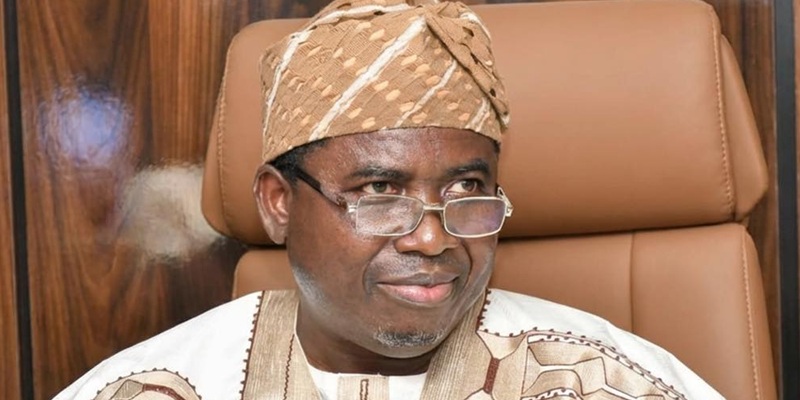

 ABUJA, Nigeria — Serious questions are emerging over the composition, accessibility and transparency of Nigeria’s voters’ register ahead of the 2027 general elections following concerns raised by former Independent National Electoral Commission (INEC) National Commissioner Festus Okoye about an apparent decline in the number of registered young voters.
Okoye has challenged the electoral commission to explain what happened to millions of young Nigerians who featured in the voters’ register ahead of the 2023 elections.
The controversy centres on a comparison between the 37,060,399 registered voters aged between 18 and 34 recorded for the 2023 general elections and a reported 29,777,576 in the corresponding age bracket in the figures attributed to INEC for the 2027 electoral cycle.
The difference amounts to approximately 7.28 million registered young voters, representing a decline of about 19.6 per cent.
The discrepancy raises important questions about voter registration, demographic classification, the treatment of existing records and the electoral commission’s obligation to make its register accessible for public scrutiny.
Although the figures do not, by themselves, establish that millions of eligible voters have been unlawfully removed, their implications demand a detailed and verifiable explanation from the electoral umpire.

The Question Festus Okoye Wants INEC to Answer
In remarks circulating in a video shared on Facebook, Okoye questioned the apparent reduction in the number of registered young voters and challenged INEC to account for the figures.
His central question is straightforward: if more than 37 million Nigerians aged between 18 and 34 were registered ahead of the 2023 elections, why does the corresponding age category reportedly contain fewer than 30 million voters in the latest figures?
The former commissioner’s intervention comes at a sensitive moment, as political parties, prospective candidates, civil society organisations and voters intensify preparations for the 2027 elections.

The question is particularly significant because young Nigerians constituted the largest age category in the 2023 voters’ register.
According to figures released by INEC in January 2023, the commission recorded 93,469,008 registered voters nationwide.
Of that number, 37,060,399 were between 18 and 34 years old, representing approximately 39.65 per cent of the electorate.

The figures were announced by the commission under the leadership of its then chairman, Mahmood Yakubu.
INEC’s official Chatham House presentation on Nigeria’s 2023 elections
The 2023 figures therefore provide an established baseline against which the latest age-distribution statistics can be examined.
The Numbers: What Changed Between 2023 and 2026?
The reported figures present a striking contrast.
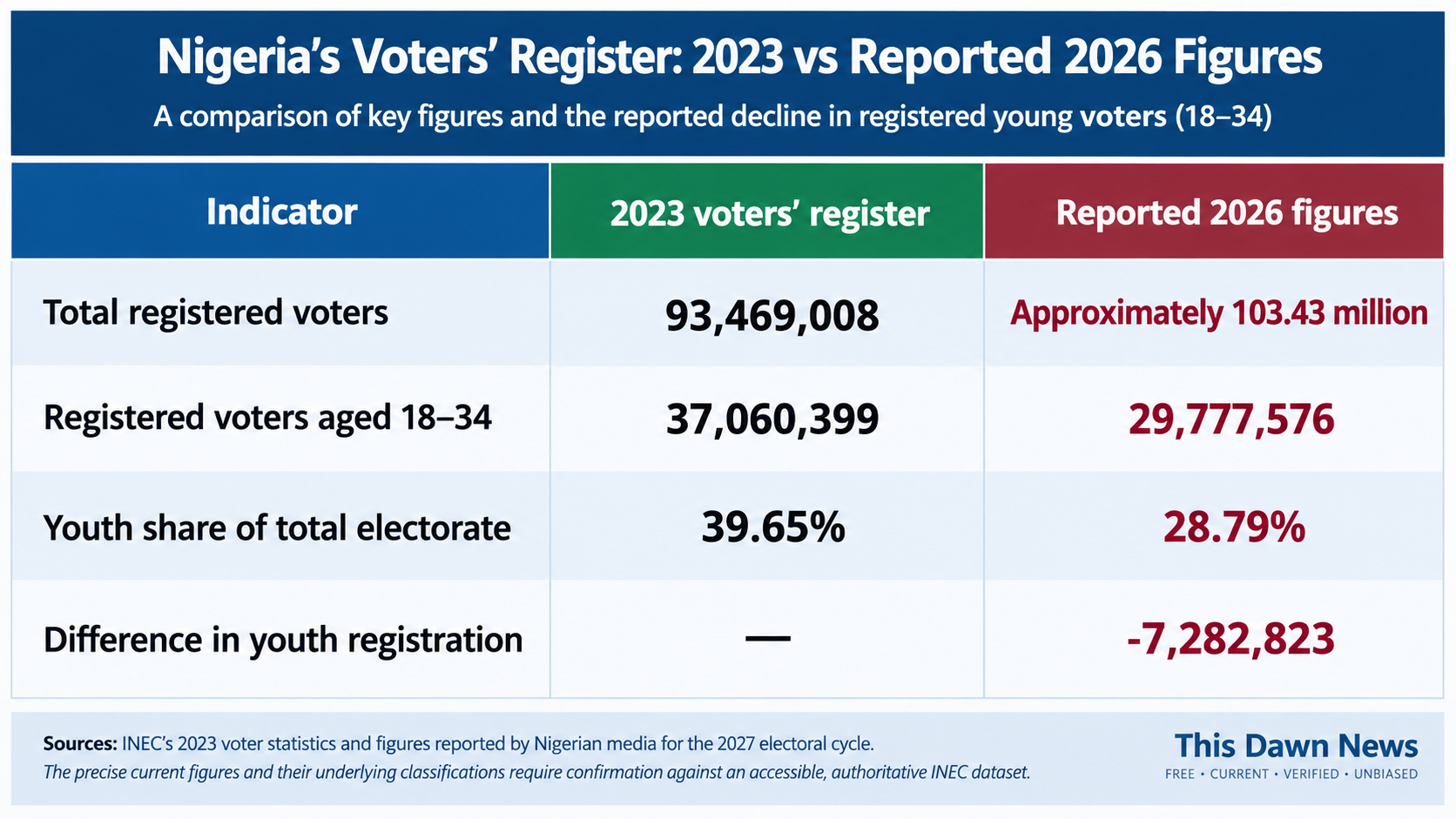
The precise current figures and their underlying classifications require confirmation against an accessible, authoritative INEC dataset.
The reported reduction is approximately 7.28 million voters.
The decline in the youth share of the electorate is also substantial, falling from approximately 39.65 per cent to 28.79 per cent.

However, the statistics must be interpreted carefully.
The number of registered voters aged between 18 and 34 is an age-defined category, not a permanent list of the same individuals across successive elections.
Someone who was 33 years old during the 2023 election would be 37 in 2027 and would no longer fall within the 18–34 category.
Similarly, a voter who was 34 in 2023 would have turned 38 by 2027.
Consequently, a decline in the number of voters within this age bracket does not necessarily mean that the same number of people has disappeared from the entire voters’ register.
The crucial investigative question is whether the change can be explained by normal demographic ageing, changes in registration records and other legitimate adjustments—or whether there are additional discrepancies requiring investigation.
INEC must provide the data needed to distinguish between these possibilities.
The Ageing Factor: An Explanation, but Not the Whole Investigation
One obvious explanation for the decline is that millions of people registered as young voters in 2023 have since moved into older age categories.
The 18–34 classification changes as voters grow older.
Consequently, the number of people in that category can decline even while the overall register expands.
INEC has reported that the national register grew beyond 103 million following three phases of continuous voter registration conducted between August 2025 and July 2026.
The commission’s chairman, Joash Amupitan, disclosed that the registration exercise produced more than 10.7 million new registrations, subject to the commission’s verification procedures.
The latest reported age distribution places voters aged between 35 and 49 at the top of the register, with 43,265,946 people, compared with 29,777,576 in the 18–34 category.
These figures indicate a substantial change in the age composition of the electorate.
Nevertheless, demographic ageing alone cannot be accepted as a complete explanation without a reconciliation of the records.
INEC should publish a breakdown showing how many voters moved out of the 18–34 category because they crossed the age threshold, how many new voters entered it, and how many records were affected by transfers, corrections, deletions or other registration adjustments.
Without that information, Nigerians cannot independently determine how much of the decline is attributable to normal demographic changes and how much arises from other causes.
A Second Controversy: Where Is the Preliminary Voters’ Register?
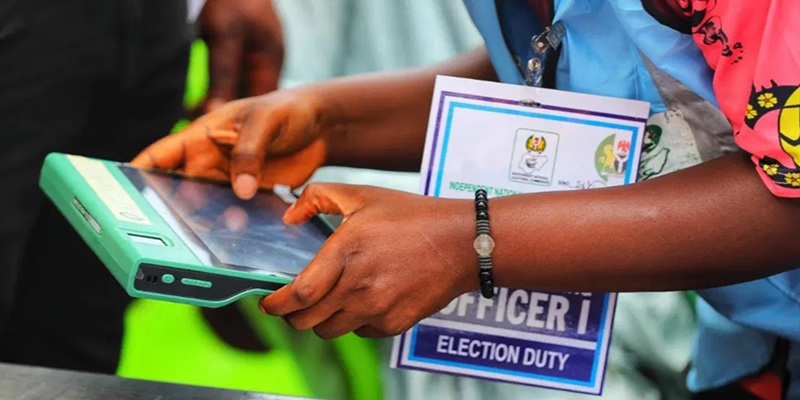
The questions surrounding the youth figures have emerged alongside another controversy: the reported failure to make INEC’s preliminary voters’ register available online during the scheduled public-inspection period in October 2026.
Under Section 19(1) of the Electoral Act 2026, the commission is required to arrange a seven-day period for public scrutiny of the voters’ register, with the register to be displayed at registration areas and published on its official website or another website established for that purpose.
The exercise is intended to allow voters to identify omissions, challenge ineligible entries and seek corrections before the register is finalised.
However, a report published by Premium Times on October 21 said the preliminary register was not available on INEC’s online portal within the relevant period.
The publication reported that the portal continued to display a message stating that there were no preliminary registers available for display.
The Foundation for Investigative Journalism also reported difficulties accessing the register online.
These developments raise questions about whether voters, political parties, civil society organisations and election observers had sufficient access to the preliminary register to scrutinise it effectively.
The online-access controversy is particularly significant because physical display and online publication serve complementary purposes.
Physical inspection enables voters to examine records at their registration areas.
Online publication can allow a broader range of stakeholders to examine the register, identify patterns and compare information across locations.
A register that is difficult to access limits the public’s ability to independently assess its accuracy.
INEC’s Position: Physical Display and a Clean Register
INEC has disputed suggestions that it failed to comply with the relevant requirements.
The commission’s spokesperson, Mohammed Haruna, said the register was displayed at registration areas between October 9 and 15, 2026.
He also said the commission was compiling claims and objections before publishing a clean register by December 15.
The commission’s position is therefore that the physical display took place and that the process of finalising the register remains underway.
However, the reported absence of the preliminary register from the online portal raises a separate question about compliance with the statutory publication requirement.
The two issues should not be conflated: evidence that the register was displayed physically does not, by itself, establish that the online-publication requirement was also fulfilled.
INEC should clarify precisely when the preliminary register became available online, where it was hosted during the inspection period, and how members of the public could access it.
It should also explain how claims and objections were received and processed, especially from citizens who could not visit their registration areas.
The commission’s explanation is essential to resolving the controversy on the basis of evidence rather than speculation.
What Happened to the Missing 7.28 Million?
The available figures do not establish that 7.28 million young Nigerians have been deliberately disenfranchised.
Nevertheless, the discrepancy raises several questions that INEC should answer.
- First, how many existing voters aged 18–34 in 2023 have since moved into older age categories?
This would help establish how much of the change reflects the ordinary passage of time.
- Second, how many new voters aged 18–34 were registered during the continuous voter registration exercises conducted between 2025 and 2026?
The commission should disclose the number of successful registrations within the age bracket, separately from applications that remained unverified or were rejected.
- Third, how many records were deleted, corrected or otherwise changed during the verification and cleaning of the register?
INEC should distinguish between duplicate registrations, deaths, ineligible entries, administrative corrections and any other categories of record adjustment.
- Fourth, how many voters transferred their registration locations?
Transfers may change the distribution of voters across wards and states, but a transfer should not automatically be treated as the disappearance of a voter from the national register.
- Fifth, can INEC demonstrate that the 2023 and 2026 figures use consistent age definitions and comparable registration criteria?
If the underlying data or classification methods differ, the commission should explain those differences.
Finally, can independent observers verify the figures?
The public should not be expected to rely exclusively on summary statistics when the underlying register is central to the credibility of a national election.
These questions are not accusations of wrongdoing. They are basic requirements of electoral accountability.
Could the Controversy Undermine Confidence in the 2027 Elections?
Public confidence in an electoral commission depends not only on the accuracy of its records but also on the transparency of the procedures used to compile and verify them.
The reported decline in young voters, combined with concerns about access to the preliminary register, creates a situation in which a clear explanation from INEC is urgently needed.
Nigeria’s 2027 elections will take place in an environment of intense political competition.
Any uncertainty surrounding the voters’ register could become a source of mistrust among political parties, candidates and citizens.
Some Nigerians may suspect that changes in the register could affect the electoral balance or influence the participation of particular demographic groups.
There is currently sufficient evidence to conclude that the reported decline is part of a deliberate plan to manipulate the 2027 elections.
The figures alone do not prove electoral fraud, deliberate voter suppression or an organised effort to remove young voters.
The appropriate response is therefore not to present such allegations as established facts, but to demand transparent records, an independently verifiable explanation and effective safeguards against electoral malpractice.
If the figures are accurate and the changes are legitimate, INEC should be able to explain them through a documented reconciliation of the registers.
If errors or irregularities exist, timely disclosure would give the commission an opportunity to correct them before the election.
Either way, transparency serves the interests of both the electoral umpire and the electorate.
What INEC Must Publish
To address the concerns raised by Okoye and other stakeholders, INEC should take the following steps:
1. Publish the complete preliminary register as required by law.
The commission should clarify the status of the online register and provide an accessible mechanism for public scrutiny.
2. Release a detailed comparison of the 2023 and 2026 age-distribution figures.
The comparison should explain the reported reduction from 37,060,399 to 29,777,576 voters aged 18–34.
3. Account for changes to the register.
INEC should provide aggregate figures for new registrations, deletions, corrections, transfers and other adjustments, with appropriate safeguards for personal information.
4. Explain its verification procedures.
The commission should disclose how biometric verification and other checks affect the inclusion, retention or removal of records.
5. Provide an effective process for claims and objections.
Eligible voters must have a meaningful opportunity to challenge omissions or inaccuracies and obtain corrections in accordance with the law.
6. Allow credible independent scrutiny.
Political parties, accredited observers, civil society organisations and other authorised stakeholders should be able to examine the relevant records under transparent rules that protect voters’ personal information.
7. Publish the final register and explain any material changes.
A clear record of the differences between the preliminary and final registers would help establish accountability before voting begins.
These measures would help replace uncertainty with verifiable evidence.
The Investigative Verdict: Questions Remain Unanswered
Festus Okoye’s intervention has drawn attention to an important statistical discrepancy in Nigeria’s electoral preparations.
The figures attributed to INEC indicate that the number of registered voters aged between 18 and 34 fell from 37,060,399 ahead of the 2023 elections to a reported 29,777,576 in the latest age distribution.
That is a reduction of approximately 7.28 million.
Demographic ageing offers an important explanation for why the youth category may shrink over time.
But without a detailed reconciliation of the records, the public cannot determine precisely how the reported decline occurred.
Separately, the reported absence of the preliminary voters’ register from INEC’s online portal during the October inspection period has raised questions about public access and compliance with the Electoral Act 2026.
INEC says the register was displayed physically and that a clean version is being prepared for publication. The commission should now provide the information needed to resolve the remaining questions.
The central issue is not whether the available statistics automatically prove wrongdoing. They do not.
The issue is whether the electoral commission can demonstrate, transparently and independently, that its register accurately reflects eligible voters and that every citizen has a fair opportunity to verify their registration.
With the 2027 elections approaching, that responsibility cannot be postponed.
Nigeria does not need speculation about its voters’ register. It needs verifiable figures, transparent procedures and clear answers from the institution entrusted with protecting the integrity of its elections.
The 7.28 million figure demands investigation. The public deserves an explanation.
This Dawn News will continue to follow developments concerning the voters’ register and INEC’s preparations for the 2027 general elections.