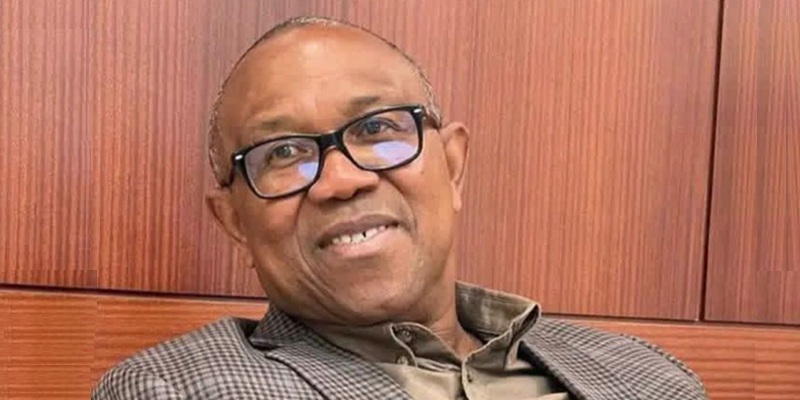

Former Labour Party presidential candidate, Peter Obi, has expressed deep concern over what he described as a troubling pattern of Nigerian universities cancelling scheduled lectures and intellectual engagements.
In a statement posted on his official X account, Obi revealed that he was scheduled to deliver a keynote lecture at Obafemi Awolowo University (OAU) on Saturday, April 25, before proceeding to Ibadan for the opposition parties’ political summit.
Despite months of preparation, he said he was informed that the event would no longer hold at the university.
Obi stressed that this was not an isolated incident.

‘Recurring Decimal’
He noted that similar cancellations have occurred more than ten times across different institutions, including his alma mater, the University of Nigeria, Nsukka (UNN).
He recalled that an inaugural memorial lecture in honour of late UNN Vice Chancellor, Professor Frank Ndili, which he was invited to deliver, was also cancelled by the university authorities.

“These are not merely personal inconveniences; they raise deeper questions about the kind of environment we are nurturing in our country.
“Universities are meant to be centres of learning, open dialogue, and the free exchange of ideas.
“When platforms for constructive engagement are repeatedly constrained, it reflects a worrying shift away from these ideals,” Obi stated.
Global Contrast
Obi contrasted the Nigerian experience with his engagements abroad, where he has been welcomed to speak at leading universities.
In the past two years, he has delivered lectures at Oxford, Cambridge, Harvard, Yale and Princeton.
Others are Chicago, University of Pennsylvania, and Imperial College, among others.
He noted that these institutions continue to demonstrate openness to dialogue, critical thinking, and shared learning.
Those values, he said, should equally define Nigerian universities.
Implications for Democracy and Development
The former governor of Anambra State warned that restricting intellectual platforms undermines Nigeria’s democratic and developmental aspirations.
He argued that a nation’s progress is anchored on its ability to encourage knowledge, debate, and the contest of ideas.
“We must ask ourselves: what kind of nation are we building if spaces meant for intellectual engagement are gradually shrinking?” Obi queried.
“Nigeria must work towards becoming a place where ideas thrive, where knowledge is shared without fear, and where our institutions uphold the principles they were established to protect,” he added.
Broader Concerns
Observers note that Obi’s remarks resonate with wider concerns about academic freedom and the independence of Nigerian universities.
The repeated cancellations of lectures involving prominent figures raise questions about political pressure and institutional autonomy.
It also raises concerns about the role of universities as neutral grounds for intellectual discourse.
For many, the issue goes beyond Obi’s personal experiences.
It touches on whether Nigerian universities can continue to serve as ivory towers — centres for pure, isolated intellectual thought — or whether they risk becoming constrained by external influences.
Peter Obi’s intervention highlights a growing debate about the state of intellectual freedom in Nigeria.
His call is not only for universities to remain open to diverse voices but also for the country to recommit to the ideals of knowledge, dialogue, and democracy.
As he concluded in his statement: “A New Nigeria is POssible.”